Thanks to the use of machine learning techniques and the implementation of new algorithms presented by Marc Carrascosa and Boris Bellalta, researchers with the Wireless Networking Research Group
Credit: UPF
An article published in the advanced online edition of the journal Computer Communications shows that the use of machine learning can improve the operation and performance of the Wi-Fi networks of the future, those of the 5G/6G ecosystem. The research was conducted by Marc Carrascosa and Boris Bellalta, researchers with the Wireless Networking Research Group at the UPF Department of Information and Communication Technologies (DTIC).
The authors focus their study on how to improve the association of Wi-Fi network users consisting of multiple access points, in order to be able to serve a large number of users. This type of Wi-Fi network is present in business and academic environments or in public spaces in cities (streets, parks, libraries, etc.).
“In this study, we look at how stations (PCs, tablets, mobile phones, etc.) may themselves decide dynamically which of the different access points available in their coverage area is offering the best service for their needs using Reinforcement Learning techniques”, Carrascosa and Bellalta explain.
Each station takes decisions dynamically
In their proposal, each station is independent and takes decisions dynamically based on the quality of service offered by the Wi-Fi network over time, i.e., the station autonomously learns how the Wi-Fi network is behaving, identifying the impact of its own actions (choosing one or another access point) on the benefits received.
“For this learning, as a basis we use an algorithm called ε-greedy, which alternates between choosing access points at random to obtain information (exploring), and choosing the best access points used based on this accumulated information (exploiting)”, the authors suggest. “Thus, the more information, the better decisions we take, considering, however, that there is a compromise between the time a station can devote to learning and the time it disposes of to use what it has learned successfully”, they add.
A new algorithm that shortens station learning time
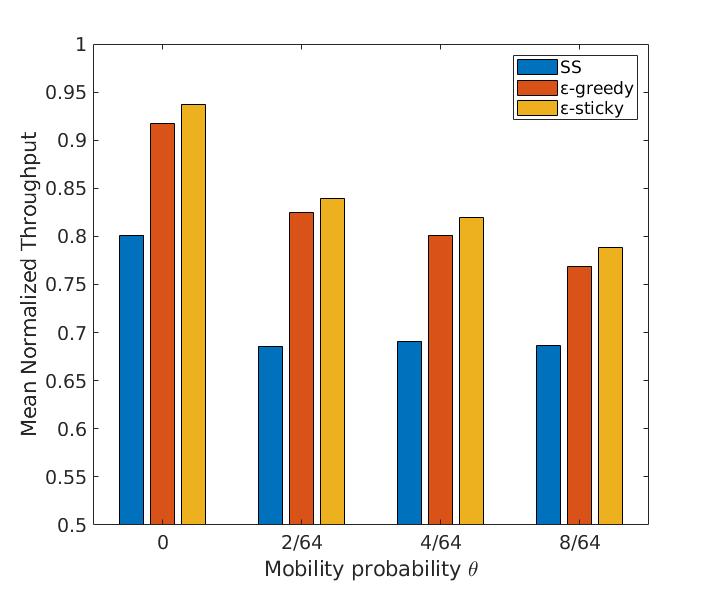
To solve the limitations of the ε-greedy algorithm, such as could be the high learning time, in their paper the authors propose a new algorithm that they call ε-sticky, which includes the concept of emotional attachment. It works so that once the station has found an access point that provides the service requested, even if it ceases to do so later, it does not immediately discard it to look for another new one again in the hope that in the future it might give the same good service.
With this new proposal, service disruptions to users and network instability are reduced, which also benefits stations that have not yet found an access point that offers the required service. “Despite not being the goal of our work, the extrapolation to humans’ social behaviour is quite direct, as is the interpretation in this field of the results we present”, Carrascosa and Bellalta comment.
“In the article, we study the impact of this change and how it allows us to get better results for the problem of Wi-Fi association. The ultimate goal is to show the effectiveness of machine learning techniques to solve problems in Wi-Fi networks that are not easily solved by preconfigured mechanisms. With our results, we also show that not all stations need to make use of these techniques, since if only a few stations implement the new algorithm, the entire network benefits”, the authors uphold.
###
Media Contact
Nuria Perez
[email protected]
Original Source
https:/
Related Journal Article
http://dx.