WASHINGTON, July 25, 2023 – Managing and classifying waste accurately for reuse is a growing challenge in environmental protection. Addressing this issue, researchers at Hefei University of Technology in China have embarked on a quest to innovate in the realm of waste management, seeking effective methods that can simplify and improve the identification and classification of recyclable waste.
Credit: Lei Yang
WASHINGTON, July 25, 2023 – Managing and classifying waste accurately for reuse is a growing challenge in environmental protection. Addressing this issue, researchers at Hefei University of Technology in China have embarked on a quest to innovate in the realm of waste management, seeking effective methods that can simplify and improve the identification and classification of recyclable waste.
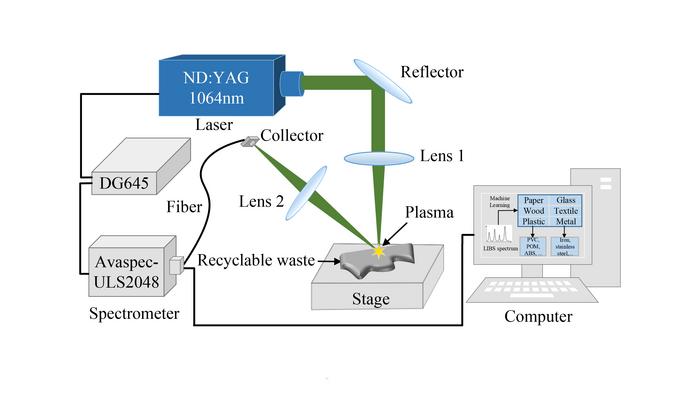
Delving into the intricacies of waste management, the researchers explored the application of laser-induced breakdown spectroscopy technology for the identification and classification of recyclable waste and discuss their work in AIP Advances, from AIP Publishing. They collected and analyzed the spectra of 80 recyclable waste samples, classifying them into paper, plastic, glass, metal, textile, and wood based on LIBS spectra. This crucial step toward waste management optimization demonstrates a significant stride toward improving environmental sustainability and promoting resource reuse.
“We have used LIBS technology for the first time to identify and classify recyclable waste,” said author Lei Yang. “This method has accurate, reliable, fast detection results, and can achieve automatic detection.”
Given the complexities of waste materials and the importance of precise classification, the researchers further subclassified metals and plastics into subcategories. With their unique properties, each subclass of waste holds a distinct potential for specific reuse and recycling practices, making accurate identification and classification a key to unlocking efficient waste management solutions.
The research methodology employed an array of machine learning models to further advance the identification process. Among the explored models, the combination of linear discriminant analysis (LDA) and random forest (RF) emerged as the most optimal for classifying recyclable waste. Additionally, for subclassifying metals and plastics, a combination of principal component analysis and RF was deemed most effective.
Researchers were struck by the accuracy of the model of LDA with RF in classifying recyclable waste, achieving an accuracy of 100%. For subclassifying metals and plastics, the model of PCA(9D) + RF scored the highest accuracy. These results indicate the potential of this method in improving recycling efficiency and waste management practices.
“What surprised us the most was that by using LIBS technology for classification and recognition without any preprocessing of the waste object, the results are satisfactory,” Yang said.
Fueled by the promising outcomes of their research, the team is eager to expand their work in the future. They plan to enhance their studies by increasing the number of waste samples and incorporating other forms of waste such as kitchen waste. Furthermore, they hope to deepen the understanding of transparent glass detection with LIBS, opening new avenues for recycling and waste management.
###
The article “Laser-induced breakdown spectroscopy identifies and classifies recyclable waste: A crucial step toward improved waste management” is authored by Lei Yang, Yong Xiang, Yinchuan Li, Wenyi Bao, Feng Ji, Jingtao Dong, Jingjing Chen, Mengjie Xu, Rongsheng Lu. It will appear in AIP Advances on July 25, 2023 (DOI: 10.1063/5.0149329). After that date, it can be accessed at https://doi.org/10.1063/5.0149329.
ABOUT THE JOURNAL
AIP Advances is an open access journal publishing in all areas of physical sciences—applied, theoretical, and experimental. The inclusive scope of AIP Advances makes it an essential outlet for scientists across the physical sciences. See https://pubs.aip.org/aip/adv.
###
DOI
10.1063/5.0149329
Article Title
Laser-induced breakdown spectroscopy identifies and classifies recyclable waste: A crucial step toward improved waste management
Article Publication Date
25-Jul-2023