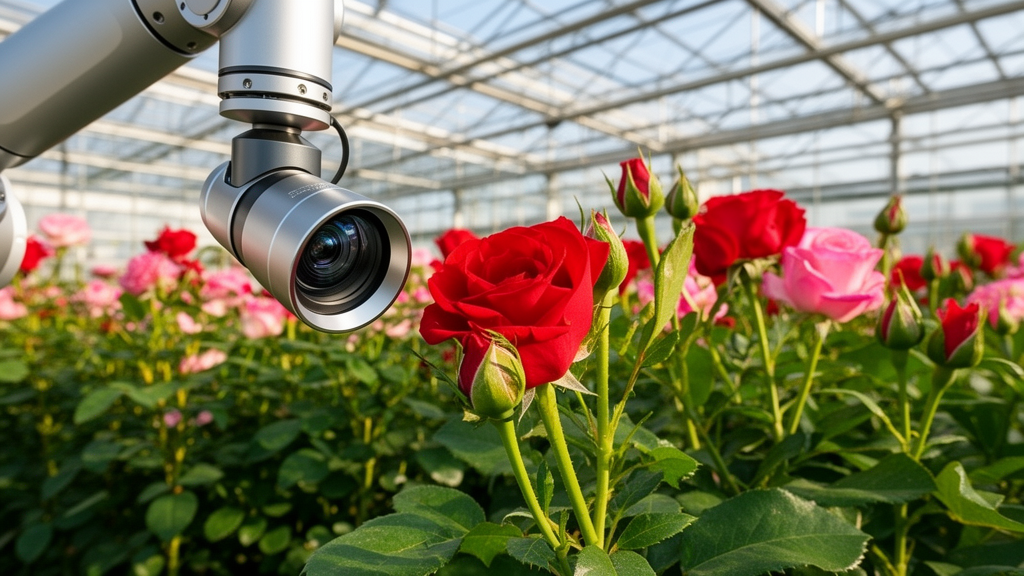
Agricultural engineers have developed an improved deep learning model named SSD-YOLOv11 that simultaneously classifies Kushui rose developmental stages and estimates the precise spatial orientation of mature flower buds directly in natural field environments. Kushui rose represents an economically vital specialty aromatic crop cultivated extensively across Gansu Province in northwestern China, prized for its distinct fragrance, high essential oil yield, and dual edible and medicinal properties. Commercial cultivation of this rose supports broad value-added processing chains, ranging from therapeutic herbal infusions and specialty foods to luxury cosmetic scents. However, industrial gathering operations still depend almost entirely on manual visual inspection and labor-intensive hand-plucking. Field labor remains constrained by heavy physical demands, worker availability, shifting ambient conditions, and an exceptionally brief harvesting window. Because flowers harvested at contrasting phenological phases demand entirely distinct industrial processing pipelines—with tightly closed mature buds reserved for premium floral teas and fully opened petals channeled into solvent extraction—the precision of field sorting directly governs downstream product value and economic viability.
Automating this delicate agricultural task with vision-guided field robotics has historically encountered formidable optical barriers under outdoor canopy conditions. Within commercial rose bushes, dense foliage continuously occludes fragile floral structures, adjacent petals intertwine, natural sunlight introduces harsh highlights and deep cast shadows, and targets appear across starkly varied scales and orientations. While earlier robotic harvesting research prioritized conventional axis-aligned bounding boxes to detect crop presence, standard rectangular detections fail to describe the structural axis connecting the apex of a flower bud to its supporting pedicel. Without directional orientation vectors, autonomous robotic manipulators cannot dynamically calculate collision-free approach paths, frequently bumping into surrounding stems, bruising unopened petals, or colliding with neighboring foliage. To overcome these fundamental sensing limitations, the research team structured SSD-YOLOv11 upon the single-stage YOLOv11n-Pose network baseline, introducing three tailored architectural components: spatially adaptive multi-dilation convolutions, spatial-channel reconstruction bottlenecks, and an explicit directional supervision loss function.
To support model training and empirical validation under authentic operating conditions, researchers constructed a dedicated high-resolution field dataset in Kushui Town within Yongdeng County, Lanzhou, China, across May 20 and May 21, 2026. Utilizing an Intel RealSense D435i depth camera positioned between 0.2 and 0.6 meters above the bush canopy at downward viewing angles ranging from 60 to 90 degrees, the team gathered 3,366 natural RGB images at a resolution of 640 by 480 pixels under clear skies between 08:00 and 18:00. This capture protocol directly replicated the optical viewpoints, variable target distances, and ambient illumination fluctuations that field harvesting robots routinely encounter. Using Labelme annotation software, targets were categorized into four rigorous harvest-oriented developmental stages based on sepal coverage, petal expansion, and visible signs of senescence: young bud, mature bud, newly opened flower, and overmature flower. For each mature bud target, annotators identified two specific anatomical key-points: the bud apex designated as the head, and the basal anatomical junction with the pedicel designated as the tail.
The complete image collection was partitioned using stratified sampling into a training set of 2,613 images, a validation set of 653 images, and an independent test set of 100 images reserved strictly for final benchmarking. To prevent overfitting and expand model generalization across noisy field conditions, eight comprehensive image augmentation techniques—including brightness adjustment, contrast-limited adaptive histogram equalization, horizontal mirroring, Gaussian noise injection, uniform geometric scaling, contrast perturbation, spatial rotation, and translation—were applied exclusively to the training images. This expanded the working training volume to 23,517 images. Across the combined augmented dataset, annotated instances totaled 513,085 items, comprising 113,412 young buds, 244,656 mature buds, 121,986 newly opened flowers, and 33,031 overmature blooms. The training partition accounted for 496,950 total annotated targets, providing extensive representation of clustered petals and complex canopy backgrounds.
The foundational architectural innovation of SSD-YOLOv11 begins at the feature extraction stage, where the authors introduced the spatially adaptive multi-dilation convolution module, termed SAMD-Conv, to replace standard down-sampling layers. Standard convolutions maintain static receptive fields that struggle to balance fine-grained boundary preservation with contextual scene interpretation. SAMD-Conv addresses this deficiency by retaining a primary three-by-three convolutional branch with a stride of two for semantic baselines while adding three parallel detail branches with dilation rates of one, two, and three, corresponding to sampling spans of three-by-three, five-by-five, and seven-by-seven pixels on input feature maps. A lightweight selector convolution computes three normalized spatial gating maps via softmax along the branch dimension, ensuring weights sum to unity at every pixel coordinate. These dynamically weighted detail features are multiplied elementwise and integrated back into the main branch through a scaled residual connection initialized with a learnable scaling coefficient of 0.1, thereby prioritizing local petal textures in clear zones while drawing wider contextual cues in severely occluded canopy regions.
Within the feature fusion neck of the network, the research team addressed redundant background noise by engineering the SCR-C3k2 module, which replaces standard C3k2 modules at the P3 and P4 scale stages along the top-down processing pathway. In natural agricultural scenes, non-target background foliage, tangled woody branches, and complex shadows routinely corrupt multiscale feature pyramids, causing false detections and boundary confusion. The SCR-C3k2 incorporates a specialized spatial channel reconstruction unit within an SCR-Bottleneck structure. During spatial reconstruction, group normalization, point-wise convolutions, depth-wise convolutions, and sigmoid gating isolate discriminative target regions while suppressing irrelevant spatial patterns. Concurrently, channel recalibration utilizes global average pooling and SiLU activation functions to adaptively reweight feature channels, accentuating feature pathways specifically corresponding to rose petals and floral apices. By maintaining channel splitting and concatenation mechanisms while filtering background interference, the module delivers highly discriminative fused representations to the detection heads.
To convert predicted key-points into accurate robotic manipulation guidance, the authors integrated a dedicated direction consistency loss, designated DCL, into the key-point coordinate supervision objective. Standard key-point loss functions optimize absolute spatial coordinates independently without penalizing angular misalignments between paired anatomical landmarks. Consequently, minor pixel displacements on closely spaced bud landmarks can induce severe angular errors in estimated picking poses. DCL directly resolves this issue by constructing predicted and ground-truth vectors from the basal tail landmark to the apical head landmark on valid mature buds. By calculating the normalized cosine similarity deviation between these directional vectors and scaling the resulting loss with a balancing hyperparameter set to 0.1, DCL actively penalizes angular divergence during network backpropagation. The resulting directed angle is computed directly in planar coordinates using a two-argument arctangent function, establishing an end-to-end framework that yields continuous orientation angles spanning negative 180 degrees to positive 180 degrees without requiring separate prediction branches.
Experimental evaluation was executed on a workstation equipped with an Intel Core i5-14600KF processor, 32 gigabytes of random-access memory, and an NVIDIA GeForce RTX 5060 Ti graphics processing unit running PyTorch 2.8.0 under Python 3.11.14. Across 300 training epochs with an input resolution of 640 by 640 pixels, an initial learning rate of 0.01, and an Adam optimizer, SSD-YOLOv11 demonstrated marked performance improvements over the baseline YOLOv11n-Pose architecture. For overall object detection, SSD-YOLOv11 attained a precision of 80.20 percent, a recall of 81.20 percent, and a mean average precision at an intersection-over-union threshold of 0.50 of 85.19 percent, surpassing the baseline by 8.53, 3.29, and 3.17 percentage points, respectively. For mature bud key-point localization, SSD-YOLOv11 achieved a precision of 94.35 percent, a recall of 88.86 percent, and a key-point mean average precision of 96.58 percent, outperforming the baseline by 5.60, 2.64, and 2.17 percentage points. Class-specific metrics confirmed robust capability on harvestable targets, with mature buds reaching 94.63 percent mean average precision and newly opened flowers reaching 90.55 percent.
Rigorous benchmarking against competing lightweight pose estimation models further substantiated these architectural advantages across identical test conditions. Evaluating 807 mature bud targets successfully matched across YOLOv9n-Pose, YOLOv10n-Pose, YOLOv11n-Pose, YOLOv12n-Pose, YOLOv26n-Pose, and SSD-YOLOv11 revealed that the proposed architecture attained the lowest overall orientation error, recording a mean absolute error of 4.40 degrees and a root mean square error of 5.45 degrees. These figures reflect relative reductions of 9.10 percent in mean absolute error and 9.89 percent in root mean square error compared to YOLOv11n-Pose, which recorded 4.84 degrees and 6.05 degrees, respectively. Ablation verification proved that removing DCL while keeping SAMD-Conv and SCR-C3k2 yielded a mean absolute error of 4.53 degrees and a root mean square error of 5.64 degrees, confirming DCL’s specific mathematical contribution. Furthermore, under strict robotic tolerances requiring angular alignment within 7, 10, and 13 degrees of ground truth, SSD-YOLOv11 correctly detected and oriented 61.36 percent, 74.13 percent, and 80.86 percent of all 1,144 test-set mature buds, exceeding all five alternative YOLO models.
Despite its superior sensory precision, the authors documented clear physical boundaries and computational trade-offs that frame future deployment efforts. SSD-YOLOv11 incorporates 4.65 million parameters, requires 11.79 giga floating-point operations, occupies 9.29 megabytes of storage, and achieves a raw inference speed of 91.65 frames per second on the desktop GPU, operating slower than baseline YOLOv11n-Pose at 132.58 frames per second. Confusion matrix analyses on the test set highlighted ongoing challenges, including a 19.72 percent miss rate for compact young buds and a 17.92 percent misclassification of overmature blooms as fresh flowers due to transitional petal morphology. Most crucially, the estimated bud orientations represent two-dimensional planar projections derived from monocular RGB image planes rather than full three-dimensional spatial poses. Practical implementation on autonomous field harvesters will necessitate integrating calibrated depth streams, executing hand-eye robotic calibration, validating algorithm resilience across multiple cultivation seasons and geographic regions, and conducting live physical grasping trials to quantify mechanical harvesting cycle times and bud damage rates.
Subject of Research: Machine vision architecture for Kushui rose maturity detection and harvest orientation estimation
Article Title: Harvest-oriented maturity recognition and bud orientation estimation in kushui roses
Article References: Wang, K., Zhang, Z., Manzoor, S. H., Ahmed, A., Wang, Z., Niu, Y., Hu, C., & Wang, Y. (2026). Harvest-oriented maturity recognition and bud orientation estimation in kushui roses. Smart Agricultural Technology, 15, Article 102711. https://doi.org/10.1016/j.atech.2026.102711
Image Credits: AI Generated
DOI: 10.1016/j.atech.2026.102711
Keywords: Kushui rose, SSD-YOLOv11, YOLOv11n-Pose, robotic harvesting, agricultural computer vision, maturity classification, key-point localization, orientation estimation, SAMD-Conv, SCR-C3k2, direction consistency loss, pose estimation, field robotics, smart agriculture, feature fusion, precision farming, deep learning in agriculture
News Source: Alan Morgan. (November 13, 2026). Improved Vision Model Accurately Estimates Rose Maturity and Harvest Orientation. Scienmag.