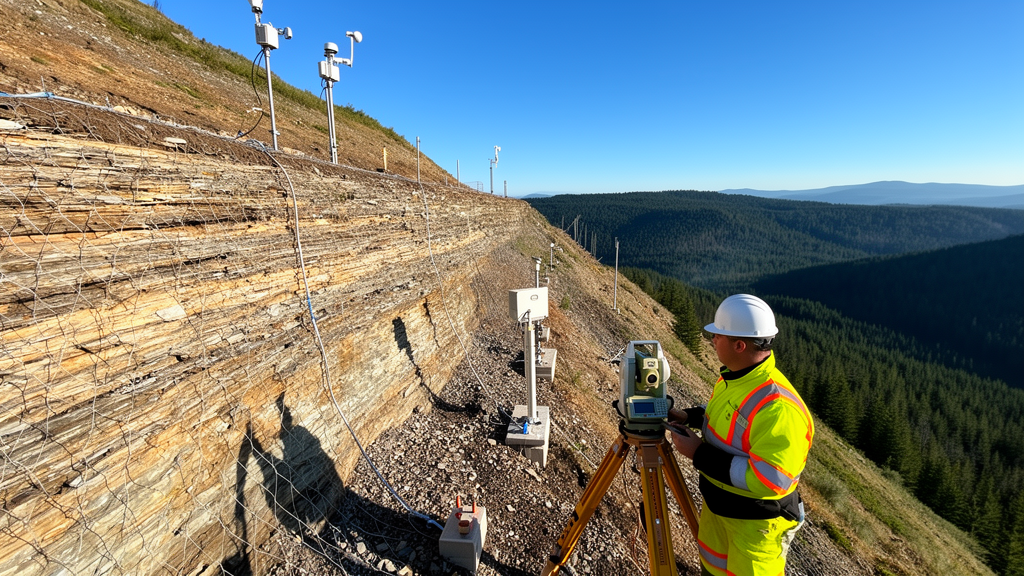
Researchers have developed a machine learning framework termed the Improved Pelican Optimization Algorithm–Random Forest (IPOA-RF) model to improve the classification of slope stability for preliminary engineering risk assessments. Reported in Discover Applied Sciences by Junfeng Shi, Xue Wen, and Xiongyu Wang, the methodology addresses the strong dependence of Random Forest performance on proper hyperparameter tuning. By refining how parameters are chosen, the model aims to provide reliable data-driven classifications for geotechnical hazard evaluations.
The research team trained and evaluated the model on a dataset comprising 898 slope cases characterized by six physically interpretable geotechnical and hydrological variables. These input features include unit weight (γ), cohesion (c), internal friction angle (φ), slope angle (β), slope height (H), and pore water ratio (ru).
To overcome standard optimization limits, the proposed IPOA method incorporates three distinct algorithmic enhancements: sine-chaotic initialization, an improved sine–cosine search strategy, and Levy flight mechanisms. Together, these strategies search the parameter space to systematically tune three foundational Random Forest hyperparameters, specifically the total number of trees, the number of predictors evaluated at each decision split, and the minimum leaf-node size.
Prior to slope stability testing, the investigators evaluated the optimization algorithm independently across benchmark-function experiments. In these initial numerical assessments, the IPOA framework demonstrated competitive optimization accuracy, convergence performance, and stability when measured against six representative swarm intelligence algorithms, confirming its general capability in global parameter search.
For the specific task of slope stability prediction, the team established a rigorous stratified nested ten-fold cross-validation framework to prevent data leakage and evaluate generalization. Within this validation structure, the IPOA-RF architecture was directly benchmarked against six alternative metaheuristic optimization-based Random Forest models as well as two non-metaheuristic Random Forest optimization baselines.
Across the outer-test folds of the validation framework, the IPOA-RF model achieved a mean classification accuracy of 89.65% ± 4.49%, an F1-score of 0.9056 ± 0.0415, and an area under the receiver operating characteristic curve (AUC) of 0.9609 ± 0.0212. Statistical analyses confirmed that the model delivered competitive predictive performance relative to the baseline algorithms under the evaluated experimental conditions.
To examine the internal decision-making behavior of the ensemble model, the authors conducted a SHAP analysis on the feature set.
The study concludes that the IPOA framework provides an effective strategy for optimizing Random Forest hyperparameters in preliminary data-driven slope stability classification. However, the authors noted that further validation using independent slope cases across more diverse geological and hydrological environments is necessary to verify the model’s reliability in broader operational settings.
Subject of Research: Machine learning slope stability prediction using hyperparameter-optimized random forests
Article Title: An improved pelican optimization algorithm-based random forest model for slope stability prediction
Article References: Shi, J., Wen, X., & Wang, X. (2026). An improved pelican optimization algorithm-based random forest model for slope stability prediction. Discover Applied Sciences. https://doi.org/10.1007/s42452-026-09735-2
Image Credits: AI Generated
DOI: 10.1007/s42452-026-09735-2
Keywords: slope stability prediction, random forest, improved pelican optimization algorithm, hyperparameter optimization, unit weight, cohesion, internal friction angle, slope angle, slope height, pore water ratio, sine-chaotic initialization, sine-cosine search strategy, Levy flight, SHAP analysis, stratified nested cross-validation, swarm intelligence algorithms
News Source: Denise Maddox. (November 13, 2026). Improved Pelican Optimization Algorithm Enhances Random Forest Slope Stability Prediction. Scienmag.