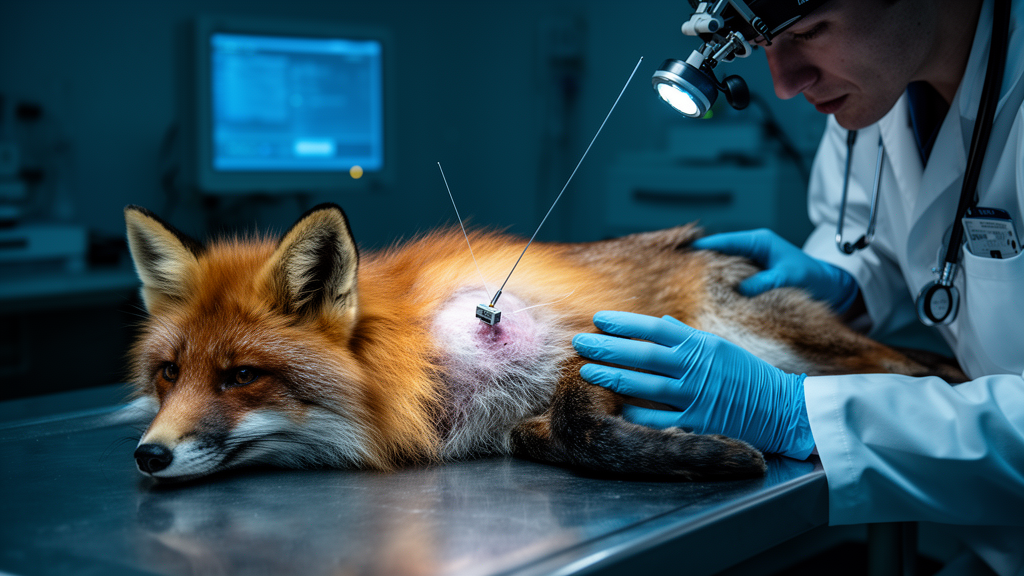
In a proof-of-concept study published in the journal Animal Biotelemetry, four foxes fitted with devices that logged body temperature and activity levels showed measurable changes in behavior during rabies infection, in some cases triggering alerts up to two weeks before the animals died.
The work addresses a practical gap. Technological advances now allow continuous health and welfare monitoring in many settings, but such tools remain little used for less common laboratory animals. ANSES maintains a colony of red foxes (Vulpes vulpes) for regulatory and research purposes, chiefly because the agency serves as a reference laboratory for rabies and Echinococcus parasites for France and the European Union. Both are serious zoonotic diseases, making fox health monitoring a matter of institutional as well as animal welfare interest.
In 2022, the four foxes were surgically fitted with internal implants recording two variables: body temperature and activity. The study team, led by Julie Teresa Shapiro, retrospectively analyzed whether these two continuously measured variables could serve as an early warning system for the onset of rabies symptoms.
The analytical approach relied on anomaly detection algorithms rather than simple thresholds. The researchers applied two established methods, the Shewhart control chart and the exponentially weighted moving average (EWMA), at varying confidence levels. Each algorithm was run individually on the temperature and activity data streams from each fox. The team then compared how early the different models could detect significant changes while limiting false alarms during a calibration period before infection.
The results were clear on one front. All four foxes significantly changed their activity levels during infection, and the EWMA algorithm detected these changes most reliably at the individual animal level. In some cases, the algorithm produced consecutive alarms as long as two weeks before the animal’s death, while keeping false alarms during the calibration period in check.
Body temperature told a different story. The researchers found no evidence of fever in any of the infected foxes, and temperature did not appear to be a reliable indicator of health in this context.
The authors are careful about the limits of the study. Rabies is a particularly severe disease model, rarely implemented in this way, and the sample size was small: four animals. The analysis was also retrospective, applied to data collected during a completed experiment rather than tested as a live alerting system. The findings therefore establish potential, not validated clinical practice, and the algorithms’ performance in other diseases or species remains to be demonstrated.
Even so, the researchers argue the approach could extend well beyond this severe model. They suggest the same implant-and-algorithm combination could support experimental protocols with milder clinical signs, and routine long-term monitoring designed to catch unexpected declines in health or welfare in captive animals.
Subject of Research: Real-time health and welfare monitoring of rabies-infected red foxes using implanted biotelemetry sensors and anomaly detection algorithms
Article Title: Potential for real-time health and welfare monitoring of red fox (Vulpes vulpes) in experimental settings using implants
Article References: Shapiro, J. T., Morignat, E., Dubois, D., Penel, N., Madouasse, A., Robardet, E., Amat, J.-P., Hénaux, V., & Lesellier, S. (2026). Potential for real-time health and welfare monitoring of red fox (Vulpes vulpes) in experimental settings using implants. Animal Biotelemetry. https://doi.org/10.1186/s40317-026-00499-5
Image Credits: AI Generated
DOI: 10.1186/s40317-026-00499-5
Keywords: red fox, rabies, biotelemetry, animal welfare, anomaly detection, EWMA, Shewhart control chart, body temperature, activity monitoring, ANSES, zoonoses, proof of concept
News Source: Drew Townsend. (October 29, 2026). Implants Track Activity Changes in Rabies-Infected Foxes Before Death. Scienmag.