Researchers have demonstrated that electromyographic signals recorded from surgically implanted intramuscular electrodes can provide continuous, multi-finger prosthetic control for months without algorithmic recalibration. Published in Bioelectronic Medicine, the longitudinal investigation tracked real-time closed-loop decoding of two independent virtual finger groups in an able-bodied rhesus macaque and a human volunteer with a transradial amputation. Across experimental durations extending to 148 days in the animal model and 283 days in the clinical participant, daily task performance exhibited no statistically significant decline when using static decoders established during initial calibration. Furthermore, the findings revealed a fundamental insight into neuroprosthetic durability: stable long-term control was sustained not because underlying biological signals remained perfectly stationary, but because operators actively adapted their muscle activation patterns to conform to the original decoder calibration parameters over time.
For individuals with upper-limb loss, losing dexterous hand function impairs daily living activities, reduces employment opportunities, and increases healthcare costs. Over thirty muscles coordinate biological hand movement, yet conventional myoelectric prostheses rarely restore multi-digit dexterity. Most clinical prostheses rely on surface electromyography recorded through skin-placed electrodes, which are vulnerable to sweat-induced impedance changes, electrode displacement, and signal crosstalk from adjacent tissues. Consequently, surface-based devices are largely restricted to switching between simple discrete grasps or executing single-degree-of-freedom hand movements. These systems require frequent recalibration to maintain functionality, imposing significant burdens on users and contributing to device abandonment rates between seventy-five and ninety percent. Developing an interface that reliably captures nuanced muscle activity without requiring frequent parameter retraining has therefore remained an enduring challenge in neural engineering.
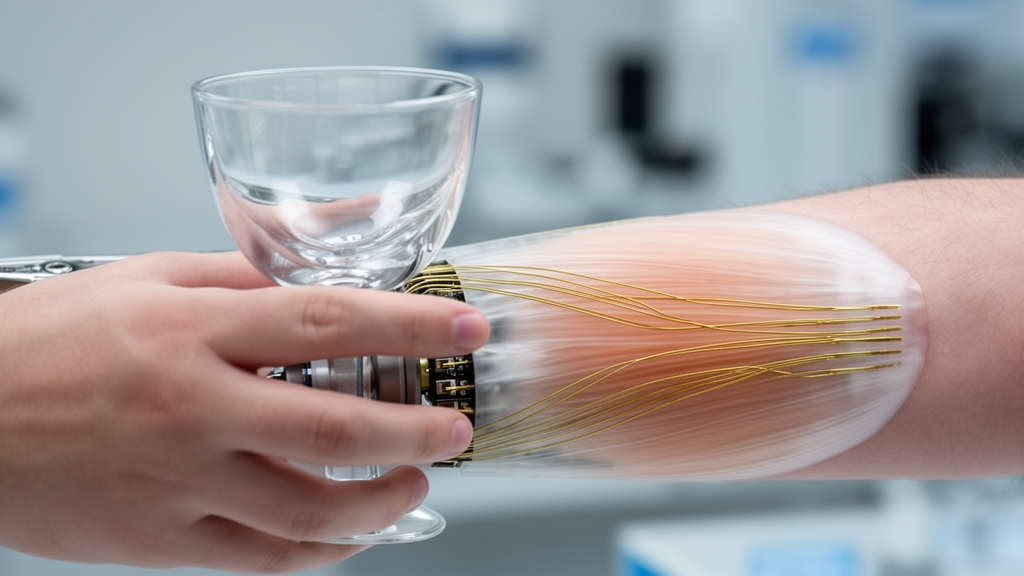
Implanted intramuscular electrodes offer a promising alternative by recording electrical potentials directly from deep and superficial musculature. These surgically placed sensors achieve superior signal-to-noise ratios and exhibit far greater mechanical resilience than surface sensors. In amputated limbs, regenerative peripheral nerve interface surgery provides an additional biological advantage by wrapping severed nerve fascicles within small autologous muscle grafts. The regenerated muscle tissue acts as a biological amplifier for faint peripheral nerve impulses, generating distinct, voluntary electromyographic signals corresponding to missing digits. Although prior studies established that implanted electrodes and regenerative interfaces could maintain discrete grip classifications or gross wrist rotations over several months, neuroscientists had not determined whether such interfaces could sustain continuous, simultaneous proportional control of multiple individuated finger groups over extended temporal horizons without frequent algorithmic recalibration.
To evaluate this question, the research team implemented a prospective, non-randomized study encompassing an able-bodied rhesus macaque and a human participant with upper-limb loss. The twelve-year-old male macaque was implanted with eight bipolar electrodes in forearm muscles controlling wrist and finger motion. The human volunteer was a fifty-two-year-old female who had undergone a distal transradial amputation with simultaneous regenerative peripheral nerve interface surgery following severe necrotizing fasciitis. One year later, she received eight implanted bipolar electrodes under an Investigational Device Exemption: five positioned in residual arm flexors and extensors, two embedded in ulnar nerve regenerative interfaces, and one in a median nerve interface. The bipolar electrodes used in both participants were modified versions of long-term pacing leads originally designed for diaphragmatic pacing systems.
Both participants performed an analogous behavioral task requiring continuous coordination of two virtual finger groups: the index finger and a combined middle-ring-small finger group. The macaque sat in an acrylic chair with elbows fixed at ninety degrees, using an instrumented manipulandum fitted with bend sensors to control virtual finger positions during open-loop calibration. In closed-loop decoding, decoded muscle signals directly drove virtual finger trajectories. Target areas spanned fifteen percent of the active range of motion, requiring a 750-millisecond hold during training and a 500-millisecond hold during testing. Because the human participant lacked physical digits, her open-loop calibration relied on computer prompts that she followed using her phantom limb. Baseline natural hand dexterity for the human was recorded separately using a sensor glove on her intact contralateral hand.
Raw electromyographic signals were acquired at thirty kilohertz, bandpass filtered between one hundred and five hundred hertz, notch-filtered at line noise harmonics, and downsampled to two kilohertz. Real-time processors computed the mean absolute value across non-overlapping bins—thirty-two milliseconds for the monkey and fifty milliseconds for the human. The investigators evaluated two decoding frameworks: a linear velocity Kalman filter, which models kinematic states and muscular observations assuming Gaussian dynamics, and a nonlinear long short-term memory recurrent neural network. Offline evaluation on hold-out calibration data demonstrated that both architectures predicted digit kinematics with high fidelity, yielding Pearson correlation coefficients exceeding 0.79 across both subjects. These robust correlations confirmed that intramuscular recordings from native muscles and regenerative interfaces preserved detailed kinematic information necessary for continuous multi-finger reconstruction.
Real-time closed-loop testing revealed that continuous multi-finger control was effectively restored, though algorithmic performance differed substantially between the participants. Natural hand throughput measured via Fitts’s law averaged 4.1 bits per second in the macaque and 1.5 bits per second for the human’s intact hand, both achieving ninety-nine percent trial success. In closed-loop operation, the monkey attained sixty-three percent of native throughput with the Kalman filter and seventy-six percent with the recurrent network, maintaining a ninety-nine percent success rate. For the human participant, the Kalman filter achieved fifty-six percent of native throughput with a ninety percent success rate. However, the nonlinear recurrent network achieved only thirty-nine percent throughput and a sixty-nine percent success rate, causing user frustration. Without physical kinematic ground truth during training, complex nonlinear decoders proved vulnerable to overfitting prompted phantom trajectories.
The study’s most notable finding emerged during longitudinal testing of static decoders whose parameters were held frozen after Day 0. The monkey operated the static Kalman filter across forty-two sessions spanning 148 days, while the human participant completed seven sessions spanning 283 days. Linear regression analysis of throughput and trial acquisition time identified no statistically significant decline over time for either participant, yielding p-values of 0.21 in the monkey and 0.78 in the human. Comparing static decoders against freshly calibrated same-day models within sessions demonstrated that the monkey achieved comparable performance, with static decoders yielding 1.2 percent higher throughput. For the human, same-day retraining provided a modest but statistically significant benefit, increasing throughput by 9.8 percent, yet the locked static decoder remained fully viable throughout the nine-month period.
This enduring online functional stability occurred despite significant day-to-day fluctuations in offline decoder accuracy and biological signal strength. When static decoders were tested offline against hold-out recordings from later sessions, prediction errors exhibited substantial day-to-day variance for both participants. Evaluating root-mean-squared electromyographic amplitudes across all recording channels revealed marked session-to-session variability during identical movement attempts. Linear regressions over time showed no significant degradation slope in signal amplitude, with example flexor carpi radialis rates of 0.7 microvolts per day in the monkey (p = 0.55) and 0.3 microvolts per day in the human (p = 0.34). These results established that although the physical interface remained biologically stable without degrading over months, daily physiological shifts caused baseline signal nonstationarities that impaired offline predictions while sparing real-time control.
To determine how closed-loop control persisted despite signal variability, the researchers analyzed muscle activation patterns using normalized Manhattan distance metrics between offline calibrations and online trials. Whenever participants operated under the locked static decoder, their online electromyographic patterns were significantly closer to their Day 0 calibration profile than to the baseline recorded on that test day. Conversely, when executing trials with a same-day trained decoder, their online activation aligned more closely with that day’s calibration profile. This shift was statistically significant in the monkey and present as a clear trend in the human. Rather than depending on absolute signal invariance, long-term functional stability was driven by user adaptation, as operators actively modulated muscle recruitment to match the specific calibration requirements of the active decoder.
Despite these positive milestones, the authors noted several limitations that must be addressed before this technology can enter daily clinical practice. The experimental paradigm evaluated continuous control of virtual finger groups on display screens rather than physical prosthetic hands subjected to mechanical inertia and tactile interactions. Additionally, participants were tethered to laboratory neural processors through percutaneous wiring harnesses that pose infection risks and preclude home use. Translating this approach into everyday life will require developing fully implantable, low-power wireless telemetry systems capable of continuous multichannel transmission. Future research must determine whether human motor adaptation and interface stability persist during unstructured daily living outside laboratory settings, advancing the development of durable, maintenance-free prosthetic hands that restore natural multi-digit dexterity to individuals with limb loss.
Subject of Research: Longitudinal stability and user adaptation in continuous prosthetic finger decoding using implanted electromyographic electrodes
Article Title: Longevity of continuous prosthetic finger control using implanted electromyographic signals without recalibration
Article References: Lee, O. G., Cubillos, L. H., Temmar, H., Wallace, D. M., Hite, A. I., DeMatteo, J. C., Costello, J. T., Joseph, J. J., Kelberman, M. M., Copenhaver, M. G., Kung, T. A., Gates, D. H., Cederna, P. S., & Chestek, C. A. (2026). Longevity of continuous prosthetic finger control using implanted electromyographic signals without recalibration. Bioelectronic Medicine, 12(1), Article 23. https://doi.org/10.1186/s42234-026-00217-9
Image Credits: AI Generated
DOI: 10.1186/s42234-026-00217-9
Keywords: prosthetic finger control, intramuscular electromyography, regenerative peripheral nerve interface, velocity Kalman filter, long short-term memory, transradial amputation, rhesus macaque, closed-loop decoding, neural interfaces, motor adaptation, decoder recalibration, simultaneous proportional control, bipolar electrodes, signal nonstationarities, Fitts law throughput, upper-limb prosthetics, bioelectronic medicine, phantom limb decoding
News Source: Denise Maddox. (November 16, 2026). Implanted Muscle Electrodes Maintain Prosthetic Finger Control for Months Without Recalibration. Scienmag.