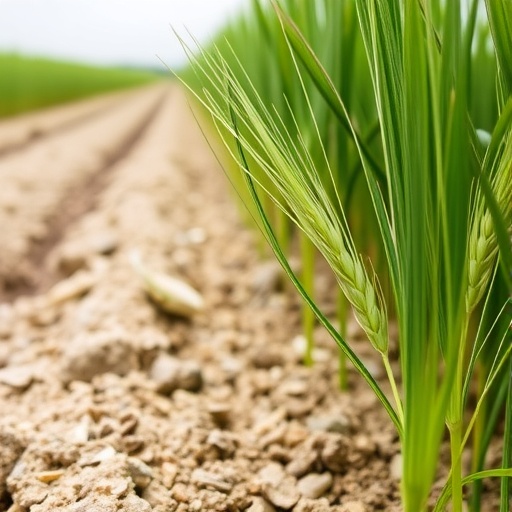
Recent studies have highlighted the complex interplay between soil amendments and crop yield, especially in the context of saline conditions which pose a significant challenge to agricultural productivity. Among the various amendments used to ameliorate soil conditions, phosphogypsum has garnered attention for its potential to enhance crop performance. A recent research article meticulously evaluates the effects of different sources and application rates of phosphogypsum on barley, a cereal grain that is instrumental in global food security.
The researchers focused specifically on barley’s yield components, nutrient uptake, and the accumulation of heavy metals under saline conditions. Salinity represents a growing concern across numerous agricultural regions worldwide, impacting plant growth and soil health. The use of phosphogypsum, a byproduct of phosphate fertilizer production, offers a dual benefit; not only does it contribute to soil amendment, but it potentially mitigates the adverse effects of salinity. This compelling study thus represents a critical advancement in agricultural science, exploring innovative solutions to enhance barley production in challenging environments.
The methodology employed by the researchers involved the systematic application of phosphogypsum at varying rates and from multiple sources to assess its impact on barley growth. Each experimental setup was designed to simulate real-world conditions where salinity stress might typically occur. This does not merely aim to see if phosphogypsum could improve yield but also examines how different sources and quantities yield varied results, providing a nuanced understanding of its efficacy.
Data were meticulously collected on different yield components such as grain weight, spike number, and plant height. These parameters were measured not only to determine the yield but also to quantify the physiological responses of barley plants to the treatment. The findings suggest that specific phosphogypsum treatments led to marked improvements in these metrics, indicating a possible enhancement in barley resilience and productivity.
Moreover, the nutrient uptake analysis revealed additional insights. The research highlighted that phosphogypsum can facilitate the absorption of vital nutrients, such as calcium and sulfur, which are essential for barley growth. By effectively improving soil nutrient availability, phosphogypsum demonstrates its potential as a sustainable solution to enrich nutrient-deficient soils, especially in regions affected by salinity.
However, another pivotal aspect examined was the heavy metals content within the barley plants. As environmental health concerns increasingly dominate agricultural practices, the accumulation of harmful metals in crops is a significant issue. The researchers scrutinized the metal content in both barley plants and soil samples, providing a comprehensive view of the safety implications of using phosphogypsum. Surprisingly, the results suggested that certain phosphogypsum sources could potentially keep heavy metal levels within acceptable limits, further underscoring the importance of source selection in agricultural applications.
The study’s outcomes not only add to the existing body of knowledge surrounding phosphogypsum’s role in agriculture but also prompt critical discussions about its broader implications. Given the ongoing challenges posed by climate change and soil degradation, integrating waste byproducts like phosphogypsum into agricultural practices could pave the way for sustainable farming solutions. This research signifies a step toward developing effective strategies aimed at improving soil quality and exploring innovative pathways to fortify food production systems.
Furthermore, the implications of these findings extend beyond barley production alone. They may serve as a framework for similar investigations targeting other crops susceptible to saline stress. Future research could leverage this groundwork to explore the efficiency of phosphogypsum across various agricultural contexts, ultimately advancing the dialogue on sustainable farming practices.
As the scientific community grapples with pressing challenges stemming from environmental change, such studies emphasize the necessity for continual innovation in agricultural methods. The quest for sustainable solutions is not merely a pursuit of efficiency; it encapsulates an ethical responsibility to ensure a safe and nutritious food supply for future generations.
In conclusion, the research on phosphogypsum’s effects on barley underscores the multifaceted approach needed to tackle contemporary agricultural issues. As more studies emerge, the potential for integrating alternative soil amendments will undoubtedly play a pivotal role in redefining agricultural paradigms, moving towards methods that bolster productivity while respecting environmental health.
Such findings prompt us to reconsider our agricultural choices and highlight the need for an evidence-based understanding of how various amendments can sustainably reform farming practices. As we advance in these explorations, the future of agriculture could very well hinge on our ability to harness innovative solutions grounded in research and environmental stewardship.
In the face of shifting climatic conditions and soil degradation, studies like this serve as a beacon of hope, illustrating that the intelligent application of knowledge can transform challenges into opportunities for growth. The journey toward sustainable agriculture would benefit immensely from continued research focused on practical solutions that prioritize both production efficiency and ecological balance.
Subject of Research: The impact of phosphogypsum on barley yield under saline conditions
Article Title: Evaluating the effect of phosphogypsum source and rate on barley yield components, nutrients uptake, and heavy metals content under saline conditions
Article References: Outbakat, M., Bouray, M., El Gharous, M. et al. Evaluating the effect of phosphogypsum source and rate on barley yield components, nutrients uptake, and heavy metals content under saline conditions. Discov Agric 3, 155 (2025). https://doi.org/10.1007/s44279-025-00339-9
Image Credits: AI Generated
DOI: 10.1007/s44279-025-00339-9
Keywords: phosphogypsum, barley, saline conditions, nutrient uptake, heavy metals, sustainable agriculture
Tags: agricultural productivity under salinitychallenges in saline agriculturecrop yield enhancementeffects of salinity on plant growthheavy metals accumulation in cropsimpact of phosphogypsum on barleyinnovative solutions for barley productionnutrient uptake in barleyphosphate fertilizer byproductsphosphogypsum as a soil amendmentsaline soil conditionssoil amendments in agriculture