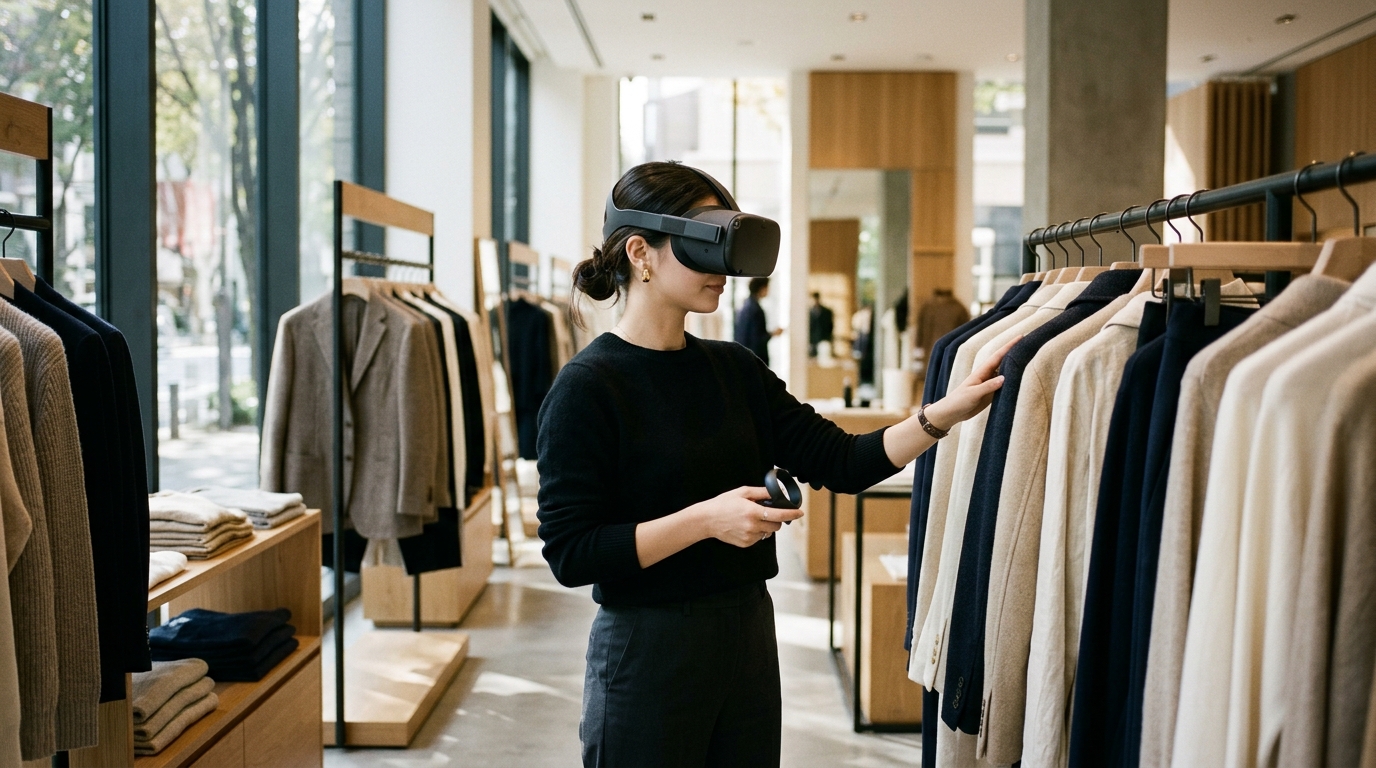
Immersive virtual reality environments do not uniformly enhance consumer evaluations across retail goods, but instead trigger distinct cognitive processing routes that depend directly on product characteristics and shopping motivations. In a laboratory-based investigation published in Fashion and Textiles, researchers Juyeun Jang and Ho Jung Choo examined how sensory immersion shapes cognitive responses within digital retail settings. Testing both product-level displays and full commercial store environments, the research team demonstrated that wearing a head-mounted display activates vivid mental imagery that heightens perceived product diagnosticity for experiential, hedonic goods like sunglasses. However, that same immersion suppresses the analytical, discursive cognitive elaboration typically relied upon when assessing utilitarian products like cameras. Rather than demonstrating an across-the-board direct benefit of technological richness, the experimental findings establish that consumer satisfaction and diagnostic evaluations depend entirely on the alignment between media vividness, imagery generation, and specific task orientations.
The theoretical framework guiding the investigation integrates Daft and Lengel’s media richness theory with Lang’s limited capacity model of mediated message processing. Media richness theory posits that communication media are most effective when their informational depth aligns precisely with the demands of a given task, cautioning that technological sophistication alone cannot guarantee superior outcomes. Complementing this perspective, the limited capacity model asserts that human working memory operates under strictly constrained cognitive resources. When an individual navigates a highly interactive, vivid environment that induces telepresence—the subjective feeling of being physically situated within a simulated space—substantial mental bandwidth is consumed by perceptual processing and sensory simulation. Consequently, fewer cognitive resources remain accessible for deliberate, discursive reasoning and analytical message elaboration. While previous non-immersive desktop research suggested interactive displays could benefit diverse product evaluations, Jang and Choo hypothesized that full immersion in head-mounted hardware alters this balance by redirecting cognitive effort into mental imagery at the expense of logical reflection.
To evaluate these cognitive mechanisms in individual product presentations, the authors conducted Study 1 using a two-by-two between-subjects experimental design involving 101 female participants aged 19 to 38, drawn from a major university in South Korea. Prior to the main experiment, two preliminary tests established representative stimuli that matched baseline attitudes while clearly separating hedonic and utilitarian qualities. Pretest 1 evaluated ten potential items among 31 participants, leading to the selection of sunglasses as a hedonic product and a camera as a utilitarian product, which exhibited distinct utilitarian-hedonic perceptions but statistically indistinguishable baseline product attitudes. Pretest 2 confirmed that displaying these items across immersive headsets and non-immersive desktop screens did not distort their core utilitarian or hedonic classifications. In the primary experiment, participants operated either an Oculus GO head-mounted display paired with a controller or a standard desktop computer with a mouse, rotating and magnifying three-dimensional product models across thirty-minute laboratory sessions.
Cognitive processing modes were systematically captured through standardized psychometric scales alongside an established thought-listing protocol originally formulated by Cacioppo and Petty. Immediately following their interaction with the virtual product model, participants completed ten open-ended sentences detailing their real-time cognitive activity during the simulated shopping experience. Three independent researchers coded all 1,010 submitted statements into product-relevant thoughts reflecting cognitive elaboration versus unrelated thoughts, achieving acceptable inter-coder consistency with an intraclass correlation coefficient of 0.68. The proportion of product-relevant statements relative to the total written sentences provided a quantitative index of discursive elaboration. Participants subsequently rated their experienced telepresence, mental imagery vividness, and perceived product diagnosticity—defined as the perceived usefulness of the media information for product evaluation—on five-point Likert scales, followed by an open-ended valuation metric assessing willingness to pay.
Initial manipulation checks confirmed that the immersive headset elicited significantly greater subjective telepresence than the desktop screen, with mean scores of 3.85 compared to 3.38. However, direct hypothesis testing revealed that immersion alone did not produce higher perceived product diagnosticity; mean diagnosticity ratings of 3.82 in the immersive condition did not significantly differ from 3.75 in the non-immersive condition. To uncover the indirect pathways through which immersion operated, the researchers performed moderated-mediation bootstrapping analyses using SPSS Process Macro Model 7. The results demonstrated that mental imagery significantly mediated the relationship between media type and product diagnosticity exclusively for hedonic items, yielding an indirect effect of 0.40 within a 95 percent bootstrap confidence interval from 0.024 to 0.817. Conversely, for the utilitarian camera, the indirect path via mental imagery was statistically non-significant, showing that imagery-driven evaluation operates specifically when consumers appraise pleasure-oriented, sensory-driven fashion goods.
Parallel moderated-mediation testing focused on cognitive elaboration revealed an inverse pattern for utilitarian goods. For the camera condition, immersion produced a statistically significant negative indirect effect on product diagnosticity through reduced cognitive elaboration, generating a coefficient of negative 0.19 within a confidence interval spanning negative 0.419 to negative 0.025. This conditional effect was absent in the hedonic sunglasses condition. Because evaluating functional items requires analytical thinking and feature comparison, the heavy cognitive demands of maintaining telepresence in the headset drained cognitive resources away from message elaboration, impairing analytical evaluation. In contrast, non-immersive desktop formats preserved sufficient discursive bandwidth to allow structured cognitive appraisal. Subsequent regression analyses confirmed that across product conditions, perceived product diagnosticity functioned as a vital commercial metric, exerting a positive and statistically significant influence on participants’ reported willingness to pay, with a standardized beta coefficient of 0.25.
Expanding the inquiry from isolated items to environmental store spaces, Study 2 investigated how immersion shapes consumer satisfaction within realistic, full-scale digital stores. Sixty-three young adult consumers, comprising 30 men and 33 women aged 19 to 37 recruited from a South Korean university, explored commercially developed virtual retail environments operated by Nike and Adidas. Captured using 360-degree cameras, these virtual store layouts replicated physical brand retail floors. Participants navigated the environments freely using Oculus GO headsets, shifting perspectives via directional gaze arrows. To examine motivational boundaries, participants were randomly allocated to one of two shopping orientations: a browsing condition instructing them to spend leisure time exploring the virtual retail space, or a goal-directed searching condition assigning them the structured objective of selecting a specific birthday gift for an acquaintance.
Post-experience measurements evaluated perceived telepresence, fashion involvement, brand attitudes, product-related mental imagery, store-related mental imagery, and store visit satisfaction, alongside future visit intentions. Manipulation checks verified that participants in the searching condition exhibited significantly higher goal specificity than leisure browsers, registering mean scores of 4.03 compared to 3.13. Simple regression modeling supported the primary expectation that telepresence positively predicted fashion store visit satisfaction, yielding a beta coefficient of 0.27. Furthermore, store visit satisfaction strongly predicted forward-looking behavioral intentions, generating significant positive effects on intentions to visit the virtual store, with a standardized beta of 0.82, as well as downstream intentions to visit physical brick-and-mortar storefronts, with a beta of 0.31, refuting concerns that digital retail spaces necessarily cannibalize offline foot traffic.
To understand the psychological architecture underlying store satisfaction, the researchers conducted dual moderated-mediation analyses separating product-related mental imagery from store-related spatial imagery. The findings demonstrated that shopping motivation significantly moderated the mediating pathway of product-related imagery. For consumers engaged in recreational browsing, telepresence positively enhanced store visit satisfaction via heightened product-related imagery, generating an indirect effect of 0.212 within a 95 percent confidence interval from 0.022 to 0.424. For goal-directed searchers, however, this indirect path via product imagery was completely extinguished, registering a non-significant coefficient of negative 0.079. Search-oriented shoppers prioritizing task efficiency did not translate sensory product simulations into heightened appraisal. In sharp contrast, store-related mental imagery—reflecting spatial presence and architectural ambiance—robustly mediated visit satisfaction across both groups, yielding significant indirect effects of 0.191 for browsers and 0.300 for goal-oriented searchers.
The study authors emphasize several methodological constraints that frame the generalizability of these findings. Both experiments relied upon relatively modest sample sizes composed predominantly of university students in South Korea, including an exclusively female cohort in Study 1, limiting external validity across older demographics, cross-cultural environments, and varied income levels. Furthermore, the operationalization of cognitive elaboration through thought listing demonstrated modest inter-coder agreement, suggesting that future investigations would benefit from multi-method tracking approaches such as eye-tracking fixation analysis, automated text analysis, and secondary response tasks. Retailers deploying virtual reality must account for these cognitive trade-offs by providing rich sensory aesthetics for browsing journeys while integrating informational scaffolds, specification grids, and navigational filters for task-driven utilitarian shoppers.
Subject of Research: Consumer information processing and mental imagery in immersive virtual reality fashion shopping environments
Article Title: Immersive VR fashion shopping: when and how mental imagery shapes consumer information processing
Article References: Jang, J., & Choo, H. J. (2025). Immersive VR fashion shopping: when and how mental imagery shapes consumer information processing. Fashion and Textiles, 12(1), Article 42. https://doi.org/10.1186/s40691-025-00450-x
Image Credits: AI Generated
DOI: 10.1186/s40691-025-00450-x
Keywords: virtual reality, consumer behavior, fashion retailing, mental imagery, cognitive elaboration, telepresence, product diagnosticity, retail technology, Immersive, fashion, shopping, mental
News Source: Denise Maddox. (November 10, 2026). Immersive Virtual Reality Shapes Consumer Information Processing in Fashion Retailing. Scienmag.