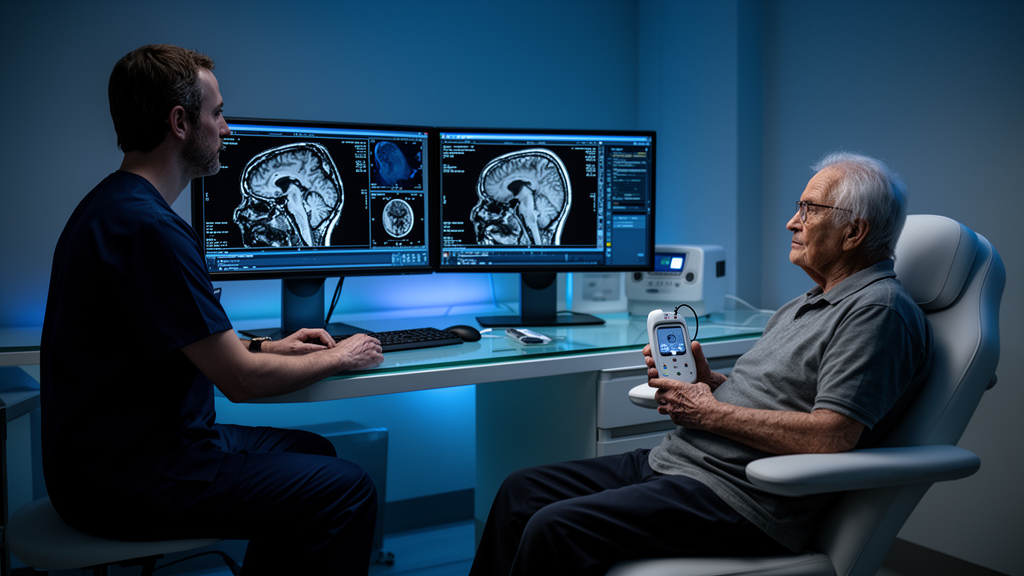
Image-guided programming significantly reduced the time required to configure subthalamic deep brain stimulation compared to local field potential-guided programming in patients with Parkinson’s disease. According to findings published in npj Parkinson’s Disease by Andrea Martínez and colleagues, image-guided programming achieved a shorter average programming duration while yielding comparable short-term clinical efficacy. Subthalamic nucleus deep brain stimulation programming is traditionally time-consuming and operator-dependent, prompting clinicians to evaluate alternative methods to streamline the setup process.
The prospective, randomized, blinded, exploratory investigation utilized a two-period crossover study design involving thirty Parkinson’s disease patients. Each participant had bilateral directional leads and BrainSense-enabled neurostimulators. During the trial, patients completed two-week phases under image-guided programming and local field potential-guided programming strategies. The researchers established programming efficiency as the primary outcome, which was evaluated through total programming time and the incidence of rescue visits.
Image-guided programming demonstrated a statistically significant reduction in overall programming time compared with local field potential guidance, recording 11.32 minutes versus 18.41 minutes. This represented an estimated treatment effect of minus 8.55 minutes with a reported p-value of less than 0.001. Regarding rescue visits, rates reached 26.7 percent in the image-guided phase compared to 20.0 percent in the local field potential phase, reflecting no statistically significant difference between the two approaches with a p-value of 0.752.
Secondary outcomes assessed by the research team covered measures of clinical efficacy alongside specific technical parameters. Clinical evaluations incorporated MDS-UPDRS parts I through IV, the PDQ-39 questionnaire, and the NMSS scale. Technical metrics examined charge delivered per second as well as the application of directional stimulation. The trial data revealed no statistically significant differences across clinical scores or charge delivered per second between the two studied strategies.
Directional stimulation showed marked differences in utilization between the two evaluated protocols, occurring in 48.3 percent of cases under image-guided programming compared to 3.3 percent under local field potential guidance, a difference that reached statistical significance with a p-value of less than 0.001. Although comparative clinical data between image guidance and local field potential guidance have remained limited, the authors concluded that image-guided programming was more time-efficient than local field potential-guided programming without demonstrating statistically significant differences in short-term clinical outcomes between the strategies.
Subject of Research: Subthalamic deep brain stimulation programming methods in Parkinson's disease
Article Title: Image-guided versus local field potential-guided programming for subthalamic deep brain stimulation in Parkinson’s disease
Article References: Martínez, A., Bejarano-Hernández, J. A., Lazaro-Hernandez, C., Rumià, J., Roldán, P., Cadena, A., Brengaret, O., Muñoz, E., Compta, Y., Camara, A., Garrido, A., Painous, C., Pérez-Soriano, A., Sánchez-Gómez, A., & Valldeoriola, F. (2026). Image-guided versus local field potential-guided programming for subthalamic deep brain stimulation in Parkinson’s disease. npj Parkinson's Disease. https://doi.org/10.1038/s41531-026-01627-x
Image Credits: AI Generated
DOI: 10.1038/s41531-026-01627-x
Keywords: Parkinson's disease, deep brain stimulation, subthalamic nucleus, image-guided programming, local field potentials, crossover study, BrainSense, directional leads, directional stimulation, programming efficiency, rescue visits, MDS-UPDRS, PDQ-39, NMSS, neurostimulators, charge delivered per second
News Source: Cassandra Pierce. (November 21, 2026). Image Guidance Speeds Subthalamic Deep Brain Stimulation Programming in Parkinson’s Disease. Scienmag.