The impact of a drop on a solid surface is an important phenomenon that has various implications and applications. Especially when the drop splashes, it can cause soil erosion, dispersal of plant pathogens, deterioration of printing and paint qualities, among others. Therefore, it is necessary to predict the deformation of a splashing drop to minimize the adverse effects. However, the multiphase nature causes complications in the prediction. To tackle this problem, several drop-impact studies have adopted artificial intelligence (AI) models and have shown excellent performances. However, the models developed in these studies use physical parameters as inputs and outputs, thus difficult to capture the deformation of the impacting drop.
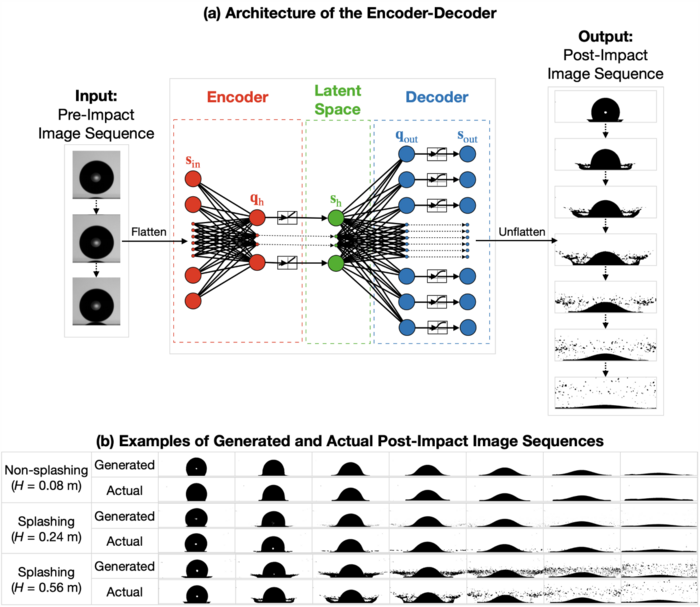
Credit: Jingzu Yee, Daichi Igarashi, Shun Miyatake and Yoshiyuki Tagawa,
Tokyo University of Agriculture and Technology
The impact of a drop on a solid surface is an important phenomenon that has various implications and applications. Especially when the drop splashes, it can cause soil erosion, dispersal of plant pathogens, deterioration of printing and paint qualities, among others. Therefore, it is necessary to predict the deformation of a splashing drop to minimize the adverse effects. However, the multiphase nature causes complications in the prediction. To tackle this problem, several drop-impact studies have adopted artificial intelligence (AI) models and have shown excellent performances. However, the models developed in these studies use physical parameters as inputs and outputs, thus difficult to capture the deformation of the impacting drop.
At the Tokyo University of Agriculture and Technology, a research team from the Department of Mechanical Systems Engineering proposed a computer-vision strategy and successfully predicted the deformation using image data. The research team led by Prof Yoshiyuki Tagawa, which includes Jingzu Yee (postdoctoral researcher), Daichi Igarashi (1st-year master’s student) and Shun Miyatake (4th-year undergraduate student), has got their findings published in Machine Learning: Science and Technology on April 6th, 2023.
In their research, the architecture of an encoder–decoder, which can take images as input and output, has been adopted to develop an image-based AI model to predict the drop deformation. By taking a pre-impact image sequence as the input, the trained encoder–decoder has successfully generated image sequence that shows the deformation of a drop during the impact, as the output. Remarkably, the generated image sequences are very similar to the actual image sequences captured during the experiment. The quantitative evaluation of the generated image sequences showed that in each frame of these generated image sequences, the spreading diameter of the drop was found to be in good agreement with that of the actual image sequences. Moreover, there was also a high accuracy in splashing/non-splashing prediction. These findings demonstrate the ability of the trained encoder–decoder to generate image sequences that can accurately represent the deformation of a drop during the impact.
“The approach proposed by this research offers a faster and more cost-effective alternative to experimental and numerical studies,” said Yoshiyuki Tagawa, professor at the Tokyo University of Agriculture and Technology. “This achievement is important in understanding and minimizing the adverse effects of splashing. In addition, it has shown the great potential of using AI and machine learning for scientific studies.”
###
About Tokyo University of Agriculture and Technology (TUAT):
TUAT is a distinguished university in Japan dedicated to science and technology. TUAT focuses on agriculture and engineering that form the foundation of industry, and promotes education and research fields that incorporate them. Boasting a history of over 140 years since our founding in 1874, TUAT continues to boldly take on new challenges and steadily promote fields. With high ethics, TUAT fulfills social responsibility in the capacity of transmitting science and technology information towards the construction of a sustainable society where both human beings and nature can thrive in a symbiotic relationship. For more information, please visit http://www.tuat.ac.jp/en/.
Journal
Machine Learning Science and Technology
DOI
10.1088/2632-2153/acc727
Article Title
Prediction of the morphological evolution of a splashing drop using an encoder-decoder
Article Publication Date
6-Apr-2023