• HOME
  • NEWS
  • EXPLORE
    • CAREER
      • Companies
      • Jobs
    • EVENTS
    • iGEM
      • News
      • Team
    • PHOTOS
    • VIDEO
    • WIKI
  • BLOG
  • COMMUNITY
    • FACEBOOK
    • INSTAGRAM
    • TWITTER
Sunday, May 3, 2026
BIOENGINEER.ORG
No Result
View All Result
  • Login
  • HOME
  • NEWS
  • EXPLORE
    • CAREER
      • Companies
      • Jobs
        • Lecturer
        • PhD Studentship
        • Postdoc
        • Research Assistant
    • EVENTS
    • iGEM
      • News
      • Team
    • PHOTOS
    • VIDEO
    • WIKI
  • BLOG
  • COMMUNITY
    • FACEBOOK
    • INSTAGRAM
    • TWITTER
  • HOME
  • NEWS
  • EXPLORE
    • CAREER
      • Companies
      • Jobs
        • Lecturer
        • PhD Studentship
        • Postdoc
        • Research Assistant
    • EVENTS
    • iGEM
      • News
      • Team
    • PHOTOS
    • VIDEO
    • WIKI
  • BLOG
  • COMMUNITY
    • FACEBOOK
    • INSTAGRAM
    • TWITTER
No Result
View All Result
Bioengineer.org
No Result
View All Result
Home NEWS Science News Chemistry

Illinois Tech assistant professor publishes paper in Science on novel chemistry behind ultra-high power density batteries

Bioengineer by Bioengineer
February 2, 2023
in Chemistry
Reading Time: 3 mins read
0
Assistant Professor Mohammad Asadi
Share on FacebookShare on TwitterShare on LinkedinShare on RedditShare on Telegram

CHICAGO—February 2, 2023—Mohammad Asadi, assistant professor of chemical engineering at Illinois Institute of Technology, has published a paper in the journal Science describing the chemistry behind his novel lithium-air battery design. The insights will allow him to further optimize the battery design, with the potential for reaching ultra-high power densities far beyond current lithium-ion technology. 
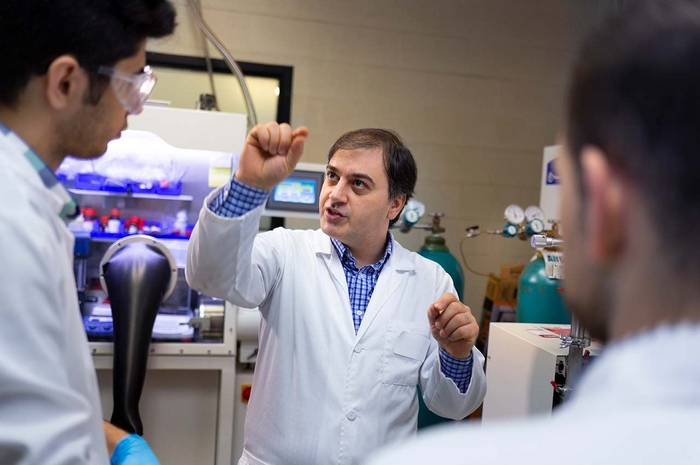
Assistant Professor Mohammad Asadi

Credit: Illinois Institute of Technology

CHICAGO—February 2, 2023—Mohammad Asadi, assistant professor of chemical engineering at Illinois Institute of Technology, has published a paper in the journal Science describing the chemistry behind his novel lithium-air battery design. The insights will allow him to further optimize the battery design, with the potential for reaching ultra-high power densities far beyond current lithium-ion technology. 

The battery design has the potential to store one kilowatt-hour per kilogram or higher—four times greater than lithium-ion battery technology, which would be transformative for electrifying transportation, especially heavy-duty vehicles such as airplanes, trains, and submarines.

Asadi aimed to make a battery with a solid electrolyte, which provides safety and energy benefits compared to liquid electrolyte batteries, and sought an option that would be compatible with the cathode and anode technologies that he has been developing for use in lithium-air batteries. He chose a mix of polymer and ceramic, which are the two most common solid electrolytes but both of which have downsides. By combining them,  Asadi found that he could take advantage of ceramic’s high ionic conductivity and the high stability and high interfacial connection of the polymer.

The result allows for the critical reversible reaction that enables the battery to function—lithium-dioxide formation and decomposition—to occur at high rates at room temperature, the first demonstration of this in a lithium-air battery.

As described in the Science paper, Asadi has conducted a range of experiments that demonstrate the science behind how this reaction occurs.

“We found that that solid-state electrolyte contributes around 75 percent of the total energy density. That tells us there is a lot of room for improvement because we believe we can minimize that thickness without compromising performance, and that would allow us to achieve a very, very high energy density,” says Asadi. 

These experiments were conducted in collaboration with University of Illinois Chicago and Argonne National Laboratory. Asadi says he plans to work with industry partners as he now moves toward optimizing the battery design and engineering it for manufacturing.  

“The technology is a breakthrough, and it has opened up a big window of possibility for taking these technologies to the market,” says Asadi. 

Disclaimer: “Research reported in this publication was supported by the United States Department of Energy under Award Number DE-AC02-06CH11357. This content is solely the responsibility of the authors and does not necessarily represent the official views of the U.S. Department of Energy.”

Image: Assistant Professor of Chemical Engineering Mohammad Asadi


Journal

Science

DOI

10.1126/science.abq1347

Method of Research

Experimental study

Subject of Research

Not applicable

Article Title

A room temperature rechargeable Li2O-based lithium-air battery enabled by a solid electrolyte

Article Publication Date

2-Feb-2023

Share12Tweet8Share2ShareShareShare2

Related Posts

Using Epigenetics to Monitor Environmental Arsenic Exposure — Chemistry

Using Epigenetics to Monitor Environmental Arsenic Exposure

May 1, 2026
Innovative Nanoreactor Design Enhances Catalysis by Optimizing Transport and Reaction Kinetics — Chemistry

Innovative Nanoreactor Design Enhances Catalysis by Optimizing Transport and Reaction Kinetics

May 1, 2026

Swift Creation of Conductive Organic Compounds via Mechanochemistry

May 1, 2026

Scientists Reveal Atomic Mechanism Behind Water-Induced Hydroxylation in CoOx Nanostructures

May 1, 2026

POPULAR NEWS

  • Research Indicates Potential Connection Between Prenatal Medication Exposure and Elevated Autism Risk

    832 shares
    Share 333 Tweet 208
  • New Study Reveals Plants Can Detect the Sound of Rain

    714 shares
    Share 285 Tweet 178
  • Scientists Investigate Possible Connection Between COVID-19 and Increased Lung Cancer Risk

    67 shares
    Share 27 Tweet 17
  • Salmonella Haem Blocks Macrophages, Boosts Infection

    61 shares
    Share 24 Tweet 15

About

We bring you the latest biotechnology news from best research centers and universities around the world. Check our website.

Follow us

Recent News

Family Health Needs of Disabled Elders Explored

Mcu Controls Bone Growth Through Mitochondrial Calcium

Physical Disorders, ADLs, Cognition, Depression in Nursing Homes

Subscribe to Blog via Email

Success! An email was just sent to confirm your subscription. Please find the email now and click 'Confirm' to start subscribing.

Join 82 other subscribers
  • Contact Us

Bioengineer.org © Copyright 2023 All Rights Reserved.

Welcome Back!

Login to your account below

Forgotten Password?

Retrieve your password

Please enter your username or email address to reset your password.

Log In
No Result
View All Result
  • Homepages
    • Home Page 1
    • Home Page 2
  • News
  • National
  • Business
  • Health
  • Lifestyle
  • Science

Bioengineer.org © Copyright 2023 All Rights Reserved.