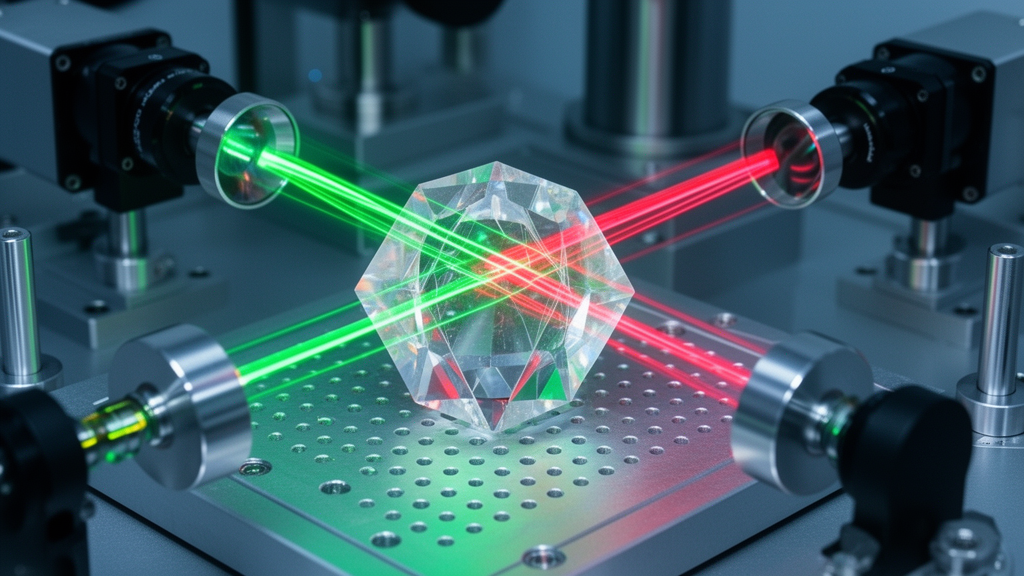
In high-energy laser physics, optical parametric chirped-pulse amplification serves as a foundational architecture for generating high-power femtosecond pulses across applications ranging from attosecond science to laser-driven particle acceleration. Scaling output energy encounters a strict physical ceiling imposed by the maximum energy deliverable by a single pump laser beam. To surpass this limitation, researchers develop multi-beam pumping schemes that combine energy from multiple independent pump sources into a single seed beam through noncollinear parametric gain. While this approach promises higher peak power and spectral control, it frequently suffers from parasitic parametric diffraction. This detrimental process occurs when nonlinear cross-coupling among intense intersecting laser beams deflects substantial pump energy away from the primary amplification channel. Now, an experimental study published in High Power Laser Science and Engineering demonstrates that absorbing unwanted idler waves within a doped crystal suppresses parasitic parametric diffraction by more than sixty percent, providing an experimental foundation for scalable nonlinear beam combining.
The fundamental mechanism driving parametric diffraction stems from secondary wave-mixing cascades that ignite inside the nonlinear crystal during multi-beam amplification. In a two-beam pumping arrangement, two separate pump beams, designated P1 and P2, interact simultaneously with the primary seed signal pulse to stimulate amplification while generating two distinct idler waves, denoted I1 and I2. Because the pump beams intersect at defined angular separations, the newly generated idler waves immediately engage in parasitic difference-frequency generation with adjacent pump channels. Specifically, interactions between pump P1 and idler I2, as well as between pump P2 and idler I1, generate secondary signal waves termed S12 and S21. These secondary waves match the exact optical spectrum of the initial seed pulse but emerge along divergent angles dictated by noncollinear phase-matching geometry. These diffracted signals then drive higher-order sum- and difference-frequency interactions, siphoning pump energy into unwanted spatial beams and sharply degrading conversion efficiency.
To eliminate this parasitic bottleneck at its physical root, researchers proposed quasi-parametric chirped-pulse amplification, abbreviated as QPCPA. Unlike standard optical parametric amplifiers where idler waves accumulate freely as pump energy converts into the signal, the quasi-parametric approach actively depletes the idler wave throughout the amplification process. Theoretical frameworks show that selectively dissipating idler waves breaks the cross-coupling loop before parasitic difference-frequency generation can take hold. Although dampening the idler slightly lowers the nonlinear coupling coefficient and small-signal gain compared to an idealized lossless interaction, it significantly improves overall pump-to-signal conversion efficiency and broadens gain bandwidth by establishing robustness against phase mismatch. Previous investigations theoretically suggested using rare-earth ion doping, secondary frequency conversion, or spatial walk-off to induce idler loss. Nevertheless, direct experimental verification quantifying how effectively controlled idler dissipation halts cascaded parametric diffraction in real multi-beam environments remained unaccomplished until now, leaving laser system designers without empirical performance metrics.
To establish theoretical guidance for experiments, the research team analyzed the three-wave coupled equations under the slowly varying envelope approximation, expanding them to incorporate first-order cross-coupling terms. The mathematical model examined two equal-intensity 515-nanometer pump beams interacting with an 800-nanometer chirped signal pulse in a noncollinear Type-I phase-matching geometry. By evaluating angular tolerance through a Taylor expansion of the phase mismatch, the researchers determined that parametric diffraction arises whenever an adjacent pump beam falls within overlapping angular tolerance cones centered on signal and idler wave vectors. Numerical simulations of yttrium calcium oxyborate crystals revealed that in standard systems, parasitic diffraction efficiency increases sharply as pump angular separation narrows. At an angular separation of one milliradian, diffraction efficiency reached 20.5 percent, whereas widening the angle to fifteen milliradians reduced diffraction to 5.6 percent. Introducing an idler dissipation coefficient of forty inverse centimeters into simulations suppressed these cross-coupling channels, stabilizing diffraction losses below one percent at fifteen milliradians.
Equipped with these numerical predictions, the researchers assembled a specialized laboratory testbed to benchmark conventional optical parametric chirped-pulse amplification directly against the quasi-parametric architecture. The experimental layout utilized a home-built ytterbium-doped yttrium aluminum garnet laser operating at one hundred hertz, delivering four-millijoule pulses with a duration of three picoseconds at a 1030-nanometer fundamental wavelength. Deriving both pump pulses and signal seed from the same laser source achieved intrinsic passive synchronization, eliminating timing jitter associated with active electronic control. To generate the broadband seed, a fourteen-microjoule fraction of the laser output was loosely focused into an undoped yttrium aluminum garnet crystal, producing a stable supercontinuum extending from 540 to 950 nanometers. This white-light continuum was subsequently shaped using short-pass dielectric filters with a 950-nanometer cutoff, yielding an initial pre-amplification seed pulse spanning 700 to 950 nanometers with a full width at half maximum bandwidth of 110.8 nanometers.
The pump preparation system employed second-harmonic generation inside a 2.5-millimeter Type-I barium borate crystal to convert fundamental infrared light into 515-nanometer green pump pulses with 42.8 percent conversion efficiency, yielding 1.2 millijoules of energy. A preliminary single-beam optical parametric amplification stage amplified the seed pulse from fifty nanojoules to ten microjoules in a three-millimeter barium borate crystal. The pre-amplified pulse then entered the main amplifier, where two independent pump arms provided balanced energies regulated by half-wave plates and thin-film polarizers. Telescopes collimated both pump beams to 0.95 millimeters in diameter, while optical delay lines aligned their arrival times with precision better than one hundred femtoseconds. The primary signal beam was aligned slightly larger than pump spots to act as a soft aperture. For the baseline optical parametric amplifier, a three-millimeter barium borate crystal was selected because its noncollinear geometry produces visible second-harmonic generation from signal and idler components, permitting direct naked-eye observation of diffraction patterns.
In the baseline barium borate setup, visual inspection of a diffusing screen revealed dense cascades of parametric diffraction spots arranged in three vertical columns corresponding to idler, pump, and signal harmonics. As pump intensity increased from 7.5 to 13 gigawatts per square centimeter at fifteen milliradians separation, higher-order diffraction spots multiplied and intensified, with parasitic conversion efficiency escalating from 19.8 percent to 35.0 percent. When researchers reduced beam separation from fifteen to seven milliradians at 13 gigawatts per square centimeter, diffraction efficiency surged to 42.8 percent, accompanied by an increased vertical density of diffraction orders. Measured angular distributions of first-, second-, and third-order diffracted beams matched calculated phase-matching angles with remarkable precision, confirming that observed patterns originated from multi-wave cross-coupling rather than scattering. Furthermore, when total pump energy rose to seven hundred microjoules, conversion efficiency into the primary signal dropped by 36.5 percent, directly confirming the severe performance degradation caused by uninhibited parametric diffraction.
To implement quasi-parametric amplification, the team replaced the barium borate crystal with a 3.9-centimeter-long samarium-doped yttrium calcium oxyborate crystal featuring a thirty percent samarium doping concentration. The trivalent samarium dopant provides an average idler absorption coefficient of approximately 1.5 inverse centimeters across the 1200-to-1600-nanometer infrared window while remaining transparent to pump and signal frequencies. Because parasitic harmonic generation is negligible in this crystal, the researchers tracked beam distributions using laser viewing cards. The experimental images revealed that the intense multi-order diffraction spots visible in the conventional amplifier vanished almost entirely. Quantitative measurements showed that at fifteen milliradians separation and 13 gigawatts per square centimeter pump intensity, the quasi-parametric system maintained parasitic diffraction conversion near seven percent, compared to thirty-five percent in the conventional system. At a narrower seven-milliradian separation, diffraction losses dropped from 42.8 percent in the standard amplifier to 17.2 percent, representing a sixty percent reduction in parasitic conversion. At larger pump angular separations of twenty-two milliradians, the quasi-parametric setup achieved a 67.2 percent reduction in diffraction efficiency relative to the conventional configuration.
Importantly, experimental characterization demonstrated that suppressing parametric diffraction preserved both spectral fidelity and spatial beam quality in the amplified signal. Under two-beam pumping, the signal spectrum was amplified uniformly across its entire bandwidth without inducing perceptible spectral distortion. Charge-coupled device diagnostics revealed that despite spatial interference fringes between the two intersecting pump beams at the crystal face, the amplified signal maintained a clean, near-Gaussian profile in near-field and far-field regimes. This spatial preservation occurs because noncollinear phase matching acts as an intrinsic spatial filter, preventing pump interference modulation from imprinting onto the signal wavefront. Experimental observations also verified that nonlinear phase distortions remained negligible. With pump separations between seven and fifteen milliradians, inter-channel phase mismatch was minimal, preventing adverse modifications to spectral phase. Calculations also confirmed that with a peak intensity of 13 gigawatts per square centimeter, the accumulated B-integral reached only about one radian, well below the three-radian threshold for self-focusing.
Despite these successful demonstrations, the researchers outlined several practical constraints and critical directions for future development. First, the experimental absorption coefficient of 1.5 inverse centimeters provided by thirty percent samarium doping was substantially lower than the ideal forty inverse centimeters modeled in numerical simulations, suggesting that higher dopant concentrations could yield even stronger diffraction suppression. Second, while near-field and far-field profiles exhibited excellent qualitative uniformity, the study did not include quantitative wavefront measurements such as Strehl ratio or beam propagation factor evaluations, leaving formal beam-quality benchmarking for future investigations. Third, because the demonstration operated on a low-average-power platform pulsing at one hundred hertz, scaling to high-repetition-rate systems will require active thermal management to handle heat generated by idler absorption, or adopting non-absorptive idler depletion mechanisms such as spatial walk-off. Nevertheless, by confirming that idler dissipation eliminates more than sixty percent of cross-coupling losses, the work establishes a validated blueprint for high-energy multi-beam optical parametric architectures.
Subject of Research: Suppression of parasitic parametric diffraction in multi-beam optical parametric chirped-pulse amplification through idler wave dissipation.
Article Title: Experimental study of parametric-diffraction suppression via idler dissipation for multi-beam-pumped optical parametric amplification
Article References: Zhu, W., Zhang, Y., Yuan, P., Qin, Z., Wang, J., Ma, J., & Qian, L. (2026). Experimental study of parametric-diffraction suppression via idler dissipation for multi-beam-pumped optical parametric amplification. High Power Laser Science and Engineering, 14, Article e98. https://doi.org/10.1017/hpl.2026.10200
Image Credits: AI Generated
Keywords: optical parametric chirped-pulse amplification, quasi-parametric chirped-pulse amplification, parametric diffraction, idler dissipation, nonlinear beam combining, multi-beam pumping, ultrafast lasers, samarium-doped YCOB, second-harmonic generation, nonlinear optics, phase matching, pump depletion, conversion efficiency, wave-mixing, chirped-pulse amplification, laser physics, barium borate crystal
News Source: Denise Maddox. (November 24, 2026). Idler Dissipation Cuts Parasitic Diffraction Over Sixty Percent in Multi-Beam Laser Amplifiers. Scienmag.