Familiarity with self-power generation devices
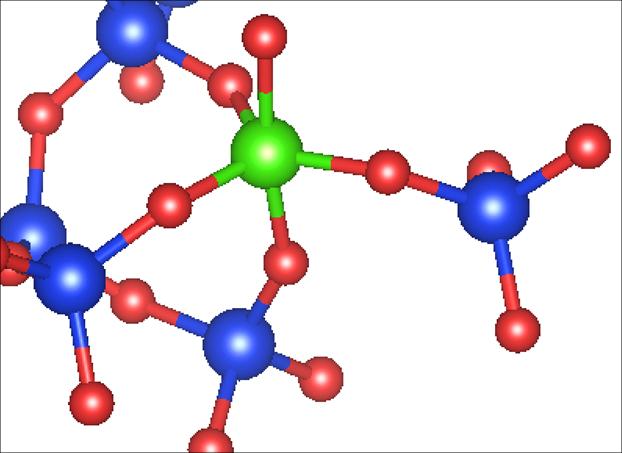
Credit: Nagoya University
The Japanese research team elucidated the microscopic mechanism in which amorphous silica(1) becomes negatively charged as a vibrational energy harvester(2), which is anticipated to achieve self-power generation without charging, as it is needed for IoT that is garnering attention in recent years with its “trillion sensors” that create a large-scale network of sensors. Unlike wind power and solar power generation, vibrational power generation, which utilizes natural vibration for power generation, is not affected by weather.
Vibrational energy harvester that uses potassium ion electret, which the research group had previously developed, is of interest since it can operate semi-permanently. The potassium ion electret(3) is a vibrational energy harvester that uses introduction of potassium atoms in amorphous silica to create a negative charge on the amorphous silica. However, its microscopic mechanism was unknown, making it difficult to improve its performance.
Through quantum mechanics calculations, the research group discovered that when potassium atoms are inserted in amorphous silica, electrons are provided from the potassium atom to the silicon atom. This causes the silicon atom to behave like a phosphorus atom. Silicon atoms form 5 covalent bonds with oxygen atoms instead of the usual 4, creating a SiO5 structure. We discovered that this structure is what accumulates negative charge.
This result provides a design guidance toward improving reliability and longevity of vibrational energy harvesters. This would allow sensors that do not require charging, to become widely available, and contribute toward actualization of the internet of things (IoT)(4).
This study was jointly conducted by the research groups of professor Gen Hashiguchi of Faculty of Engineering, Shizuoka University and professor Hiroshi Toshiyoshi of Institute of Industrial Science, The University of Tokyo, along with professor Kenji Shiraishi, graduate student Toru Nakanishi, researcher Kenta Chokawa, and assistant professor Masaaki Araidai of Institute of Materials and Systems for Sustainability, Nagoya University, as part of JST Strategic Basic Research Programs. JST aims to create innovative basic technologies that convert unused microscopic energy in the environment into electric energy (energy harvesting). This result will be presented at the 37th Sensor Symposium “On Sensors, Micromachines and Applied Systems” (held online), titled “Investigation of negative charge storage mechanism in the potassium ion electret by first-principle calculation.”
###
(1) Amorphous silica
Silica refers to any form of silicon dioxide (SiO2) consisting of silicon (Si) and oxygen (O). Quartz and quartz crystal are members of silica. Amorphous silica is where atomic arrangement of silica is quite random. It is often denoted as a-SiO2.
(2) Vibrational energy harvester
A system that converts natural vibrations (vibrations caused by vehicles in operation and people walking) to electrical energy. It can self-supply electricity and be used for various purposes without charging.
(3) Potassium ion electret
Electret is a charged object made of materials in which, as in magnetic polarization in permanent magnets, dielectric polarization remains in a dielectric even when the electrical field is lost. It was named electret in reference to magnets. Potassium ion electret is where a potassium atom is inserted into amorphous silica and then removed, which causes amorphous silica to be negatively charged semi-permanently.
(4) Internet of Things (IoT)
Various objects are connected to the Internet where these objects can mutually control each other through the Internet. This promises to move the digital society forward.
Media Contact
Gen Hashiguchi
[email protected]
Original Source
https:/