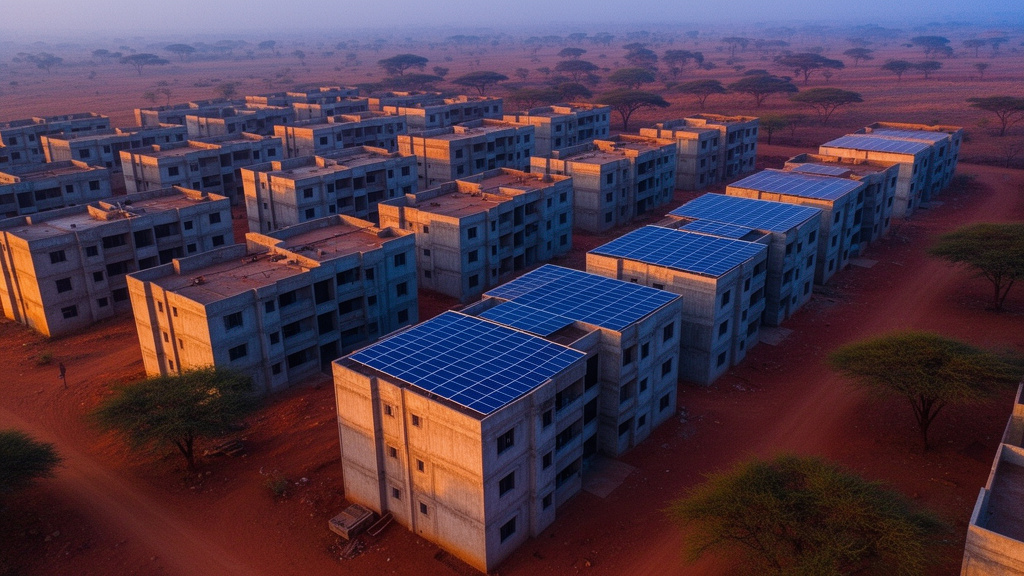
Two standardized apartment blocks built from the same national blueprint, one in Ethiopia’s cool highland capital and one in its hot semi-arid lowlands, are heading toward sharply different energy futures. A new open-access study in Discover Energy reports the first validated lifecycle energy benchmarks for Ethiopia’s Integrated Housing Development Program (IHDP), the state program that has delivered more than 500,000 urban housing units using identical construction specifications regardless of climate. The findings expose what the researchers call a ‘Climatic Thermal Compromise’: envelopes that perform acceptably in temperate Addis Ababa leave occupants in semi-arid Adama on the threshold of a rapid shift from passive ventilation to mechanical cooling.
The study, led by Getahun Ayele Tessema with P. S. Chani, E. Rajasekar and Bereket Lafraw Dire, coupled smart-meter-calibrated EnergyPlus operational models with embodied energy estimates localized to Ethiopia’s hydropower-dominated grid. The team analyzed two IHDP estates: Gelan in Addis Ababa at 2,400 meters elevation, classified Köppen Cwb subtropical highland, and Andode in Adama at 1,550 meters, classified BSh hot semi-arid. The case buildings were an M2 five-story block of 35 units in Addis Ababa and an M1 four-story block of 28 units in Adama, both naturally ventilated multi-family blocks with no mechanical heating or cooling installed.
Calibration rested on 2022 monthly electricity records for 53 households retrieved from the Ethiopian Electric Utility, supplemented by occupancy surveys and official bills of quantities. Households with incomplete billing histories were excluded rather than imputed. Both digital prototypes, modeled in Rhino 3D and simulated in ClimateStudio–EnergyPlus, satisfied ASHRAE Guideline 14 acceptance criteria: Addis Ababa achieved a CV(RMSE) of 4.1 percent and NMBE of −0.8 percent with R² of 0.79, while Adama reached CV(RMSE) of 3.9 percent, NMBE of −1.1 percent and R² of 0.64. The authors note that residual uncertainty stems partly from modest per-typology household counts, as few as eight metered units in some sub-groups, and from fans operating on unmetered circuits, which the team corroborated through field observation and interviews.
The validated models revealed a strikingly appliance-dominated consumption profile. Injera mitads, the locally manufactured electric griddles used to bake Ethiopia’s staple flatbread, accounted for 33.7 percent of household electricity in Addis Ababa and 30.3 percent in Adama; standard electric stoves contributed another 29.3 percent and 29.7 percent respectively. Cooking appliances together consume 60 to 62 percent of residential electricity in both cities, a concentration the authors say is absent from global building energy benchmarks and constitutes the single largest efficiency lever in Ethiopian housing. Addis Ababa households showed stable monthly consumption of 240 to 270 kilowatt-hours with minimal seasonal variation, while Adama units ranged 260 to 290 kilowatt-hours with overheating-period surges of 8 to 12 percent between October and December.
That seasonal asymmetry connects to the study’s most consequential projection. Field documentation found that 20 percent of Adama households own fans, used roughly four hours during afternoon discomfort peaks, while fan penetration in Addis Ababa was absent. When the researchers modeled a transition from those fans to equivalent mechanical air-conditioning operating hours, grounded in income-driven cooling-adoption trends documented in other Sub-Saharan African cities, Adama’s operational energy surged 31 percent during overheating periods, against only a 6 percent rise in temperate Addis Ababa. The authors stress these are scenario-based projections under present-day climate conditions, contingent on observed behavioral trends, and should be read as conservative lower bounds rather than predictions; using downscaled future-climate projections elsewhere suggests semi-arid East African cities face an additional 8 to 22 percent increase in cooling degree days by 2050.
The thermal evidence behind the projection is tangible. Indoor monitoring in occupied Adama units recorded mid-afternoon operative temperatures of 30 to 33 degrees Celsius in top-floor apartments during October to December, approaching the upper boundary of adaptive comfort tolerance. Prior Ethiopian comfort research has found that free-running IHDP occupants tolerate operative temperatures of 32 to 36 degrees under cost constraints while expressing a latent preference for mechanical cooling. The 20 percent fan ownership rate, the authors argue, is therefore not merely an energy statistic but an adaptive comfort indicator: occupants are already investing in mechanical cooling at the point where passive ventilation can no longer maintain acceptable conditions.
On the embodied side, Ethiopia-specific cradle-to-site accounting, adjusted from Ecoinvent v3.8 global coefficients by subtracting a 0.30 megajoule-per-kilogram renewable energy factor to reflect a grid that is 90 percent hydropower, yielded an initial embodied energy of 7,137,128 megajoules for the studied building, rising to 8,207,697 megajoules with 15 percent recurrent contributions. Normalized, this equals 6,865.4 megajoules per square meter, identical at both sites because the IHDP’s centralized delivery model uses the same bills of quantities, hollow concrete block walls and supply chains within roughly 100 kilometers of both estates. Hollow concrete blocks dominate at 52.1 percent of initial embodied energy, followed by finishes and fixtures at 29.4 percent. Morris global sensitivity analysis confirmed hollow concrete blocks and structural concrete as the most influential parameters, with mean absolute elementary effects of 0.82 and 0.78.
Integrated over a 50-year service life, lifetime energy baselines reached 24,660.7 megajoules per square meter in Addis Ababa and 21,741.7 megajoules per square meter in Adama, with operational energy dominating at 72.2 percent and 68.4 percent respectively. Mitigation scenarios combining behavioral shifts worth a 6.8 percent operational reduction, appliance upgrades delivering 18.0 to 18.6 percent operational savings, and material substitutions cutting embodied energy by 3.63 percent produced near-identical lifetime savings of 28.4 to 29.0 percent in both cities. The substitutions, including clay tiles replacing galvanized steel roofing, geopolymer concrete and engineered bamboo, were selected through the sensitivity analysis as drop-in replacements preserving the existing structure, though the authors caution that thermal performance, durability and cost of the substituted materials were not independently tested under Ethiopian conditions.
From this evidence the study proposes a three-tier framework of climatically differentiated Minimum Energy Performance Standards. Tier one, applicable nationally, would mandate efficiency standards for electric cooking appliances, targeting the injera mitad and stoves that drive roughly 18 percent operational savings per unit. Tier two, prioritized for semi-arid zones, would require glazing improvements, with a recommended maximum solar heat gain coefficient of 0.40 and U-factor of 1.8 watts per square meter-kelvin, alongside passive pre-cooling measures and fan efficiency standards to head off mass mechanical cooling adoption. Tier three would embed low-embodied-energy material specifications in centralized IHDP procurement rather than leaving substitution to individual designers. The authors frame these as policy inferences from two case-study locations, noting that extension to additional climate zones and typologies requires further validation.
The team is explicit about the limits of the evidence. The analysis covers only two representative IHDP typologies at two sites and should not be generalized to other Ethiopian cities or construction systems without further work. Cooling projections rely on current typical meteorological weather files rather than downscaled climate futures. The embodied energy adaptation applies a fixed renewable-energy deduction and an average 300-kilometer transport distance rather than a fully disaggregated supply-chain model. The study quantifies energy only, not carbon emissions or economics, and the authors warn readers not to infer carbon performance directly from the energy metrics, since Ethiopia’s near-zero-carbon grid makes operational carbon savings modest in absolute terms while embodied-carbon implications of material substitution may diverge materially from the energy findings. Even so, the core validated message stands: in standardized mass housing, one envelope size does not fit all climates, and the grid-stress risk is concentrated precisely where the design least anticipated it.
Subject of Research: Lifecycle operational and embodied energy performance of standardized mass housing across two climatically divergent Ethiopian cities
Article Title: Energy efficiency imperatives from lifecycle energy demand trajectories in Global South mass housing
Article References: Tessema, G. A., Chani, P. S., Rajasekar, E., & Dire, B. L. (2026). Energy efficiency imperatives from lifecycle energy demand trajectories in Global South mass housing. Discover Energy, 6(1), Article 73. https://doi.org/10.1007/s43937-026-00202-y
Image Credits: AI Generated
DOI: 10.1007/s43937-026-00202-y
Keywords: Ethiopia, IHDP mass housing, lifecycle energy, embodied energy, operational energy, cooling demand, EnergyPlus calibration, smart meter data, Minimum Energy Performance Standards, material substitution, semi-arid climate, building energy policy
News Source: Denise Maddox. (October 29, 2026). Identical Housing Blocks, Divergent Energy Futures: Ethiopia’s Climate Compromise. Scienmag.