• HOME
  • NEWS
  • EXPLORE
    • CAREER
      • Companies
      • Jobs
    • EVENTS
    • iGEM
      • News
      • Team
    • PHOTOS
    • VIDEO
    • WIKI
  • BLOG
  • COMMUNITY
    • FACEBOOK
    • INSTAGRAM
    • TWITTER
Saturday, February 7, 2026
BIOENGINEER.ORG
No Result
View All Result
  • Login
  • HOME
  • NEWS
  • EXPLORE
    • CAREER
      • Companies
      • Jobs
        • Lecturer
        • PhD Studentship
        • Postdoc
        • Research Assistant
    • EVENTS
    • iGEM
      • News
      • Team
    • PHOTOS
    • VIDEO
    • WIKI
  • BLOG
  • COMMUNITY
    • FACEBOOK
    • INSTAGRAM
    • TWITTER
  • HOME
  • NEWS
  • EXPLORE
    • CAREER
      • Companies
      • Jobs
        • Lecturer
        • PhD Studentship
        • Postdoc
        • Research Assistant
    • EVENTS
    • iGEM
      • News
      • Team
    • PHOTOS
    • VIDEO
    • WIKI
  • BLOG
  • COMMUNITY
    • FACEBOOK
    • INSTAGRAM
    • TWITTER
No Result
View All Result
Bioengineer.org
No Result
View All Result
Home NEWS Science News Chemistry

Ideal type-II Weyl points are observed in classical circuits

Bioengineer by Bioengineer
November 25, 2020
in Chemistry
Reading Time: 2 mins read
0
IMAGE
Share on FacebookShare on TwitterShare on LinkedinShare on RedditShare on Telegram

IMAGE

Credit: ©Science China Press

The elementary particles that build the universe have two types: bosons and fermions, where the fermions are classified as Dirac, Weyl, and Majorana fermions. In recent years, Weyl fermions are found in condensed matter systems Weyl semimetals as a kind of quasiparticles, and they manifest themselves as Weyl points from dispersion relations. In contrast to the high-energy physics which requires the stringent Lorentz symmetry, there are two types of Weyl points in condensed matter systems: type-I Weyl points with symmetric cone-like band structures and type-II Weyl points with strongly tilted band structures.

Type-II Weyl points have been observed in condensed matter systems and several artificial periodic structures, such as photonic and phononic crystals. However, these type-II Weyl points are not symmetry-related, and they have small separations and different energies. Thus, it is challenging to distinguish the type-II Weyl points with other degenerate points and observe the related phenomena such as topological surface states.

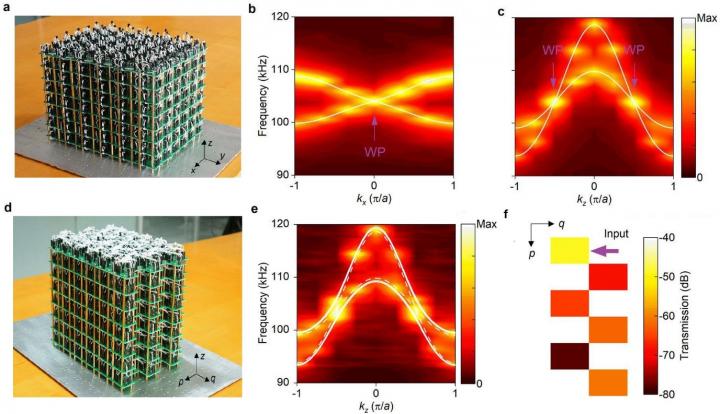
Recently, Dr. Rujiang Li and Prof. Hongsheng Chen from Zhejiang University, Dr. Bo Lv and Prof. Jinhui Shi from Harbin Engineering University, Prof. Huibin Tao from Xi’an Jiaotong University, and Prof. Baile Zhang and Prof. Yidong Chong from Nanyang Technological University observe the ideal type-II Weyl points in classical circuits by utilizing the high flexibility of circuit node connections. For a circuit structure with periodic boundaries in three dimensions (Fig. 1a), this Weyl system only has two bands. Due to the protections from mirror symmetries and the time-reversal symmetry, there exists the minimal number of four type-II Weyl points in momentum space and these Weyl points reside at the same frequency. Experimentally, they prove the existence of linear degenerate points and the strongly tilted band structure by reconstructing the band structures of the circuit system (Fig. 1b-c), which imply that these four Weyl points are ideal type-II Weyl points. Besides, they fabricate a circuit structure with an open boundary (Fig. 1d) and observe the topological surface states within an incomplete bandgap (Fig. 1e-f). These phenomena further imply the existence of ideal type-II Weyl points.

Circuit system has high flexibility and controllability. Compared with other experimental platform, lattice sites in a circuit system can be wired in an arbitrary manner with arbitrary numbers of connections per node and long-range connections, and the hopping strengths are independent of the distance between the nodes. Precisely because of this flexible and highly customizable connectivity, and the distance independent hopping, a circuit lattice that can observe the ideal type-II Weyl points are easily fabricated. This circuit platform can be used to the further study of Weyl physics and other topological phenomena.

###

See the article:

Rujiang Li, Bo Lv, Huibin Tao, Jinhui Shi, Yidong Chong, Baile Zhang, and Hongsheng Chen
Ideal type-II Weyl points in topological circuits
Natl Sci Rev
https://doi.org/10.1093/nsr/nwaa192

Media Contact
Hongsheng Chen
[email protected]

Related Journal Article

http://dx.doi.org/10.1093/nsr/nwaa192

Tags: Chemistry/Physics/Materials Sciences
Share12Tweet8Share2ShareShareShare2

Related Posts

blank

Breakthrough in Environmental Cleanup: Scientists Develop Solar-Activated Biochar for Faster Remediation

February 7, 2026
blank

Cutting Costs: Making Hydrogen Fuel Cells More Affordable

February 6, 2026

Scientists Develop Hand-Held “Levitating” Time Crystals

February 6, 2026

Observing a Key Green-Energy Catalyst Dissolve Atom by Atom

February 6, 2026
Please login to join discussion

POPULAR NEWS

  • Robotic Ureteral Reconstruction: A Novel Approach

    Robotic Ureteral Reconstruction: A Novel Approach

    82 shares
    Share 33 Tweet 21
  • Digital Privacy: Health Data Control in Incarceration

    63 shares
    Share 25 Tweet 16
  • Study Reveals Lipid Accumulation in ME/CFS Cells

    57 shares
    Share 23 Tweet 14
  • Breakthrough in RNA Research Accelerates Medical Innovations Timeline

    53 shares
    Share 21 Tweet 13

About

We bring you the latest biotechnology news from best research centers and universities around the world. Check our website.

Follow us

Recent News

Digital Health Perspectives from Baltic Sea Experts

Florida Cane Toad: Complex Spread and Selective Evolution

Exploring Decision-Making in Dementia Caregivers’ Mobility

Subscribe to Blog via Email

Enter your email address to subscribe to this blog and receive notifications of new posts by email.

Join 73 other subscribers
  • Contact Us

Bioengineer.org © Copyright 2023 All Rights Reserved.

Welcome Back!

Login to your account below

Forgotten Password?

Retrieve your password

Please enter your username or email address to reset your password.

Log In
No Result
View All Result
  • Homepages
    • Home Page 1
    • Home Page 2
  • News
  • National
  • Business
  • Health
  • Lifestyle
  • Science

Bioengineer.org © Copyright 2023 All Rights Reserved.