Gamma-hydroxybutyrate, a medication primarily known for its role in treating narcolepsy, has been associated with significantly deeper and more efficient sleep in awake patients within the intensive care unit. A recent correspondence published in Critical Care details a polysomnographic experience involving thirteen non-sedated patients, highlighting that nocturnal intravenous administration of the drug resulted in striking changes to sleep architecture. The study, conducted at Pitié-Salpêtrière University Hospital in Paris, France, represents a preliminary exploration of how this specific GABA-B agonist shapes sleep patterns in critically ill individuals who are not under mechanical ventilation or heavy sedation. The findings suggest that the drug may offer a pharmacological option for addressing the fragmented and depleted sleep often observed in this vulnerable population, although the authors emphasize the need for further controlled trials to confirm these observations.
The clinical context for this investigation stems from a broader shift in intensive care medicine towards lighter or no sedation protocols. As a growing proportion of ICU patients remain awake, their sleep quality has become a significant concern. These patients frequently experience sleep that is fragmented and lacking in slow-wave sleep, also known as N3 sleep, as well as rapid-eye-movement sleep. Such alterations in sleep architecture are clinically significant because they have been associated with the development of delirium and prolonged weaning from mechanical ventilation. Current pharmacological options for managing sleep in this setting are limited. Melatonin is suggested on low-certainty evidence, while other common sedatives like benzodiazepines and propofol may lengthen sleep duration but at the cost of disrupting its natural architecture. Gamma-hydroxybutyrate, also known as sodium oxybate, has previously been used for sedation in neurocritical care, but its specific effects on sleep structure in general ICU patients had not been described until this report.
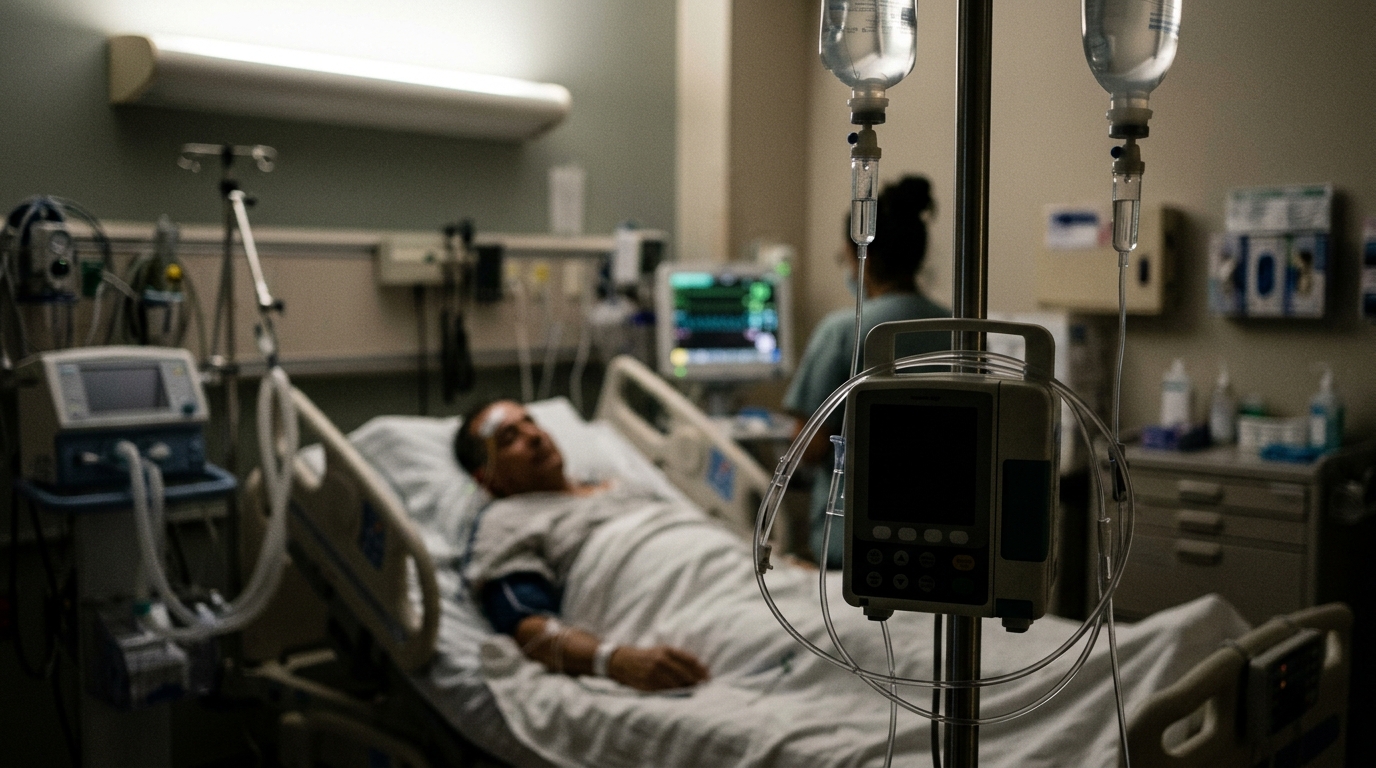
The study involved non-sedated patients in a general ICU who were offered one night of ambulatory polysomnography as part of routine sleep assessment. The recordings were scored according to American Academy of Sleep Medicine rules. Night-time treatment was left to the discretion of the attending physician. When gamma-hydroxybutyrate was chosen, it was administered as an intravenous bolus followed by a continuous infusion from 22:00 to 06:00. The specific formulation used was Gamma-OH, a sodium oxybate product. Each morning, patients rated the quality of their sleep on a numerical rating scale ranging from 0, representing the worst possible sleep, to 10, representing the best possible sleep. Bedside nurses also noted whether patients had slept, and electrolyte levels were measured to monitor for potential side effects.
Thirteen patients had interpretable recordings, defined as having at least four hours of signal. The patients had a median age of 57 years, with an interquartile range of 37 to 68 years. Nine of the participants were men. Their severity of illness was quantified by the Simplified Acute Physiology Score II, which had a median value of 54, with an interquartile range of 34 to 64. All participants were calm and awake, as indicated by a Richmond Agitation-Sedation Scale score of 0. They were free of delirium, confirmed by a negative Confusion Assessment Method for the ICU, and none were invasively ventilated. Eight patients received gamma-hydroxybutyrate, while five did not. The dose of gamma-hydroxybutyrate administered to the treated group was 9.0 grams, with an interquartile range of 8.5 to 9.7 grams, which equated to 126 milligrams per kilogram of body weight, with an interquartile range of 106 to 159 milligrams per kilogram.
The polysomnographic recordings of patients who received gamma-hydroxybutyrate appeared strikingly different from those who did not. The difference in sleep efficiency was 21 percentage points, with a 95 percent confidence interval of 7 to 35. More notably, the proportion of total sleep time spent in N3 slow-wave sleep was 58 percent in the gamma-hydroxybutyrate group, with an interquartile range of 28 to 77 percent, versus 8 percent in the untreated group, with an interquartile range of 1 to 17 percent. This difference was 48 percentage points, with a 95 percent confidence interval of 18 to 76. In four of the treated patients, slow-wave sleep exceeded half of the night, and in one patient, it reached 99 percent of total sleep time, occurring at the expense of lighter sleep stages.
Conversely, rapid-eye-movement sleep was scarcer in the gamma-hydroxybutyrate group, accounting for 5 percent of sleep time compared to 13 percent in the untreated group. In two of the patients who received gamma-hydroxybutyrate, rapid-eye-movement sleep was entirely absent. The subjective perception of sleep quality aligned with these objective polysomnographic findings. Nurses considered that all eight patients who received gamma-hydroxybutyrate had slept, whereas only two of the five untreated patients were noted to have slept. The patient-rated sleep quality on the numerical rating scale was 6, with an interquartile range of 6 to 7, in the gamma-hydroxybutyrate group, compared to 4, with an interquartile range of 2 to 5, in the untreated group. For the six patients in the gamma-hydroxybutyrate group who had also rated their sleep the previous night, the score rose from a median of 3, with an interquartile range of 2 to 6, to a median of 7, with an interquartile range of 6 to 7. Every one of these six patients reported an improvement in their perceived sleep quality after the gamma-hydroxybutyrate infusion.
The tolerance of the treatment was generally acceptable, though not entirely uneventful. No instances of bradycardia, hypotension, desaturation, vomiting, or seizure were observed. However, morning sodium levels were higher in the gamma-hydroxybutyrate group, averaging 140 millimoles per liter compared to 135 millimoles per liter in the untreated group. This increase is attributable to the sodium content of the medication; each gram of sodium oxybate provides approximately 8 millimoles of sodium, meaning a 9-gram dose delivers around 70 millimoles. This sodium load warrants daily electrolyte monitoring in clinical practice. Three patients who received gamma-hydroxybutyrate experienced repeated arousals from slow-wave sleep, a phenomenon reminiscent of disorders of arousal reported with oral sodium oxybate. One patient became agitated at the end of the night and required diazepam, a concern for patients carrying catheters and drains. Importantly, none of the patients were delirious the following day.
The authors note that the convergence of objective polysomnographic signals and subjective patient reports is unusual for an ICU hypnotic. However, they call for caution in interpreting these results. American Academy of Sleep Medicine scoring rules cannot distinguish between physiological slow-wave sleep and drug-induced delta activity. The near-total presence of N3 sleep in one patient suggests an at least partly pharmacological electroencephalographic pattern, a phenomenon described with GABA-B agonists. It remains unknown whether this drug-induced activity carries the restorative properties of natural slow-wave sleep, although gamma-hydroxybutyrate-enhanced slow-wave sleep has been accompanied by physiological growth-hormone secretion in healthy volunteers. Rapid-eye-movement sleep, which is already depleted in the ICU, was further reduced and even abolished in two patients. Loss of rapid-eye-movement sleep has been linked to delirium in critically ill patients, but a single night of observation cannot determine whether this sleep stage recovers or remains suppressed with repeated administration.
The study has several limitations that must be considered. The sample size was small, and the design was uncontrolled. Gamma-hydroxybutyrate was preferentially given to patients who had slept poorly the night before, introducing potential confounding by indication and regression to the mean, which may explain part of the observed improvement. Furthermore, no recording was available before treatment for all patients, limiting the ability to establish a baseline for every individual. These factors mean that the observed improvements cannot be definitively attributed to the drug alone without further controlled investigation.
Despite these limitations, the findings suggest that nocturnal intravenous gamma-hydroxybutyrate appears feasible in awake ICU patients and is associated with longer, deeper, and better-perceived sleep. This comes at the price of a sodium load, reduced rapid-eye-movement sleep, and occasional arousal-related agitation. The authors conclude that these observations need confirmation before any routine use can be considered. To address the need for rigorous evidence, a double-blind, placebo-controlled randomized trial with blinded polysomnography, named GAMMA-SLEEP and registered as NCT07596342, is scheduled to start in October 2026.
Subject of Research: Polysomnographic evaluation of intravenous gamma-hydroxybutyrate effects on sleep architecture in non-sedated intensive care unit patients.
Article Title: Nocturnal intravenous gamma-hydroxybutyrate and sleep architecture in non-sedated intensive care unit patients: a polysomnographic experience
Article References: Blanchard, F., Arnulf, I., Clavieras, N., Charbonnier-Beaupel, F., Braik, R., James, A., & Constantin, J.-M. (2026). Nocturnal intravenous gamma-hydroxybutyrate and sleep architecture in non-sedated intensive care unit patients: a polysomnographic experience. Critical Care, 30(1), Article 554. https://doi.org/10.1186/s13054-026-06429-4
Image Credits: AI Generated
DOI: 10.1186/s13054-026-06429-4
Keywords: gamma-hydroxybutyrate, intensive care unit, sleep architecture, polysomnography, slow-wave sleep, critical care, sedation, sodium oxybate, ICU sleep, GABA-B agonist, Nocturnal, intravenous
News Source: Ophelia Keating. (November 8, 2026). ICU GHB Infusion Linked to Deeper Sleep. Scienmag.