• HOME
  • NEWS
  • EXPLORE
    • CAREER
      • Companies
      • Jobs
    • EVENTS
    • iGEM
      • News
      • Team
    • PHOTOS
    • VIDEO
    • WIKI
  • BLOG
  • COMMUNITY
    • FACEBOOK
    • INSTAGRAM
    • TWITTER
Tuesday, September 22, 2026
BIOENGINEER.ORG
No Result
View All Result
  • Login
  • HOME
  • NEWS
  • EXPLORE
    • CAREER
      • Companies
      • Jobs
        • Lecturer
        • PhD Studentship
        • Postdoc
        • Research Assistant
    • EVENTS
    • iGEM
      • News
      • Team
    • PHOTOS
    • VIDEO
    • WIKI
  • BLOG
  • COMMUNITY
    • FACEBOOK
    • INSTAGRAM
    • TWITTER
  • HOME
  • NEWS
  • EXPLORE
    • CAREER
      • Companies
      • Jobs
        • Lecturer
        • PhD Studentship
        • Postdoc
        • Research Assistant
    • EVENTS
    • iGEM
      • News
      • Team
    • PHOTOS
    • VIDEO
    • WIKI
  • BLOG
  • COMMUNITY
    • FACEBOOK
    • INSTAGRAM
    • TWITTER
No Result
View All Result
Bioengineer.org
No Result
View All Result
Home NEWS Science News Health

I won’t have what he’s having: The brain and socially motivated behavior

Bioengineer by Bioengineer
March 27, 2020
in Health
Reading Time: 2 mins read
0
IMAGE
Share on FacebookShare on TwitterShare on LinkedinShare on RedditShare on Telegram

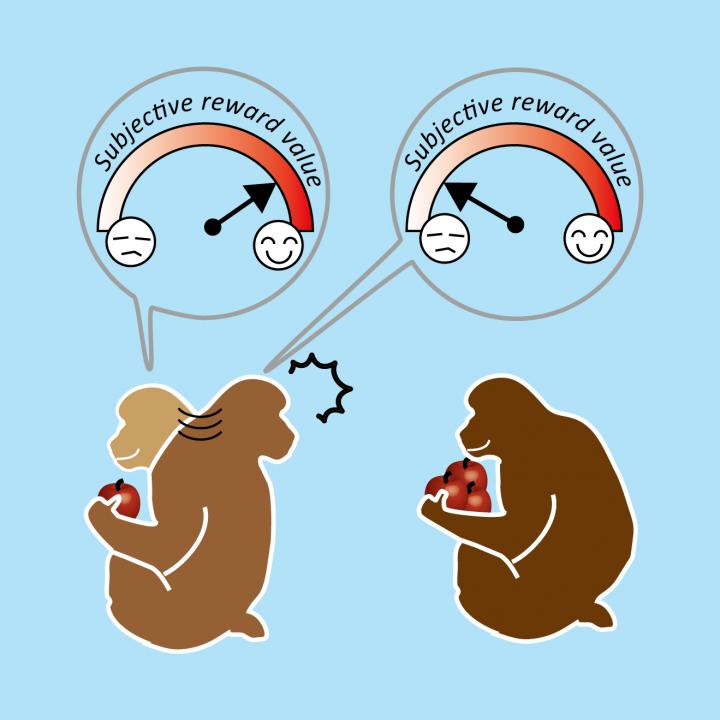
Researchers at the National Institutes of Natural Sciences in Okazaki, Japan find brain cells that are responsible for socially based changes in what monkeys want
IMAGE

Credit: Atsushi Noritake


Aichi, Japan — How much we value an item is often related to what other people have. You might want the newest fashion, but not once everybody has it. Or, winning a free lunch at your favorite restaurant might not seem as great if the other person won a million dollars. Now, researchers in Japan have discovered a region of the brain that controls these kinds of behaviors in monkeys.

In their study published in Proceedings of the National Academy of Sciences, USA, a team of researchers from the National Institutes of Natural Sciences in Okazaki, Japan show that when monkeys think other monkeys will be rewarded, their own rewards become less appealing. This was evident in the amount that monkeys licked their lips while waiting for their reward. The team found that licking increased the more monkeys anticipated receiving a reward and decreased as they anticipated the other monkey would receive it instead.

This behavior was reflected in the brain. As first author Atsushi Noritake explains, “We found a clear link between brain activity in the lateral hypothalamus and the licking behavior that represented subjective value of the reward.” The team recorded activity from neurons as monkeys saw pictures that indicated the chance that they or another monkey would receive a reward. The scientists found that for some cells, firing rates increased with the probability of receiving the reward and decreased with the probability that the other monkey would get the reward.

A second experiment showed that the same brain region was necessary for the social observations to affect how much the monkeys valued the reward. When the scientists temporarily shut down the lateral hypothalamus using an inhibitory drug, the monkeys’ licking behavior was unchanged when they anticipated receiving the reward themselves–it still increased with the chance of reward. However, the amount of licking was now unrelated to the chance of reward when they were cued that the other monkey was likely to get it.

This behavior was similar to what happened when the other monkey was prevented from getting the reward or when it was absent altogether.

“Without a functioning lateral hypothalamus, it was as if the monkeys no longer processed what they were seeing as a social situation,” says team leader Masaki Isoda. “Thus, we believe that the lateral hypothalamus is necessary for shaping socially motivated behavior, perhaps in coordination with other brain areas such as the medial prefrontal cortex.”

###

Media Contact
Masaki Isoda
[email protected]
81-564-557-761

Related Journal Article

http://dx.doi.org/10.1073/pnas.1917156117

Tags: BiologyMemory/Cognitive ProcessesneurobiologyPerception/AwarenessSocial/Behavioral Science
Share12Tweet8Share2ShareShareShare2

Related Posts

Cleaner Air Slows Kidney Disease Progression in Half-Million-Patient Taiwan Study

September 22, 2026

New Diffusion Model Blends Local and Global Views to Generate Better Molecules

September 22, 2026

ICU Care for Acute Leukemia Is No Longer a Death Sentence, Landmark Analysis Shows

September 22, 2026

Two Lungs, Two Diseases: Rare Case Shows Bilateral Chest Fluid Can Hide Different Causes

September 22, 2026
Please login to join discussion

POPULAR NEWS

  • Decades-Old Newborn Blood Spots Yield High-Quality DNA Methylation Data With Tiny DNA Inputs

    29 shares
    Share 12 Tweet 7
  • Discover Informatics Launches as Fully Open Access Home for Cross-Disciplinary Data Science

    29 shares
    Share 12 Tweet 7
  • Tiny Cell Structures Called Migrasomes May Predict Gastric Cancer Outcomes

    29 shares
    Share 12 Tweet 7
  • Cleaner Air Slows Kidney Disease Progression in Half-Million-Patient Taiwan Study

    29 shares
    Share 12 Tweet 7

About

We bring you the latest biotechnology news from best research centers and universities around the world. Check our website.

Follow us

Recent News

Decades-Old Newborn Blood Spots Yield High-Quality DNA Methylation Data With Tiny DNA Inputs

Discover Informatics Launches as Fully Open Access Home for Cross-Disciplinary Data Science

Tiny Cell Structures Called Migrasomes May Predict Gastric Cancer Outcomes

Subscribe to Blog via Email

Enter your email address to subscribe to this blog and receive notifications of new posts by email.

Join 85 other subscribers
  • Contact Us

Bioengineer.org © Copyright 2023 All Rights Reserved.

Welcome Back!

Login to your account below

Forgotten Password?

Retrieve your password

Please enter your username or email address to reset your password.

Log In
No Result
View All Result
  • Homepages
    • Home Page 1
    • Home Page 2
  • News
  • National
  • Business
  • Health
  • Lifestyle
  • Science

Bioengineer.org © Copyright 2023 All Rights Reserved.