


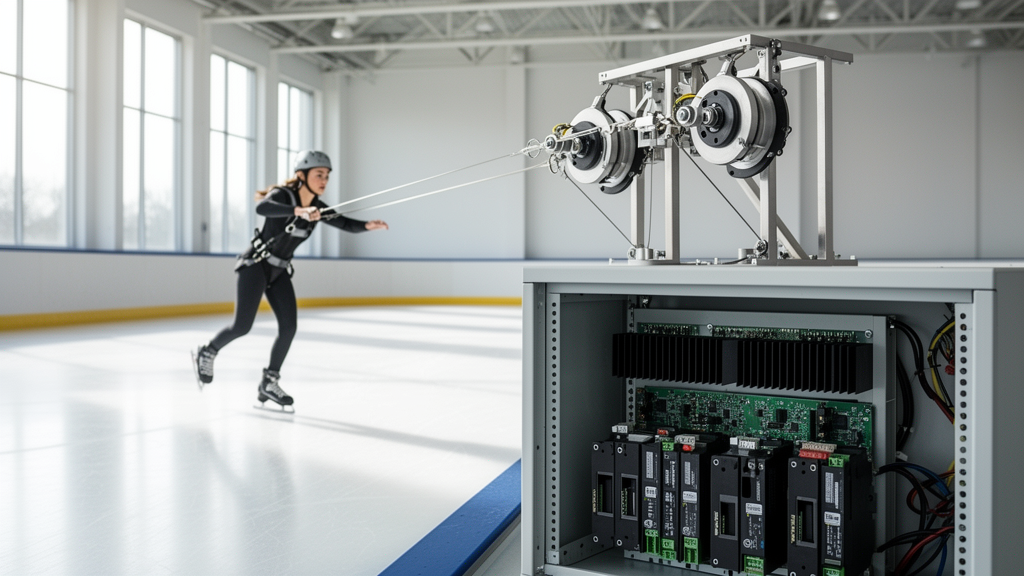
A new control strategy for the servo drives of a cable-based skating-training robot promises to keep joints on target while dramatically reducing the wear-inducing mode changes that electric motors must perform. The work, presented as a preprint under review for the journal Mechanical Sciences, addresses a subtle but persistent problem in robots that guide a speed skater’s legs with motor-driven cables: the controllers that correct motion errors tend to switch between operating modes far more often than necessary.
Whether such a training robot reproduces the prescribed motion depends on whether its servo layer can follow the motor-angle reference amplified by the screw transmission and the cable geometry. Switching active disturbance rejection control improves large-error response by switching between linear and nonlinear corrections, but the authors note that the switching frequency and the tracking accuracy lack a quantitative relation, and that the hysteresis width has traditionally been selected without a stated rule.
The research team, led by Heyu Shi and corresponding author Baihang Wang of Udon Thani Rajabhat University in Thailand, together with Xue Zhao, Tong Tong and Dandan Han, first built an integrated model of the whole drive chain. This model runs from the cable geometry and screw transmission through to the permanent-magnet synchronous motor, and it yields the torque, speed and voltage margins of each drive. That modelled chain then forms the testbed for the controller design.
The core innovation is a state-preserving hysteretic implementation of switching active disturbance rejection control. Two normalized switching variables act separately on the observer and on the feedback corrections, and a hysteresis band is added around the switching threshold. The effect is that the controller changes mode only when the error genuinely warrants it, and it keeps its disturbance estimate intact across the switch rather than discarding it.
To evaluate the design, the authors compared six controller families at fixed gains with equal tuning effort across 154 test cases. The results are striking. In a 30 rad step test, the overshoot falls from 52.171 percent to 0.311 percent, meaning the joints essentially no longer shoot past the target. In the load interval, the maximum error drops from 0.101 rad to 0.0447 rad, roughly halving the worst-case tracking error.
Perhaps most significant for hardware longevity is the reduction in switching activity. The number of mode actions falls from 46 to 18 at a hysteresis width of 0.2, a reduction of about sixty percent, and this is achieved without sacrificing tracking quality.
With the switching frequency treated as a design variable rather than an emergent nuisance, the servo layer can set the switching count to its target while preserving tracking quality. The authors describe this as a reusable, parameterized method for the servo design of comparable cable robots, suggesting the approach could transfer beyond skating trainers to other cable-driven systems with similar drive architectures.
Nevertheless, the quantitative framing of the problem is itself a contribution: by measuring how often the controller switches, and tying that count to a stated hysteresis rule, the work turns a previously unexamined source of drive wear into a parameter that engineers can deliberately choose.
A hysteresis band, applied carefully to the observer and feedback paths separately, appears to buy both accuracy and restraint at the same time.
Subject of Research: Hysteretic switching active disturbance rejection control for the servo drives of a skating-training cable robot
Article Title: Hysteretic switching active disturbance rejection control for the servo drives of a skating-training cable robot
Article References: Shi, H., Wang, B., Zhao, X., Tong, T., & Han, D. (2026). Hysteretic switching active disturbance rejection control for the servo drives of a skating-training cable robot. https://doi.org/10.5194/ms-2026-193
Image Credits: AI Generated
DOI: 10.5194/ms-2026-193
Keywords: cable robot, servo drives, active disturbance rejection control, hysteresis, switching frequency, permanent-magnet synchronous motor, speed skating training, control engineering, drive wear, tracking accuracy, preprint, Mechanical Sciences
News Source: Denise Maddox. (October 29, 2026). Hysteretic controller cuts switching wear in skating-training cable robot drives. Scienmag.



