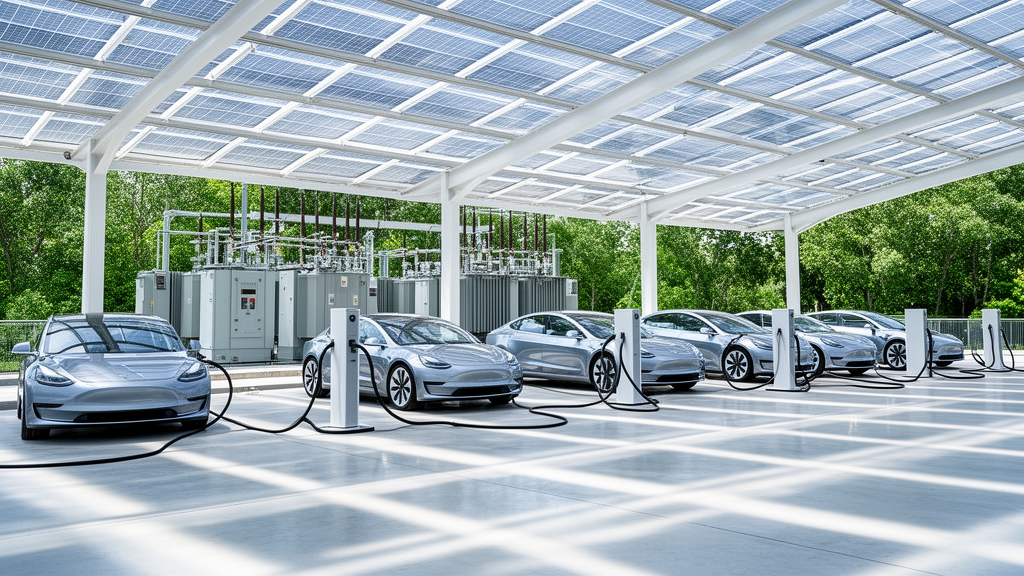
A simulation study demonstrates that a hybrid electric vehicle charging station integrating solar photovoltaic power and utility grid electricity achieves improved power flow optimization and charging efficiency through a specialized hypergraph-based control algorithm. Researchers evaluated a three-phase grid-integrated charging infrastructure designed to ensure smooth power delivery across multiple operating conditions. Computational simulation results confirmed that the proposed control strategy significantly enhances the system’s operational performance, energy flow management, and overall charging efficiency during vehicle charging and power feedback cycles.
The investigation addresses the rapid adoption of electric vehicles and solar photovoltaic systems across the global energy and transportation sectors. To sustain this ongoing growth, establishing reliable and efficient electric vehicle charging infrastructure has become essential. Systems based on solar photovoltaic charging are gaining increasing attention within the engineering community due to their low operational maintenance requirements and their ability to improve the overall performance of the photovoltaic modules themselves.
To meet these infrastructure needs, the study focuses on developing a hybrid charging station that integrates both solar photovoltaic generation and utility grid power sources. An efficient Maximum Power Point Tracking technique is utilized within the system design to extract the maximum possible electrical energy from the solar photovoltaic array.
A primary objective of the research is ensuring smooth and dependable power delivery across two distinct operational regimes: grid-to-vehicle and vehicle-to-grid modes.
To regulate the station’s grid-linked inverter, the researchers developed and applied a novel control framework termed the Spider Wasp Optimizer–Multi-scale Hypergraph-based Feature Alignment Network. Simulation results demonstrated that this proposed control strategy effectively coordinates the grid-linked inverter, optimizes power flow, and enhances overall charging performance. The authors conclude that the developed three-phase grid-integrated electric vehicle charging system provides a practical, simple, and accurate solution for sustainable charging operations.
Subject of Research: Grid-integrated solar electric vehicle charging control
Article Title: Application of hypergraph-based grid integrated solar power hybrid electric vehicle charging in G2V and V2G modes of operation
Article References: Das, S. R., Patro, K. A. K., Sahoo, B. M., Dhaka, A., & Malsaria, A. (2026). Application of hypergraph-based grid integrated solar power hybrid electric vehicle charging in G2V and V2G modes of operation. Discover Applied Sciences. https://doi.org/10.1007/s42452-026-09743-2
Image Credits: AI Generated
DOI: 10.1007/s42452-026-09743-2
Keywords: electric vehicles, solar photovoltaics, hybrid charging station, grid-to-vehicle, vehicle-to-grid, grid-linked inverter, maximum power point tracking, power flow optimization, charging efficiency, three-phase charging system, Spider Wasp Optimizer, hypergraph network, feature alignment network, sustainable transportation, renewable energy integration, power electronics control, photovoltaic performance
News Source: Denise Maddox. (November 13, 2026). Hypergraph Network Optimizes Solar Electric Vehicle Charging in Grid Simulation Study. Scienmag.