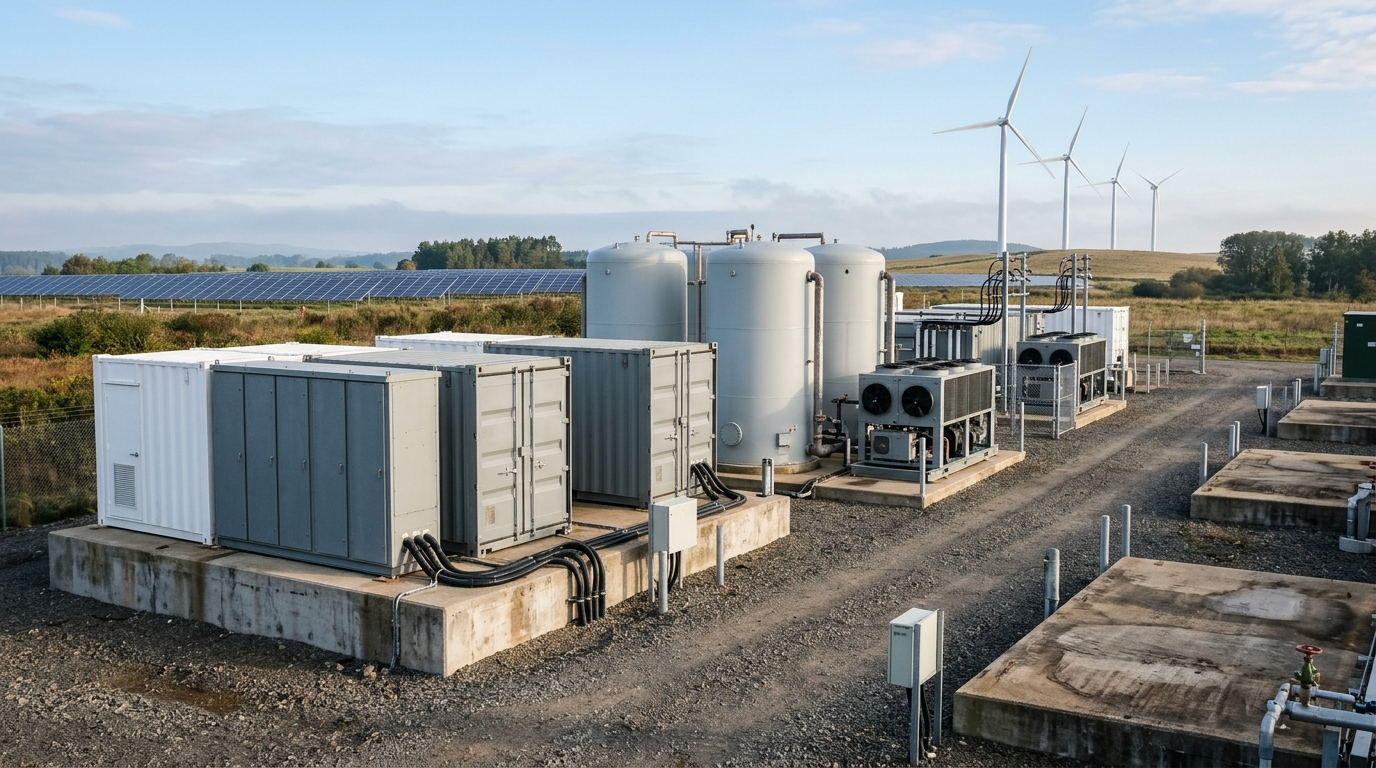
Integrating distributed wind generation, combined heat and power units, and hydrogen production systems into multi-energy microgrids presents persistent operational challenges due to the compound stochasticity of renewable generation and multi-carrier load demands. In a research study published in Frontiers in Energy Research, an engineering research team based in Guangzhou, China, introduced an optimal energy storage configuration framework that uses hybrid multi-stage robust optimization to reconcile investment expenditure with power supply reliability. Testing on a grid-connected electricity, heat, and hydrogen microgrid demonstrated that sizing battery energy storage under this dual-layer uncertainty model eliminated an average daily loss of load of 85.6 kilowatt-hours observed in a baseline configuration lacking battery storage, while decreasing out-of-sample expected total operating costs by 6.7 percent and lowering worst-case daily operational expenses by 11.3 percent.
Microgrids coordinating electricity, thermal networks, and hydrogen streams serve as vital structural carriers for accommodating high penetrations of volatile renewable power. Within these integrated networks, combined heat and power units generate electricity and heat simultaneously, gas boilers provide supplemental thermal output, and electrolyzers convert off-peak electricity into hydrogen that is stored in pressurized tanks and subsequently dispatched through fuel cells. Although battery energy storage systems offer essential rapid balancing capability to smooth fluctuations and execute peak shaving and valley filling, high initial capital costs mean oversized installations risk stranded assets, while undersized capacities expose local networks to severe power deficits. Conventional sizing frameworks typically rely on standard stochastic programming, which assumes a precisely known probability distribution, or standard robust optimization, which hedges strictly against worst-case realization boundaries without regard to likelihood, often leading to excessively conservative and economically burdensome infrastructure investments.
To overcome these limitations, the researchers formulated a min–max–max–min hybrid multi-stage stochastic-robust planning architecture structured across four mathematical layers and three distinct operational stages. In the first stage, the capacity configuration decisions, encompassing both the rated energy capacity and rated power of the battery storage, alongside day-ahead binary operating status variables, are fixed before any operational uncertainty is revealed, thereby strictly respecting nonanticipativity conditions across all operating scenarios. The second and third layers explicitly separate the distinct facets of real-world operational volatility: an outer maximization identifies the worst-case scenario probability distribution across a comprehensive-norm ambiguity set, while an inner maximization isolates the most adverse intra-scenario continuous source and load deviations within a budgeted box uncertainty set. The final innermost minimization level establishes the optimal re-dispatch recourse actions across grid power exchanges, storage charge and discharge schedules, combined heat and power output adjustments, boiler dispatches, and hydrogen cycling.
The uncertainty representation establishes mathematical tractability by pairing a comprehensive-norm ambiguity set for scenario probabilities with budgeted fluctuation intervals for physical generation and demand. The probability ambiguity set combines one-norm and infinity-norm constraints bounded by formal confidence parameters, constraining the degree to which operational scenario probabilities can deviate from historical baseline distributions. Concurrently, intra-scenario source and load volatility is bounded through deviation coefficients centered on forecasted values, where uncertainty budgets restrict the aggregate number of periods in a single daily scheduling cycle that can simultaneously hit extreme deviation boundaries. This formulation allows system operators to adjust conservativeness flexibly along two distinct analytical dimensions, tuning the parameter budgets in response to historical forecast accuracy and statistical confidence in available scenario data.
Solving the resulting multi-level optimization problem directly is computationally intractable due to the bilevel intra-scenario subproblem and non-convex bilinear interactions. The investigators resolved this complexity by implementing a column-and-constraint generation solution algorithm coupled with Karush–Kuhn–Tucker optimality reformulations. The intra-scenario max–min bilevel problem, being continuous and linear at the lower level for given upper-level decisions, was converted into an equivalent single-level mixed-integer linear programming problem by deriving stationarity conditions, dual feasibility constraints, and complementary slackness conditions linearized using big-M bounding parameters derived from physical asset operating envelopes. This structural conversion allowed the iterative decomposition of the master planning problem and two auxiliary subproblems, where the scenario probability subproblem is solved rapidly as a small-scale linear program and generates dynamically violated cuts that update lower and upper bounds until convergence.
The methodology was verified through extensive numerical case studies conducted on a simulated grid-connected multi-energy microgrid modeled on high-performance computing hardware using MATLAB and the Gurobi mixed-integer solver. The physical setup evaluated an energy storage unit featuring capital investment parameters of 1,100 Chinese Yuan per kilowatt-hour of storage capacity and 370 Chinese Yuan per kilowatt of inverter power, alongside an operational lifetime of ten years and a five percent discount rate. Under three base operating scenarios, the column-and-constraint generation algorithm converged rapidly within three iterative cycles, requiring approximately fifteen seconds of total computational runtime. Across convergence, the master problem identified an optimal battery storage capacity of 5,094.82 kilowatt-hours paired with a rated power of 1,273.71 kilowatts, resulting in an annualized equivalent daily capital investment of 2,155.66 Chinese Yuan and a worst-case total operating and investment expense of 29,140.15 Chinese Yuan.
Detailed operational dispatch profiles during the most adverse operating conditions illustrated the active thermodynamic and electrical coordination among the microgrid components. During off-peak periods when main grid power prices dropped to 0.35 Chinese Yuan per kilowatt-hour, the system purchased low-cost energy to recharge the battery to its upper ninety percent state-of-charge ceiling and powered the electrolyzer to replenish the hydrogen storage tank. When retail electricity tariffs peaked at 1.80 Chinese Yuan per kilowatt-hour, the battery discharged at its full rated output to displace costly grid imports, while the fuel cell consumed hydrogen to export power. Concurrently, the combined heat and power unit operated under a heat-led profile, teaming with the auxiliary gas boiler to fulfill thermal demand peaks. Over intraday cycles, the hydrogen storage inventory cycled between 68 and 117 kilograms, returning reliably to its baseline 80-kilogram level to prevent cross-day energy drift.
To evaluate performance beyond deterministic assumptions, the investigators conducted rigorous out-of-sample stress testing using 900 daily stochastic source-load realizations per seed, incorporating correlated daily variations and independent hourly noise with forecast uncertainty amplitudes reaching thirty percent for wind generation and twenty percent for electrical and thermal loads. In the storage-free benchmark configuration, grid transmission constraints and operational limits on thermal units resulted in severe power shortages, yielding an average daily unserved energy volume of 85.6 kilowatt-hours, peak daily unserved energy reaching 532.0 kilowatt-hours, and an expected total cost of 23,760 Chinese Yuan. Installing the battery capacity derived from the hybrid robust model completely eradicated unserved energy, dropping loss of load to zero across all sampled evaluation days and cutting expected total expenditures to 22,164 Chinese Yuan.
Comparative evaluations against standard stochastic programming, distributionally robust optimization, and two-stage robust optimization highlighted the distinctive economic and operational tradeoffs of the hybrid model. Under nominal baseline evaluations, stochastic programming and distributionally robust methods configured a smaller battery capacity of 4,000 kilowatt-hours, yielding an out-of-sample expected cost of 22,151 Chinese Yuan but incurring a worst-case daily cost of 30,607 Chinese Yuan. In contrast, the proposed method configured 5,095 kilowatt-hours, keeping expected costs essentially level at 22,164 Chinese Yuan while reducing the worst-case daily cost to 30,078 Chinese Yuan, representing an operational cost saving of 529 Chinese Yuan. Sensitivity evaluations under distribution-shift scenarios where adverse conditions occurred more frequently showed that stochastic programming suffered substantial reliability degradation, incurring 18.11 kilowatt-hours per day of unserved energy, whereas the proposed method maintained zero unserved energy and achieved the lowest worst-day cost among all fully reliable models.
Statistical stability was confirmed through repeated testing across fifteen independent random evaluation seeds, confirming that the observed robustness margins were not artifacts of idiosyncratic random sampling draws. Future investigations are planned to incorporate progressive battery aging dynamics, multi-interval price uncertainty, and coordinated energy storage resource sharing across interconnected multi-microgrid networks.
Subject of Research: Energy storage capacity optimization for multi-energy microgrids under dual uncertainty
Article Title: Optimal energy storage configuration for multi-energy microgrids based on hybrid multi-stage robust optimization
Article References: Zhou, S., Zheng, M., Yu, H., Huang, X., Liang, K., Su, X., & Qiao, X. (2026). Optimal energy storage configuration for multi-energy microgrids based on hybrid multi-stage robust optimization. Frontiers in Energy Research, 14, Article 1946552. https://doi.org/10.3389/fenrg.2026.1946552
Image Credits: AI Generated
DOI: 10.3389/fenrg.2026.1946552
Keywords: multi-energy microgrid, battery energy storage, robust optimization, hydrogen storage, renewable integration, uncertainty modeling, grid reliability, clean energy systems, Optimal, energy, storage, configuration
News Source: Faith Mcneil. (November 7, 2026). Hybrid Robust Optimization Balances Cost and Reliability in Multi-Energy Microgrid Storage. Scienmag.