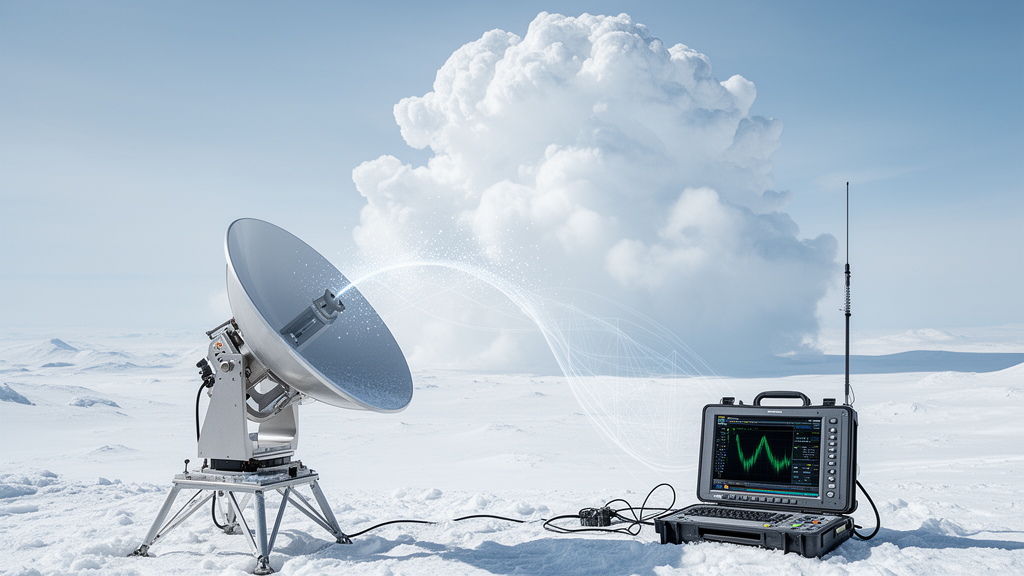
A hybrid Bayesian algorithm designed for upcoming submillimeter-wave satellite radiometers can reproduce observed brightness temperatures more closely than a conventional database-only method, according to a study using simulated observations and airborne measurements over the United States. The approach combines Bayesian Monte Carlo Integration, or BMCI, with an Optimal Estimation Method when the retrieval database contains too few brightness-temperature cases resembling an observation. Tests with the planned C2OMODO radiometer and with the CoSSIR instrument aboard NASA’s ER-2 aircraft showed that the hybrid method reduced brightness-temperature discrepancies and modestly improved retrievals of ice water content, particle size, ice water path and column-averaged mean mass diameter.
The algorithm was developed in support of NASA’s Polarized Submillimeter Ice-cloud Radiometer, or PolSIR, and the NASA–Japan Aerospace Exploration Agency Precipitation Measuring Mission. Submillimeter wavelengths occupy a particularly sensitive region for measuring ice clouds. Their frequencies interact strongly with ice particles, including scattering by particles whose dimensions are comparable to the observing wavelength, while penetrating more deeply than visible or infrared radiation.
The authors describe this combination as important for bridging gaps in cloud and precipitation remote sensing. Previous validation has involved instruments including CoSSIR and the International Submillimetre Airborne Radiometer, while spaceborne demonstrations include NASA’s IceCube, launched in 2017, and the European Space Agency’s Arctic Weather Satellite, launched in August 2024. PolSIR and the C2OMODO instrument planned for the Precipitation Measuring Mission represent further opportunities to observe ice clouds globally.
The central obstacle is that established database-driven retrieval methods depend on finding simulated atmospheric and cloud profiles whose brightness temperatures fall within measurement uncertainty of an observation. BMCI assigns Bayesian weights to matching database cases and integrates them to estimate cloud properties and uncertainty. It is computationally efficient and can accommodate a prior probability distribution that is not Gaussian, but it can fail when a multidimensional measurement space is sparsely represented.
Enlarging the database improves coverage but cannot eliminate this limitation. The hybrid method therefore uses BMCI for most cases and activates an optimal-estimation optimization when fewer than 25 sufficiently close cases are available. In the reported implementation, the assumed noise-equivalent differential temperature is first inflated in increments of two until the minimum number of matches is found; the resulting BMCI estimate then initializes the optimal-estimation search, which explores beyond the fixed database under broadly consistent prior constraints.
Applying the Optimal Estimation Method directly to ice-cloud variables would normally be difficult because the atmospheric and cloud parameters have strongly non-Gaussian distributions. The researchers address this with cumulative distribution functions and empirical orthogonal functions. Rank-based cumulative distribution functions transform the original variables into approximately Gaussian coordinates, while empirical orthogonal functions capture correlations between quantities and atmospheric levels and reduce the dimension of the optimization problem.
The optimal-estimation iteration begins with the BMCI solution, and a Levenberg–Marquardt procedure updates the state using numerically calculated sensitivities because the radiative transfer model has no analytical Jacobian. The resulting covariance is propagated back into physical variables, allowing uncertainty estimates for vertical profiles and column quantities. The approach therefore retains the nonparametric strengths of the database while adding a flexible optimization stage for poorly represented observations.
The mission-oriented retrieval database contains about 1.5 million atmospheric and cloud profiles assembled from CloudSat and CALIPSO products, with one orbit selected every three days from 2007 between 30 degrees south and 30 degrees north. Ice water content profiles come from the 2C-ICE product, which uses CloudSat radar and CALIPSO lidar observations; liquid water content profiles come from the radar-only 2B-CWC-RO product. The atmospheric and cloud profiles have a vertical resolution of 240 metres, while thermodynamic profiles and surface parameters are supplied separately by an auxiliary ECMWF dataset.
The forward model uses the ARTS radiative transfer solver and represents ice with five candidate particle habits: LargePlateAggregate, LargeBlockAggregate, LargeColumnAggregate, 6BulletRosette and EvansSnowAggregate. Liquid droplets are spherical, particle orientation is random, and the simulations currently include only the first Stokes component. Because both ice and liquid particle-size distributions use one-moment schemes, retrieved water contents can be mapped directly to characteristic particle sizes.
The same framework can be rebuilt for other regions, as the authors did for wintertime clouds around the East Coast of the United States. Ice water path was tracked closely down to roughly 30 grams per square metre, below which thin-cloud retrievals developed negative biases. Particle size was well constrained for mean mass diameters above approximately 400 micrometres but tended to be underestimated for smaller particles.
About 7% of test profiles triggered the optimal-estimation stage because BMCI could not find enough close database matches. Adding that stage reduced many chi-squared brightness-temperature mismatch values from above 100 to below 10 and produced moderate but consistent gains in ice water path and particle-size accuracy. These simulations used the same forward model and particle-habit assumptions to generate the observations and perform the retrievals, and all results assumed nadir viewing even though both target radiometers scan across track.
Diagnostics showed that the radiometer’s information is intrinsically limited. Averaging kernels indicated a median vertical resolution of roughly 2–3 kilometres for ice and liquid clouds and about 4 kilometres for water vapour. The effective number of independent pieces of information generally rose with ice water path and atmospheric moisture, reaching about 5–7 for appreciable ice clouds, but fell to 4–5 for the thickest clouds as information became saturated.
Shannon information analysis attributed approximately four additional bits to the 325 GHz channels when ice water path information from the 183 GHz channels was already present. The 89 GHz channel contributed relatively little to ice-water retrieval but supplied substantial information about liquid water and integrated water vapour, demonstrating the value of combining frequency bands rather than relying on a single spectral region. The information analysis also found that the 325 GHz channel closest to the water-vapour absorption line provided the largest incremental contribution among the 325 GHz channels.
The field evaluation used dual-polarized CoSSIR observations collected during the 2022–2023 phase of NASA’s IMPACTS campaign over winter storms along the East Coast. CoSSIR carried four subchannels near 183 GHz, three near 325 GHz and one at 684 GHz, while the W-, Ka- and Ku-band CRS and HIWRAP radars on the same aircraft provided collocated triple-frequency measurements used as a reference. In a representative scene on 15 January 2023, BMCI-only profiles overextended the observed cloud at its top and bottom and generated spurious ice in nearly clear air on either side.
The hybrid method assigned those clouds to more plausible altitudes, reduced their geometric thickness, improved the representation of the cloud core and closely reproduced most observed brightness temperatures after the optimisation stage. Radar simulations generally agreed with measured reflectivities within about 4 decibels, although some biases remained in very thick and melting-layer regions. A broader evaluation covering four deep cloud scenes confirmed that the choice of ice-particle habit strongly affected performance.
LargePlateAggregate, LargeBlockAggregate and 6BulletRosette produced the most consistent brightness-temperature agreement, while LargeColumnAggregate and EvansSnowAggregate generally left larger mismatches. Averaging the median absolute logarithmic differences for those three better-performing habits, the hybrid CoSSIR retrievals differed from triple-frequency radar estimates by 3.75 decibels for layer-resolved ice water content, 0.82 decibels for layer-resolved particle size, 2.53 decibels for ice water path and 0.55 decibels for mean mass diameter. Relative to BMCI alone, the respective reductions were 0.21, 0.02, 0.85 and 0.13 decibels.
These are moderate improvements rather than a transformation of retrieval accuracy: radiometer-derived layer values still varied by nearly an order of magnitude around radar estimates, reflecting the limited information in brightness-temperature observations and the continuing influence of the prior distribution. Several constraints remain before the algorithm can be applied routinely to the planned missions. The radiative transfer simulations use a pencil-beam approximation and do not yet account for instrument beam width, footprint size or beam-filling effects at large scanning angles, even though both PolSIR and C2OMODO scan away from nadir.
The model also assumes randomly oriented particles and omits the additional Stokes components needed for polarized observations; preferential horizontal alignment could therefore introduce errors even in the unpolarized component. Numerical Jacobian calculations add computational expense, and the authors identify faster methods as a subject of continuing work. The study nevertheless demonstrates that the hybrid Bayesian framework can be extended to different sensors: radar reflectivities replaced brightness temperatures in the measurement vector, allowing the same retrieval machinery to process triple-frequency radar data.
The authors say that multi-sensor combinations and eventually hyperspectral measurements could provide additional information for constraining cloud microphysical properties, while future instrument-level simulations and faster Jacobian methods remain necessary for operational applications.
Subject of Research: Hybrid Bayesian retrieval of ice-cloud microphysics from submillimeter-wave radiometers
Article Title: A hybrid ice hydrometeor retrieval algorithm for submillimeter-wave radiometers in support of the PolSIR and PMM missions
Article References: Liu, Y., Gong, J., Adams, I. S., Kroodsma, R. A., Chen, R., Wu, D. L., Bennartz, R., & Braun, S. A. (2026). A hybrid ice hydrometeor retrieval algorithm for submillimeter-wave radiometers in support of the PolSIR and PMM missions. Atmospheric Measurement Techniques, 19(20), 6661-6679. https://doi.org/10.5194/amt-19-6661-2026
Image Credits: AI Generated
Keywords: submillimeter radiometry, ice-cloud microphysics, Bayesian retrieval, brightness temperature, satellite missions, particle-size retrieval, PolSIR, Precipitation Measuring Mission, IMPACTS campaign, triple-frequency radar, hydrometeors, remote sensing
News Source: Denise Maddox. (October 22, 2026). Hybrid algorithm improves ice-cloud retrievals from submillimeter radiometers. Scienmag.