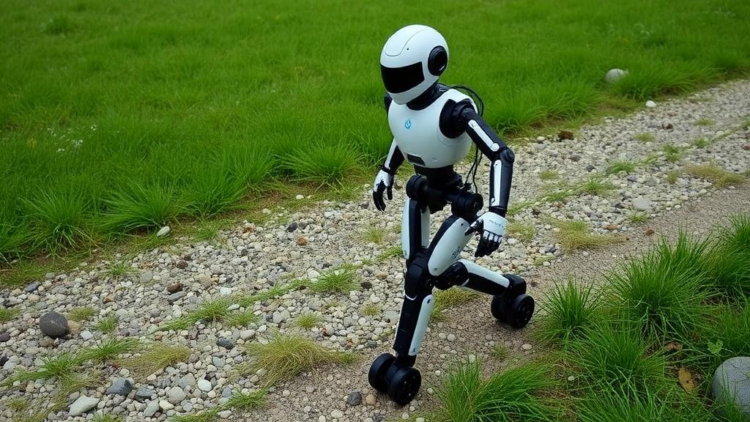
A humanoid robot has learned to walk across grass, wood chips and a steep fifteen-degree ramp without cameras, LiDAR, or any other external sensor — relying entirely on the same kind of body-awareness that lets you feel the slope of the ground beneath your feet. The achievement, published in the journal Autonomous Robots by Hongtao Zhang, Lan Wu and Thomas Bräunl of the University of Western Australia, demonstrates a fully proprioceptive control framework that lets the Unitree G1 humanoid adapt its gait to unseen terrain in real time, with no terrain-specific tuning by engineers.
The central insight of the work is deceptively simple: continuous terrain does not need to be seen to be handled. Most terrain-adaptive walking robots depend on depth cameras or laser scanners to build a map of the ground ahead, adding cost, computational burden and vulnerability to dust, glare and occlusion. The Australian team instead showed that the local geometry of the ground can be inferred purely from joint encoders and a body-mounted inertial measurement unit, and that every layer of the robot’s control stack can continuously reshape itself around this estimate.
The foundation is an extended Kalman filter that fuses IMU readings with leg kinematics to estimate the robot’s base motion. The key innovation lies in how each foot is modeled. Rather than the conventional single contact point per foot, the researchers assigned two — one at the toe and one at the heel — yielding four non-collinear contact estimates during double support. Those four points provide exactly the geometric redundancy needed to fit a local terrain plane through least-squares, from which the ground’s pitch and roll angles are extracted. A pseudo-measurement enforcing the known rigid geometry between toe and heel keeps the two points physically consistent; in ablation tests, removing this constraint caused foothold estimates to drift apart and base-position error to jump from under 1.5 percent to 4.2 percent of the traveled distance.
This terrain estimate then propagates through the entire control architecture, which follows the now-standard cascade of a nonlinear model predictive controller atop a whole-body controller. The NMPC, built on the OCS2 toolbox and running at 100 Hz, uses the estimated terrain normal in two ways: its horizontal components set the direction of posture and friction-cone references, tilting the robot’s base orientation to match the slope, while swing-foot touchdown heights are continuously adjusted to the estimated ground plane. The friction cone — the set of contact forces that will not cause the foot to slip — is rotated to align with the terrain normal rather than the world vertical, ensuring the planned forces remain physically achievable on an incline.
The most novel contribution is the feasibility-aware whole-body controller, or FAWBC, which solves a quadratic program at 500 Hz to convert the planned motion into joint torques. Conventional whole-body controllers use fixed cost weights that trade off trajectory tracking, contact-force tracking and torque minimisation — weights tuned offline for flat ground and left unchanged. On a slope, however, gravity forces the ground reaction force to develop a tangential component, pushing it toward the friction cone boundary and shrinking the optimizer’s freedom. The team formalized this with a feasibility margin: the fraction of the friction budget remaining after equilibrium is satisfied, equal to one minus the tangent of the slope angle divided by the friction coefficient. On flat ground the margin is 1.0; at ten degrees with a friction coefficient of 0.6 it falls to about 0.71.
The FAWBC modulates its weights according to three mathematically stated principles. First, as the margin shrinks, the force-tracking weight must rise and the base-tracking weight must fall, pulling the solution away from the cone boundary. Second, on flat ground the controller must degenerate exactly to the fixed-weight baseline, guaranteed by a zero-derivative condition that creates an implicit deadzone — small estimation noise near level ground produces only second-order weight perturbations, preventing oscillation. Third, the response must be asymmetric, because slipping is far more catastrophic than a transient tracking error, so the force weight moves faster than the tracking weight at every non-zero slope. Concretely, the force weight follows a power law with exponent 1.5 while the tracking weight follows a quadratic, and torque regularization is relaxed by up to ten percent to permit the larger joint torques needed against gravity on a slope.
The results are striking. In MuJoCo simulation on a path of flat ground, uneven terrain, flat ground and a ten-degree ramp, the fixed-weight baseline lost balance and fell within the first few steps on the incline, while the FAWBC traversed all four segments stably. On the ramp, the adaptive controller achieved a base trajectory error of just 0.032 meters versus 0.534 meters for the falling baseline, and its vertical contact-force tracking error dropped to 3.47 newtons. On flat segments the two controllers were virtually indistinguishable, confirming the deadzone design works as intended.
Real-world trials on the physical Unitree G1 pushed the demonstration further: stable walking on flat concrete, artificial grassland, a U-shaped path over wood-chip terrain, and a fifteen-degree ramp including a turn on the incline and a descent. On the wood chips, where each foot lands on a different facet, the estimated inclination swung between roughly five and ten degrees and the force weight repeatedly cycled between its nominal value of 10 and its saturated value of 60, tracking the chaotic surface in real time. On the ramp, the ankle torque peaked above 40 newton-meters during the ascent — the robot actively pushing against gravity — but dropped markedly on the descent, when gravity assists the motion. The knee, by contrast, mainly absorbed landing impacts, its torque spikes growing denser and larger as the ground grew rougher.
The team was equally candid about the limits. On a twenty-degree ramp the robot fell, and a careful failure analysis showed the sequence: friction utilization hit its limit first, the feet slipped, and only then did the divergent component of motion — the unstable part of the dynamics — escape the support region. Slippage, not loss of balance, is the binding failure mode, which validates the design choice of defending the friction cone above all else. More fundamentally, proprioceptive terrain sensing is inherently retrospective: the ground can only be felt after the feet touch it, so discontinuous obstacles like steps cannot be anticipated and remain out of reach. The authors suggest that adding exteroceptive sensing, or learning the platform-specific weight parameters from interaction data, are the natural next steps.
Even with those caveats, the work marks a meaningful milestone for humanoid robotics. By coupling estimation, planning and control through a single terrain representation and a principled feasibility margin, the framework shows that robust, terrain-adaptive bipedal locomotion is achievable without expensive perception hardware or per-terrain hand tuning — a practical path toward humanoids that can operate in the messy, unstructured world outside the laboratory.
Subject of Research: Proprioceptive, feasibility-aware whole-body control for terrain-adaptive humanoid locomotion
Article Title: Feasibility-aware whole-body control for terrain-adaptive humanoid locomotion
Article References: Zhang, H., Wu, L., & Bräunl, T. (2026). Feasibility-aware whole-body control for terrain-adaptive humanoid locomotion. Autonomous Robots, 50(4), Article 42. https://doi.org/10.1007/s10514-026-10263-6
Image Credits: AI Generated
DOI: 10.1007/s10514-026-10263-6
Keywords: humanoid robot, bipedal locomotion, proprioceptive sensing, whole-body control, model predictive control, terrain adaptation, friction cone, Kalman filtering, Unitree G1, robotics, state estimation, quadratic programming
Cite Scienmag News
APA
MLA
Chicago
Denise Maddox. (September 30, 2026). Humanoid Robot Walks Blind Across Grass, Gravel and Steep Ramps Using Only Its Own Senses. Scienmag. https://scienmag.com/humanoid-robot-walks-blind-across-grass-gravel-and-steep-ramps-using-only-its-own-senses/
Denise Maddox. “Humanoid Robot Walks Blind Across Grass, Gravel and Steep Ramps Using Only Its Own Senses.” Scienmag, 30 September 2026, https://scienmag.com/humanoid-robot-walks-blind-across-grass-gravel-and-steep-ramps-using-only-its-own-senses/. Accessed 30 September 2026.
Denise Maddox. “Humanoid Robot Walks Blind Across Grass, Gravel and Steep Ramps Using Only Its Own Senses.” Scienmag. September 30, 2026. https://scienmag.com/humanoid-robot-walks-blind-across-grass-gravel-and-steep-ramps-using-only-its-own-senses/
Copy citation
Download RIS
Tags: bipedal locomotionfriction conehumanoid robotKalman filteringmodel predictive controlproprioceptive sensingquadratic programmingroboticsstate estimationterrain adaptationUnitree G1whole-body control