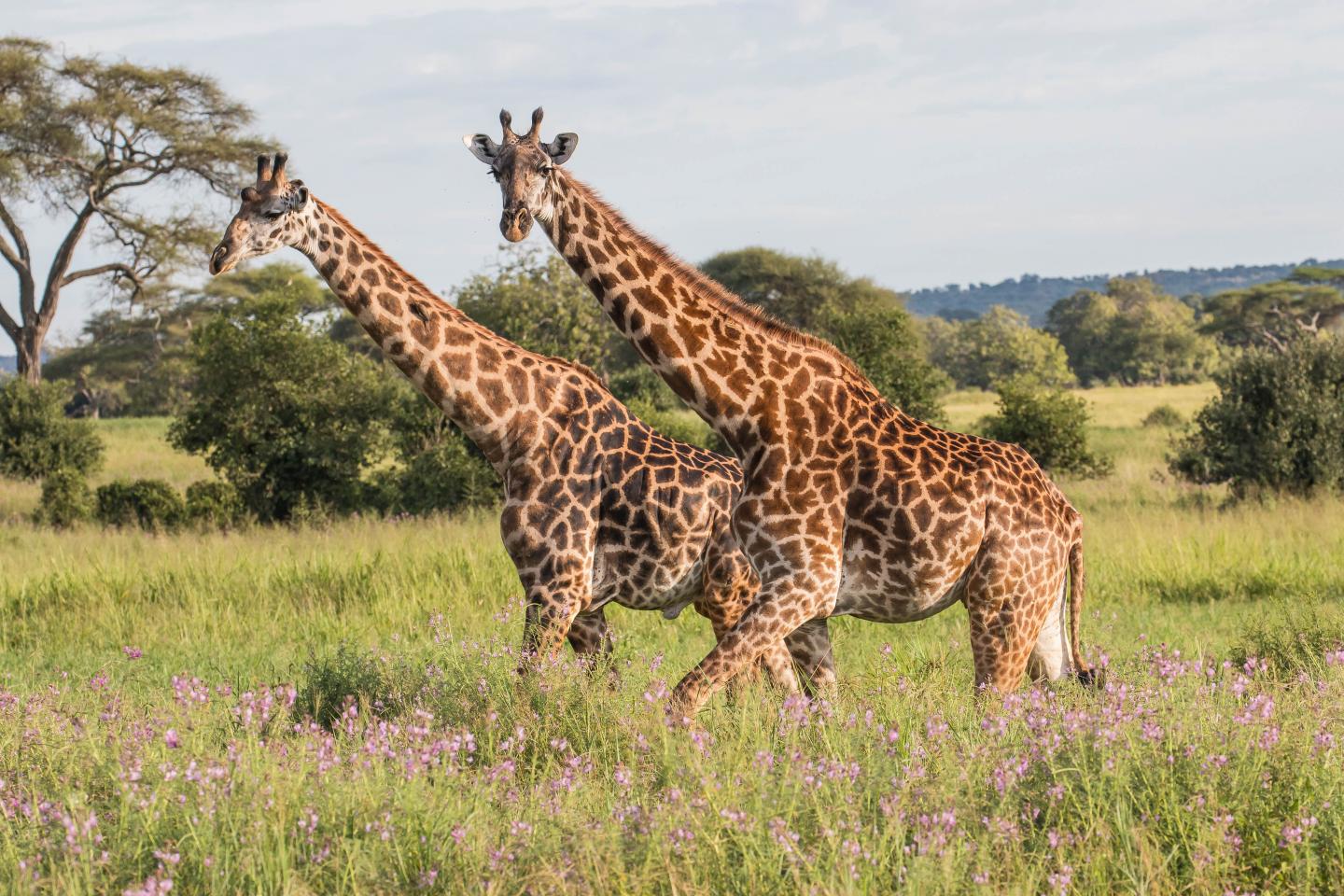
Credit: Gary Bembridge from London, UK [CC BY 2.0 (https://creativecommons.org/licenses/by/2.0)]
Giraffes that live close to densely populated towns have larger home ranges than giraffes that live far from towns, according to a new study by an international team of wildlife researchers from the University of Zürich, Penn State, and the Wild Nature Institute. This suggests that the giraffes in human-impacted areas need to travel longer distances–and expend more energy–to obtain critical resources. The researchers found that average rainfall also impacts giraffe home ranges, which are smaller in areas with more rain. The study was published February 22, 2019 in the journal Animal Behaviour.
“Giraffes are huge browsing animals that live in African savanna ecosystems where they must find everything they need to survive and reproduce in landscapes increasingly impacted by human activities,” said Derek E. Lee, associate research professor of biology at Penn State and principal scientist of the Wild Nature Institute. “People are converting natural savannas to towns and farms, and cutting trees for fuelwood and charcoal industries, all of which potentially degrade giraffe habitat.”
The team quantified home range sizes–the spatial area over which an animal repeatedly travels in search of food, water, shelter and mates–for 71 adult giraffes from data collected over six years in the spatially heterogeneous Tarangire Ecosystem of Tanzania. They examined correlations between individual home range sizes and environmental and anthropogenic–human related–factors, to better understand the mechanisms driving space use of this threatened megaherbivore.
Home range behavior is an expression of an animal’s decision-making process about how to access the resources needed for survival and reproduction. The researchers found that giraffes that lived closer to large human settlements had larger home-ranges. No such relationship was evident with bomas, which are homesteads built by indigenous livestock-keeping Maasai people, suggesting that giraffes are tolerant of more traditional, lower-impact land uses.
“Giraffes are vulnerable to extinction after a 40 percent population decline during the past three decades,” said Mara Knüsel, a graduate student at the University of Zurich and first author of the study. “Identifying factors affecting space use help wildlife conservationists to make better decisions for at-risk species such as giraffes.”
As one of the largest herbivores on earth, giraffes have a profound impact on plant populations, vegetation structure, and ecosystem processes where they live. Giraffes are also a favorite animal sought by ecotourists on safari in Tanzania, where the safari industry is the largest economic sector in the country.
“Most studies that previously looked at home ranges of giraffes didn’t look for environmental factors that determine the observed home range size, so this study goes beyond the pattern to reveal the process behind it,” said Monica Bond, PhD candidate at the University of Zürich and senior author of the study.
The research team also compared home range estimates from published data for eight giraffe populations across Africa and examined the relationship between giraffe home range size and mean annual rainfall as a potential explanation for observed variation in space use among populations. Rainfall was negatively correlated with home range size–giraffes in areas with less rainfall had larger home ranges.
“This relationship between rainfall and space use by a large herbivore is not surprising, given that rainfall is the main driver of vegetation productivity and thus food availability,” said Lee. “Greater availability and access to critical resources such as food and water leads to smaller home range sizes.”
“Human disturbance and fragmentation of habitat in and around densely populated areas likely reduced the local forage and water resources available for giraffes, forcing individuals to increase their movements and use of space to obtain these resources,” said Knüsel. “Similarly, lower rainfall and lower primary productivity forces individuals to range more widely.”
###
In addition to Lee, Knüsel, and Bond, the research team includes Barbara König at the University of Zurich. The research was funded by the University of Zurich Grant of the Forschungskredit, the Sacramento Zoo, the Columbus Zoo, the Tulsa Zoo, the Tierpark Berlin, the Cincinnati Zoo, the Parrotia Foundation, the Temperatio Foundation, the Promotor Foundation, the African Wildlife Foundation, and Save the Giraffes.
Media Contact
Sam Sholtis
[email protected]
Original Source
http://science.
Related Journal Article
http://dx.