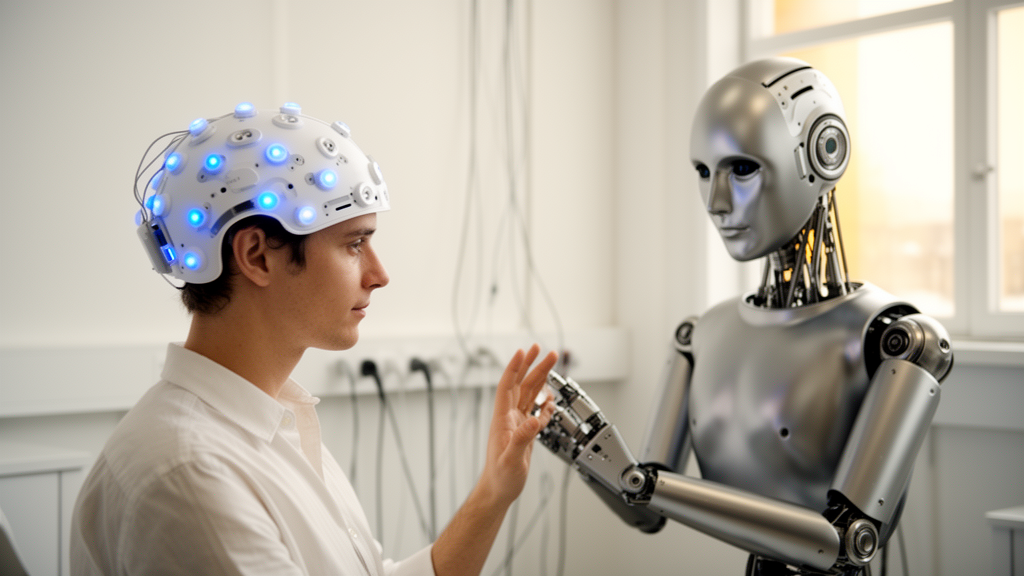
For more than a decade, neuroscientists and machine learning researchers have been quietly merging two of the most powerful data streams on Earth: the electrical and metabolic chatter of the living human brain, and the training pipelines of artificial intelligence. Experiments have shown that recordings from functional magnetic resonance imaging (fMRI), electroencephalography (EEG), and magnetoencephalography (MEG) can be used to sharpen AI models that see, hear, and speak. Now, a new perspective article published in Frontiers in Neurorobotics argues that the next frontier lies in a place where no scanner has fully gone before: the embodied, touch-driven world of humanoid robots.
The article, authored by Maël Donoso of Ouroboros Neurotechnologies in Lausanne, Switzerland, lays out a framework for what the author calls brain-trained humanoid robots. The core idea builds on the recently proposed concept of brain-trained foundation models, in which neuroimaging data serves as a direct training resource for AI systems rather than a mere source of inspiration. According to this framework, if B(t) represents the brain activity of a human subject over time and A(t) the observable actions of that subject, then neuroimaging data B*(t) can capture elements of brain activity that are not visible in behavior alone. In other words, the brain may contain information about cognition that actions never reveal, and machines could in principle learn from it.
Until now, however, nearly all brain-trained AI research has focused on cognitive processes that are relatively disembodied: vision, audition, language, and reward or error signals recorded while a human passively observes a machine. What has been almost entirely missing, Donoso argues, is the vast territory of embodiment-dependent neural signals, such as those tied to touch, motor control, and physical interaction with the world. The reason is practical. To make sense of neural activity generated by grasping a fragile object or navigating a crowded room, an AI system needs a body that can do roughly the same things. Humanoid robots, though far from equivalent to humans, may now be approaching the level of sensorimotor capability where this becomes possible.
The timing is not coincidental. Robotic arms can now solve Rubik’s cubes and perform fine bimanual manipulations, quadrupedal robots have mastered agile locomotion, and bipedal humanoids can navigate diverse outdoor terrain and even learn sports skills through deep reinforcement learning. Foundation models have added semantic and sensorimotor reasoning on top of these physical abilities, with vision-language-action models combining linguistic knowledge with robotic control. Crucially, researchers have also developed methods for crossing the so-called embodiment gap, transferring skills learned from human demonstrations to robots with entirely different bodies, using both visual and tactile data. If behaviors can cross that gap, the article hypothesizes, perhaps the neural signals underlying those behaviors can cross it too, provided they encode sufficiently high-level representations rather than the low-level singularities of the human body.
The article proposes two computational strategies for putting brain data to work in humanoid robotics. The first, called pattern decoding, aligns the internal representations of an AI model with high-dimensional neural patterns from the human brain. This approach has worked well in vision and audition, where deep networks already show representational similarity to the visual and auditory cortex. The second, called cognitive and computational inference, extracts low-dimensional signals such as reward, error, uncertainty, or surprise, and uses them to modulate reinforcement learning. This is the approach that has dominated brain-trained robotics so far, with EEG-based reward signals successfully guiding robot learning since pioneering work in 2010.
To make the idea concrete, the article presents two worked examples. In the first, a humanoid robot learning complex manipulations, such as handling fragile or deformable objects, could be trained on human demonstrations weighted by neural uncertainty signals. The policy optimization objective would include a term derived from brain activity, mapped through a sigmoid function, that down-weights examples when the human demonstrator was uncertain. Neuroscience offers plausible sources for such signals: the somatosensory cortex can encode uncertainty in sensory processing, motor cortex activity varies with the degree of certainty even when actions are identical, and uncertainty-related patterns have been found in the posterior parietal cortex and cerebellum. In the second example, a robot learning spatial navigation could be guided by neural surprise signals, up-weighting training examples when the human demonstrator was surprised by an outcome, since surprising scenarios are rarer and more informative. The hippocampus and the hippocampal-entorhinal system, which show novelty-related activity during navigation, could provide the raw material.
From these examples, the article expands to a broader map of six humanoid robot functions that could benefit from embodiment-dependent neural signals, ordered by increasing abstraction. Sensorimotor tasks would draw on the somatosensory cortex, motor cortex, posterior parietal cortex, and cerebellum. Spatial navigation would target the hippocampus and entorhinal cortex. Sensorimotor integration, the ability to maintain a functional body schema, would involve the posterior parietal cortex, premotor cortex, and supplementary motor area, with a newly developed motion-compatible PET prototype that can record the brains of walking humans hinting at future possibilities. Embodied alignment would tap valuation networks in the ventral striatum, ventromedial prefrontal cortex, orbitofrontal cortex, and insula to help robots follow human values and preferences in open-ended contexts. Embodied reasoning would engage the dorsolateral prefrontal cortex, anterior cingulate cortex, and frontopolar cortex to improve step-by-step planning under real-world constraints. Finally, social integration would draw on the temporo-parietal junction, medial prefrontal cortex, and superior temporal sulcus to align robots with human social representations.
The practical challenges are substantial. Neuroimaging data is noisy, highly variable across individuals, and only an approximation of true brain activity, and the correspondence between neural signals and cognitive functions must be inferred with care. Portable techniques such as EEG and functional near-infrared spectroscopy would likely be preferred for real-world recording, while fMRI and MEG combined with virtual reality could serve controlled experiments. Invasive techniques, including intracortical arrays and intracranial EEG, offer far higher resolution and signal quality, and have already been used to control robotic arms, deliver tactile sensations, and study navigation-related neural activity, but their restriction to clinical settings limits scalability. The article suggests that invasive recordings might complement non-invasive methods for optimizing a small set of widely shared behaviors, while non-invasive modalities cover the broader diversity of human action. The scarcity of neuroimaging datasets on touch, compared with the abundance available for vision, remains another obstacle, though pre-trained models that generate synthetic neuroimaging data could help fill the gap.
Beyond engineering, the article raises a distinctive ethical concern: excessive anthropomorphism. If robots are trained on human brain data, they may appear more human than they actually are, creating a mismatch between human expectations and the real capabilities of the machines. The author proposes a guiding principle: neural signals should be incorporated only when they improve robot function without undermining transparency about their robotic nature. The stakes are high, but so is the potential payoff. Brain-trained humanoid robots could serve as embodied computational models of human cognition, offering neuroscientists a new experimental platform for testing hypotheses about sensorimotor processing, one of the least understood systems in the brain. In the long term, successful pattern decoding might even allow robots to generate synthetic neuroimaging data at scale. And in a nod to Isaac Asimov’s fictional positronic brains, the article closes with the suggestion that narrowing the distance between humanoid robotics and human neuroscience may one day reveal whether robots themselves dream of electric brains.
Subject of Research: Using human neuroimaging data, especially embodiment-dependent signals like touch, to train humanoid robots
Article Title: Toward brain-trained humanoid robots
Article References: Donoso, M. (2026). Toward brain-trained humanoid robots. Frontiers in Neurorobotics, 20, Article 1903423. https://doi.org/10.3389/fnbot.2026.1903423
Image Credits: AI Generated
DOI: 10.3389/fnbot.2026.1903423
Keywords: brain-trained AI, humanoid robots, neuroimaging, EEG, fMRI, reinforcement learning, embodiment, tactile perception, spatial navigation, alignment, human-robot interaction, Frontiers in Neurorobotics
News Source: Cassandra Pierce. (October 17, 2026). Human Brain Signals Could Train the Next Generation of Humanoid Robots. Scienmag.