• HOME
  • NEWS
  • EXPLORE
    • CAREER
      • Companies
      • Jobs
    • EVENTS
    • iGEM
      • News
      • Team
    • PHOTOS
    • VIDEO
    • WIKI
  • BLOG
  • COMMUNITY
    • FACEBOOK
    • INSTAGRAM
    • TWITTER
Wednesday, April 1, 2026
BIOENGINEER.ORG
No Result
View All Result
  • Login
  • HOME
  • NEWS
  • EXPLORE
    • CAREER
      • Companies
      • Jobs
        • Lecturer
        • PhD Studentship
        • Postdoc
        • Research Assistant
    • EVENTS
    • iGEM
      • News
      • Team
    • PHOTOS
    • VIDEO
    • WIKI
  • BLOG
  • COMMUNITY
    • FACEBOOK
    • INSTAGRAM
    • TWITTER
  • HOME
  • NEWS
  • EXPLORE
    • CAREER
      • Companies
      • Jobs
        • Lecturer
        • PhD Studentship
        • Postdoc
        • Research Assistant
    • EVENTS
    • iGEM
      • News
      • Team
    • PHOTOS
    • VIDEO
    • WIKI
  • BLOG
  • COMMUNITY
    • FACEBOOK
    • INSTAGRAM
    • TWITTER
No Result
View All Result
Bioengineer.org
No Result
View All Result
Home NEWS Science News Health

Huge bacteria-eating viruses found in DNA from gut of pregnant women and Tibetan hot spring

Bioengineer by Bioengineer
February 13, 2020
in Health
Reading Time: 3 mins read
0
IMAGE
Share on FacebookShare on TwitterShare on LinkedinShare on RedditShare on Telegram

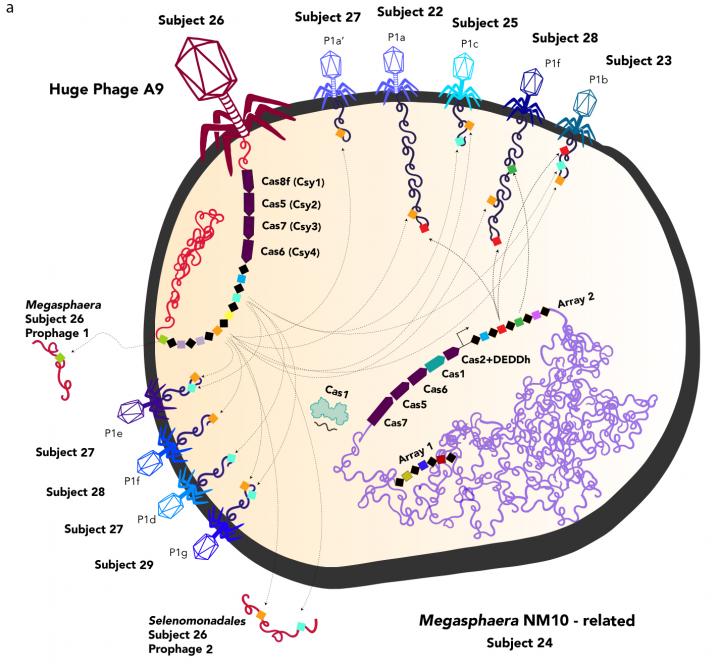
Bacteria-eating viruses provide new insight into warfare between phages and bacteria
IMAGE

Credit: UC Berkeley image courtesy of Jill Banfield lab


Scientists have discovered hundreds of unusually large, bacteria-killing viruses with capabilities normally associated with living organisms.

The huge phages were found by scouring a large database of DNA generated from nearly 30 different environments, ranging from the guts of premature infants and pregnant women to a Tibetan hot spring, a South African bioreactor, hospital rooms, oceans, lakes and deep underground.

The phages — short for bacteriophage because they “eat” bacteria — are of a size and complexity considered typical of life, carry numerous genes normally found in bacteria and use these genes against their bacterial hosts.

The findings provide new insight into the constant warfare between phages and bacteria.

The study was done by scientists from the University of Melbourne and the University of California, Berkeley, who identified 351 different huge phages, all with genomes four or more times larger than the average genomes of viruses that prey on bacteria.

Among the discovery was the largest bacteriophage to date: its genome, 735,000 base-pairs long, is nearly 15 times larger than the average phage. This largest known phage genome is much larger than genomes of many bacteria.

“We are exploring Earth’s microbiomes and sometimes unexpected things turn up,” said Professor Jill Banfield, the senior author of the findings now published in Nature. “These viruses of bacteria are a part of biology, of replicating entities, that we know very little about.”

Professor Banfield is now at Berkeley in earth and planetary science and environmental science, policy and management but did a significant portion of her work on the phages when she was in the School of Earth Sciences at the University of Melbourne.

“These huge phages bridge the gap between non-living bacteriophage, on the one hand, and bacteria and Archaea (the diversity of bacteria),” she said. “There definitely seems to be successful strategies of existence that are hybrids between what we think of as traditional viruses and traditional living organisms.”

The new findings also have implications for human disease. Viruses in general carry genes between cells, including genes that confer resistance to antibiotics. And since phages occur wherever bacteria and Archaea live, including the human gut microbiome, they can carry damaging genes into the bacteria that colonize humans.

“Some diseases are caused indirectly by phages, because phages move around genes involved in pathogenesis and antibiotic resistance,” said Professor Banfield. “And the larger the genome, the larger capacity you have to move around those sorts of genes, and the higher the probability that you will be able to deliver undesirable genes to bacteria in human microbiomes.”

Professor Banfield has been studying the diversity of bacteria for more than 15 years.

###

Media Contact
Lito Vilisoni Wilson
[email protected]
61-466-867-909

Original Source

https://about.unimelb.edu.au/newsroom/news/2020/february/huge-bacteria-eating-viruses-found-in-dna-from-gut-of-pregnant-women-and-tibetan-hot-spring

Related Journal Article

http://dx.doi.org/10.1038/s41586-020-2007-4

Tags: Medicine/HealthMolecular Biology
Share12Tweet8Share2ShareShareShare2

Related Posts

Loss of Luminal Lineage Fuels Resistance to ERα Antagonists

April 1, 2026

Adults with Unknown Autoinflammation Mimic Still’s Disease

April 1, 2026

Excess Pancreatic Fat in Obese Youth Associated with Increased Cardiometabolic Health Risks

April 1, 2026

Questions Raised About the Efficacy of Popular ‘KT-Tape’ in Relieving Joint and Muscle Pain and Enhancing Mobility

April 1, 2026
Please login to join discussion

POPULAR NEWS

  • blank

    Revolutionary AI Model Enhances Precision in Detecting Food Contamination

    96 shares
    Share 38 Tweet 24
  • Imagine a Social Media Feed That Challenges Your Views Instead of Reinforcing Them

    1006 shares
    Share 398 Tweet 249
  • Promising Outcomes from First Clinical Trials of Gene Regulation in Epilepsy

    51 shares
    Share 20 Tweet 13
  • Popular Anti-Aging Compound Linked to Damage in Corpus Callosum, Study Finds

    43 shares
    Share 17 Tweet 11

About

We bring you the latest biotechnology news from best research centers and universities around the world. Check our website.

Follow us

Recent News

Urban Systems and Traffic: Unequal Two-Way Links

Loss of Luminal Lineage Fuels Resistance to ERα Antagonists

Adults with Unknown Autoinflammation Mimic Still’s Disease

Subscribe to Blog via Email

Enter your email address to subscribe to this blog and receive notifications of new posts by email.

Join 78 other subscribers
  • Contact Us

Bioengineer.org © Copyright 2023 All Rights Reserved.

Welcome Back!

Login to your account below

Forgotten Password?

Retrieve your password

Please enter your username or email address to reset your password.

Log In
No Result
View All Result
  • Homepages
    • Home Page 1
    • Home Page 2
  • News
  • National
  • Business
  • Health
  • Lifestyle
  • Science

Bioengineer.org © Copyright 2023 All Rights Reserved.