• HOME
  • NEWS
  • EXPLORE
    • CAREER
      • Companies
      • Jobs
    • EVENTS
    • iGEM
      • News
      • Team
    • PHOTOS
    • VIDEO
    • WIKI
  • BLOG
  • COMMUNITY
    • FACEBOOK
    • INSTAGRAM
    • TWITTER
Wednesday, June 24, 2026
BIOENGINEER.ORG
No Result
View All Result
  • Login
  • HOME
  • NEWS
  • EXPLORE
    • CAREER
      • Companies
      • Jobs
        • Lecturer
        • PhD Studentship
        • Postdoc
        • Research Assistant
    • EVENTS
    • iGEM
      • News
      • Team
    • PHOTOS
    • VIDEO
    • WIKI
  • BLOG
  • COMMUNITY
    • FACEBOOK
    • INSTAGRAM
    • TWITTER
  • HOME
  • NEWS
  • EXPLORE
    • CAREER
      • Companies
      • Jobs
        • Lecturer
        • PhD Studentship
        • Postdoc
        • Research Assistant
    • EVENTS
    • iGEM
      • News
      • Team
    • PHOTOS
    • VIDEO
    • WIKI
  • BLOG
  • COMMUNITY
    • FACEBOOK
    • INSTAGRAM
    • TWITTER
No Result
View All Result
Bioengineer.org
No Result
View All Result
Home NEWS Science News

Hubble hones in on a hypergiant’s home

Bioengineer by Bioengineer
March 10, 2017
in Science News
Reading Time: 1 min read
0
Share on FacebookShare on TwitterShare on LinkedinShare on RedditShare on Telegram
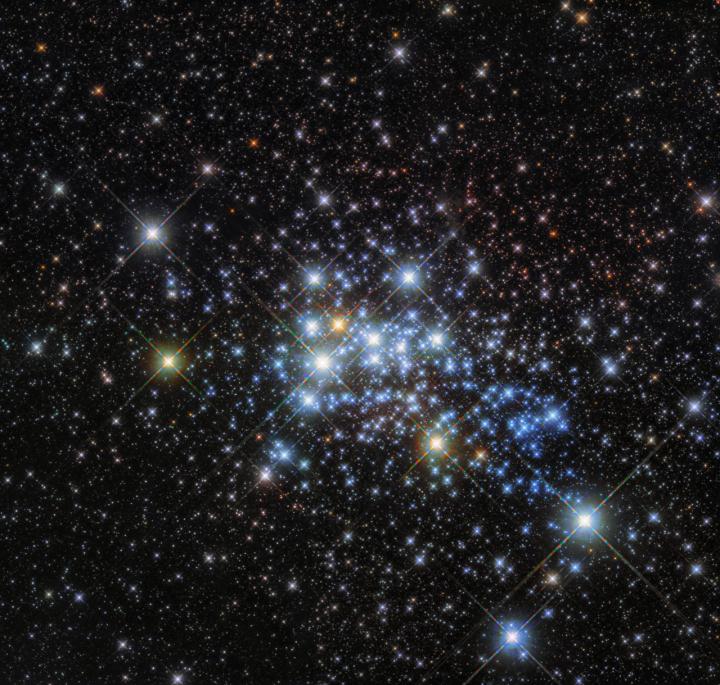
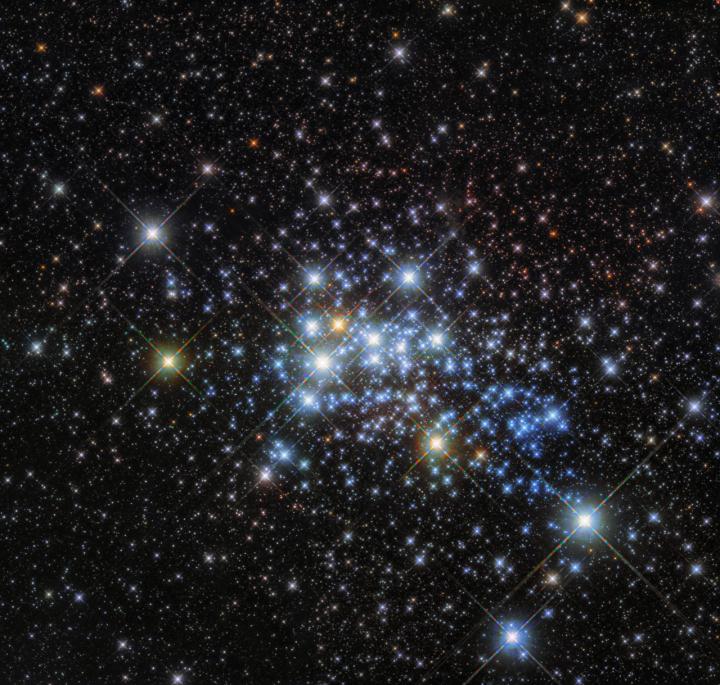
IMAGE

Credit: ESA/Hubble & NASA

This beautiful Hubble image reveals a young super star cluster known as Westerlund 1, only 15,000 light-years away in our Milky Way neighborhood, yet home to one of the largest stars ever discovered.

Stars are classified according to their spectral type, surface temperature, and luminosity. While studying and classifying the cluster's constituent stars, astronomers discovered that Westerlund 1 is home to an enormous star. Originally named Westerlund 1-26, this monster star is a red supergiant (although sometimes classified as a hypergiant) with a radius over 1,500 times that of our sun. If Westerlund 1-26 were placed where our sun is in our solar system, it would extend out beyond the orbit of Jupiter.

Most of Westerlund 1's stars are thought to have formed in the same burst of activity, meaning that they have similar ages and compositions. The cluster is relatively young in astronomical terms –at around three million years old it is a baby compared to our own sun, which is some 4.6 billion years old.

###

Media Contact

Robert Gutro
[email protected]
@NASAGoddard

http://www.nasa.gov/goddard

############

Story Source: Materials provided by Scienmag

Share12Tweet8Share2ShareShareShare2

Related Posts

Machine Vision: Learning Fast and Slow Thinking

June 23, 2026
Biochar-Enhanced Hydrogel Paves the Way for Advanced Solar Water Purification — Technology and Engineering

Biochar-Enhanced Hydrogel Paves the Way for Advanced Solar Water Purification

June 23, 2026

New Research Uncovers Sex-Specific Immune Mechanism in Lethal Brain Cancer

June 23, 2026

Mayo Clinic Scientists Uncover Structure of Crucial Protein Implicated in Cancer and Neurological Disorders

June 23, 2026
Please login to join discussion

POPULAR NEWS

  • Saying Goodbye to PGY-6: Pediatric Fellowship Realities

    103 shares
    Share 41 Tweet 26
  • Multi-Hospital Study Reveals Long Covid Burden Is Twice as High as Current Estimates

    92 shares
    Share 36 Tweet 23
  • Detection of EDCs in Breast Milk and Infant Urine Up to Six Months Highlights Early Exposure Risks

    77 shares
    Share 31 Tweet 19
  • New Drug Candidate Developed at McMaster Shows Potential for Treating Brain Cancer

    58 shares
    Share 23 Tweet 15

About

We bring you the latest biotechnology news from best research centers and universities around the world. Check our website.

Follow us

Recent News

Machine Vision: Learning Fast and Slow Thinking

Biochar-Enhanced Hydrogel Paves the Way for Advanced Solar Water Purification

New Research Uncovers Sex-Specific Immune Mechanism in Lethal Brain Cancer

Subscribe to Blog via Email

Enter your email address to subscribe to this blog and receive notifications of new posts by email.

Join 82 other subscribers
  • Contact Us

Bioengineer.org © Copyright 2023 All Rights Reserved.

Welcome Back!

Login to your account below

Forgotten Password?

Retrieve your password

Please enter your username or email address to reset your password.

Log In
No Result
View All Result
  • Homepages
    • Home Page 1
    • Home Page 2
  • News
  • National
  • Business
  • Health
  • Lifestyle
  • Science

Bioengineer.org © Copyright 2023 All Rights Reserved.