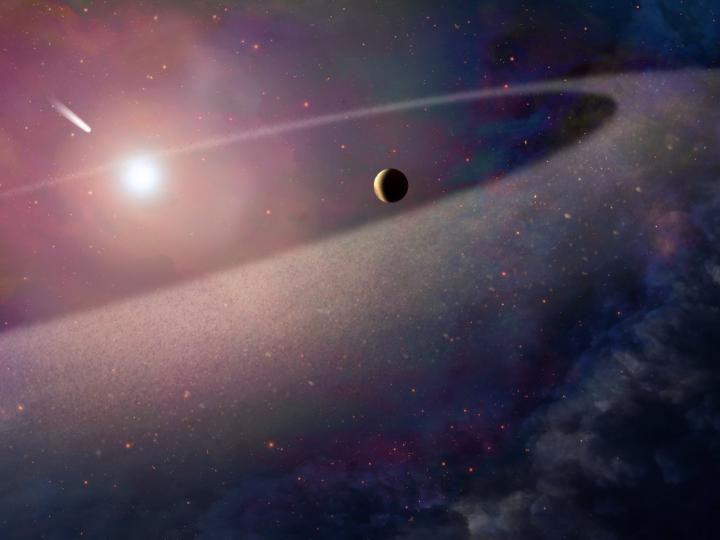
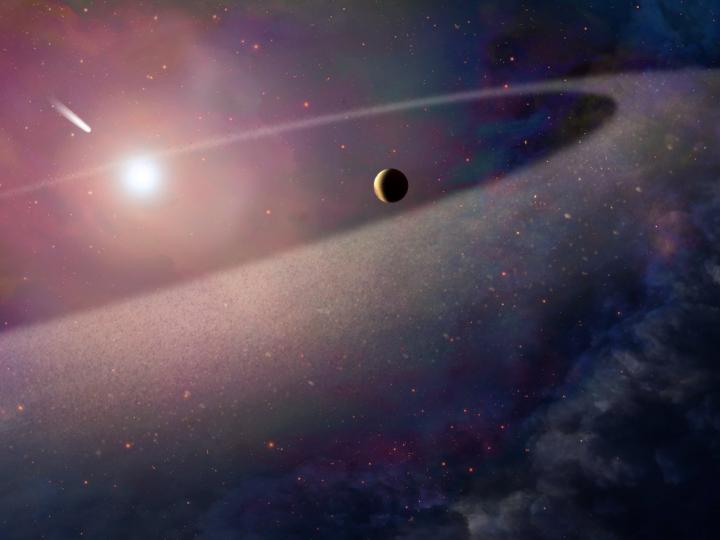
Credit: NASA, ESA, and Z. Levy (STScI)
The international team of astronomers observed the white dwarf WD 1425+540, about 170 light-years from Earth in the constellation Boötes (the Herdsman) [1]. While studying the white dwarf's atmosphere using both the NASA/ESA Hubble Space Telescope and the W. M. Keck Observatory the team found evidence that an object rather like a massive comet was falling onto the star, getting tidally disrupted while doing so.
The team determined that the object had a chemical composition similar to the famous Halley's Comet in our own Solar System, but it was 100 000 times more massive and had twice the proportion of water as its local counterpart. Spectral analysis showed that the destroyed object was rich in the elements essential for life, including carbon, oxygen, sulphur and even nitrogen [2].
This makes it the first detection of nitrogen in the debris falling onto a white dwarf. Lead author Siyi Xu of the European Southern Observatory, Germany, explains the importance of the discovery: "Nitrogen is a very important element for life as we know it. This particular object is quite rich in nitrogen, more so than any object observed in our Solar System."
There are already more than a dozen white dwarfs known to be polluted with infalling debris from rocky, asteroid-like objects, but this is the first time a body made of icy, comet-like material has been seen polluting a white dwarf's atmosphere. These findings are evidence for a belt of comet-like bodies, similar to our Solar System's Kuiper Belt, orbiting the white dwarf. These icy bodies apparently survived the star's evolution from a main sequence star — similar to our Sun — to a red giant — and its final collapse to a small, dense white dwarf.
The team that made this discovery also considered how this massive object got from its original, distant orbit onto a collision course with its parent star [3]. The change in the orbit could have been caused by the gravitational distribution by so far undetected, surviving planets which have perturbed the belt of comets. Another explanation could be that the companion star of the white dwarf disturbed the belt and caused objects from the belt to travel toward the white dwarf. The change in orbit could also have been caused by a combination of these two scenarios.
The Kuiper Belt in the Solar System, which extends outward from Neptune's orbit, is home to many dwarf planets, comets, and other small bodies left over from the formation of the Solar System. The new findings now provide observational evidence to support the idea that icy bodies are also present in other planetary systems and have survived throughout the history of the star's evolution.
###
Notes
[1] The white dwarf was first found in 1974 and is part of a wide binary system, with a companion star separated by 2000 times the distance that the Earth is from the Sun.
[2] The measurements of carbon, nitrogen, oxygen, silicon, sulphur, iron and nickel and hydrogen come from the Cosmic Origins Spectrograph (COS, installed at the NASA/ESA Hubble Space Telescope . The W. M. Keck Telescopes provided the calcium, magnesium, and hydrogen.
[3] The team calculated that the accreted object originally resided about 300 astronomical units — 300 times the distance Earth-Sun — away from the white dwarf. This is seven times further out than the Kuiper-Belt objects in the Solar System.
More information
The Hubble Space Telescope is a project of international cooperation between ESA and NASA.
The international team of astronomers in this study consists of S. Xu (ESO, Germany), B. Zuckerman (Department of Physics and Astronomy, University of California, Los Angeles, USA), P. Dufour (Institut de Recherche sur les Exoplanètes, Université de Montréal, Canada), E. D. Young (Department of Earth, Planetary, and Space Sciences, University of California, Los Angeles), B. Klein (Department of Physics and Astronomy, University of California, Los Angeles, USA), M. Jura (Department of Physics and Astronomy, University of California, Los Angeles, USA)
Image credit: NASA, ESA and Z. Levy (STScI)
Links
- Images of Hubble – http://www.spacetelescope.org/images/archive/category/spacecraft/
- hubblesite release
- science paper
Contacts
Siyi Xu
European Southern Observatory
Garching bei München, Germany
Tel: +49 89 3200 6298
Email: [email protected]
Mathias Jäger
ESA/Hubble, Public Information Officer
Garching, Germany
Tel: +49 176 62397500
Email: [email protected]
Media Contact
Mathias Jäger
[email protected]
49-176-623-97500
@Hubble_space
http://www.spacetelescope.org
############
Story Source: Materials provided by Scienmag