• HOME
  • NEWS
  • EXPLORE
    • CAREER
      • Companies
      • Jobs
    • EVENTS
    • iGEM
      • News
      • Team
    • PHOTOS
    • VIDEO
    • WIKI
  • BLOG
  • COMMUNITY
    • FACEBOOK
    • INSTAGRAM
    • TWITTER
Wednesday, October 28, 2026
BIOENGINEER.ORG
No Result
View All Result
  • Login
  • HOME
  • NEWS
  • EXPLORE
    • CAREER
      • Companies
      • Jobs
        • Lecturer
        • PhD Studentship
        • Postdoc
        • Research Assistant
    • EVENTS
    • iGEM
      • News
      • Team
    • PHOTOS
    • VIDEO
    • WIKI
  • BLOG
  • COMMUNITY
    • FACEBOOK
    • INSTAGRAM
    • TWITTER
No Result
View All Result
Bioengineer.org
No Result
View All Result
Home NEWS Science News Biology

HP1α rise silences MERVL and stalls oxidatively damaged embryos

by
October 28, 2026
in Biology
Reading Time: 2 mins read
0
HP1α rise silences MERVL and stalls oxidatively damaged embryos

HP1α rise silences MERVL and stalls oxidatively damaged embryos

Share on FacebookShare on TwitterShare on LinkedinShare on RedditShare on Telegram

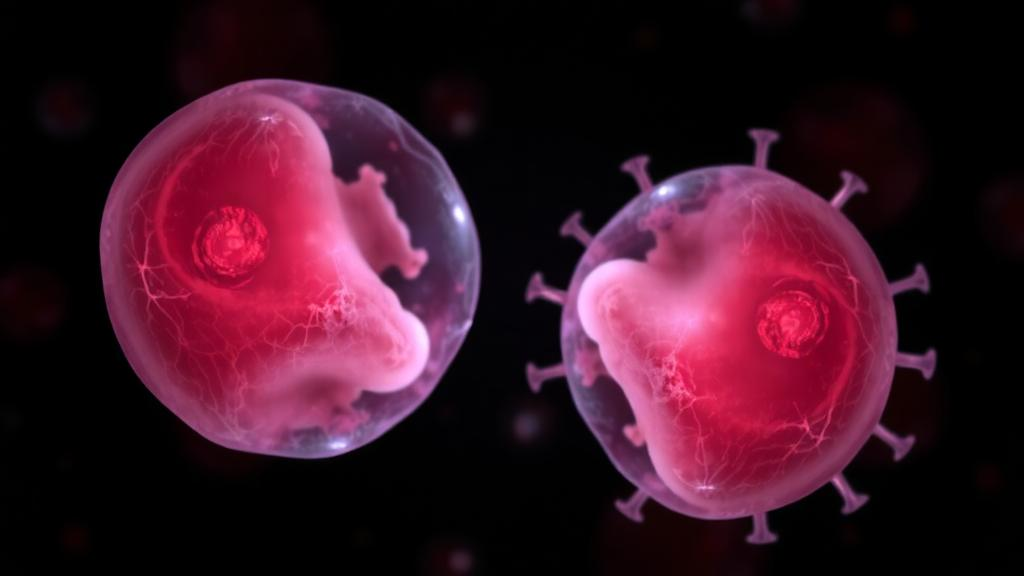
Mouse embryos exposed to oxidative damage during in vitro fertilization can stall at the two-cell stage, and a new study points to a specific epigenetic culprit: the chromatin protein HP1α. Researchers report that oxidative damage increases HP1α, which suppresses the totipotency marker MERVL and drives developmental arrest, while reducing HP1α partially rescues embryo development.

The team used an established embryonic oxidative damage model to show that oxidative damage impaired mouse embryonic totipotency and caused developmental arrest. Oxidative damage significantly altered two key epigenetic marks, H3K4me3 and H3K9me3, in mouse two-cell stage embryos, a critical period for zygotic genome activation, when the embryonic genome must be properly reprogrammed for development to proceed.

To map these changes, the researchers employed CUT&Tag technology to profile H3K4me3 after oxidative damage. They found a significant decrease in H3K4me3 distribution at promoters and transcription start sites, and the biological functions associated with the differentially marked regions were closely related to DNA damage repair, growth, and development. Differential analysis further revealed that H3K4me3 enrichment was significantly increased at the transcription start region of Cbx5, the gene encoding HP1α, after oxidative damage.

By generating HP1α overexpression and knockdown embryonic models, the authors found that HP1α overexpression enhanced H3K9me3 enrichment and suppressed MERVL expression, whereas HP1α knockdown produced the opposite effects. Moreover, knocking down HP1α in H₂O₂-treated embryos reversed the oxidative-stress-induced increase in H3K9me3, reinstated MERVL transcription, and markedly improved the blastocyst formation rate.

The study, published open access in Epigenetics & Chromatin, concludes that proper epigenetic reprogramming is essential for embryonic development and identifies HP1α as a key player in oxidative damage-induced loss of embryonic totipotency. The authors suggest HP1α may represent a novel therapeutic target for mitigating oxidative damage in embryos, though the findings so far come from mouse embryo models and interventional approaches remain at the experimental stage.

Subject of Research: Epigenetic regulation by HP1α in oxidatively damaged mouse embryos during zygotic genome activation

Article Title: Repressed MERVL expression by increased HP1α causes developmental arrest in oxidatively damaged embryos

Article References: Cao, D., Liu, L., & Li, Z. (2026). Repressed MERVL expression by increased HP1α causes developmental arrest in oxidatively damaged embryos. Epigenetics & Chromatin. https://doi.org/10.1186/s13072-026-00708-8

Image Credits: AI Generated

DOI: 10.1186/s13072-026-00708-8

Keywords: HP1α, MERVL, oxidative damage, mouse embryos, zygotic genome activation, H3K4me3, H3K9me3, CUT&Tag, totipotency, developmental arrest, IVF, Cbx5

News Source: Juliet Wilcox. (October 28, 2026). HP1α rise silences MERVL and stalls oxidatively damaged embryos. Scienmag.


Tags: Cbx5CUT&Tagdevelopmental arrestH3K4me3H3K9me3HP1αIVFMERVLmouse embryosoxidative damagetotipotencyzygotic genome activation
Share12Tweet7Share2ShareShareShare1

Related Posts

AI learns to fix CT scans by protecting what algorithms actually measure

AI learns to fix CT scans by protecting what algorithms actually measure

October 28, 2026
CRISPR centromere editing reshapes wheat chromosomes

CRISPR centromere editing reshapes wheat chromosomes

October 28, 2026

Vitrobot-based protocol makes graphene oxide cryo-EM grids reproducible and accessible

October 28, 2026

Two Barklice Species Recorded in South Korea for the First Time

October 28, 2026

POPULAR NEWS

  • Scoping review finds clinical supervision of radiography students in Africa lacks structure and training

    Scoping review finds clinical supervision of radiography students in Africa lacks structure and training

    29 shares
    Share 12 Tweet 7
  • Three Suicide Risk Subtypes Identified in Adolescents with Major Depression

    29 shares
    Share 12 Tweet 7
  • Adding a Skin Bilirubin Scan to Visual Jaundice Checks Cuts Costs in Clinics

    29 shares
    Share 12 Tweet 7
  • AI in public health remains pre-emergent in one Congolese health zone, study finds

    29 shares
    Share 12 Tweet 7

About

We bring you the latest biotechnology news from best research centers and universities around the world. Check our website.

Follow us

Recent News

CO2-derived vitrimer epoxy matches conventional carbon fiber composites in tensile strength while adding recyclability

Malaria metabolomics review maps metabolic signatures in hosts, parasites and mosquitoes

Explainable AI framework adds semantic rule layer to network intrusion detection

Subscribe to Blog via Email

Enter your email address to subscribe to this blog and receive notifications of new posts by email.

Join 85 other subscribers
  • Contact Us

Bioengineer.org © Copyright 2023 All Rights Reserved.

Welcome Back!

Login to your account below

Forgotten Password?

Retrieve your password

Please enter your username or email address to reset your password.

Log In
No Result
View All Result
  • Homepages
    • Home Page 1
    • Home Page 2
  • News
  • National
  • Business
  • Health
  • Lifestyle
  • Science

Bioengineer.org © Copyright 2023 All Rights Reserved.