Credit: (Picture: Sönke Scherzer/Dirk Becker)
Venus flytrap (Dionaea muscipula) is a carnivorous plant. Catching its prey, mainly insects, with a trapping structure formed by its leaves, the plants' glands secrete an enzyme to decompose the prey and take up the nutrients released.
Although postulated since Darwin's pioneering studies, these secretory events have not been measured and analysed until now: An international team of researchers headed by Rainer Hedrich, a biophysicist from Julius-Maximilians-Universität (JMU) Würzburg in Bavaria, Germany, present the results in the journal PNAS.
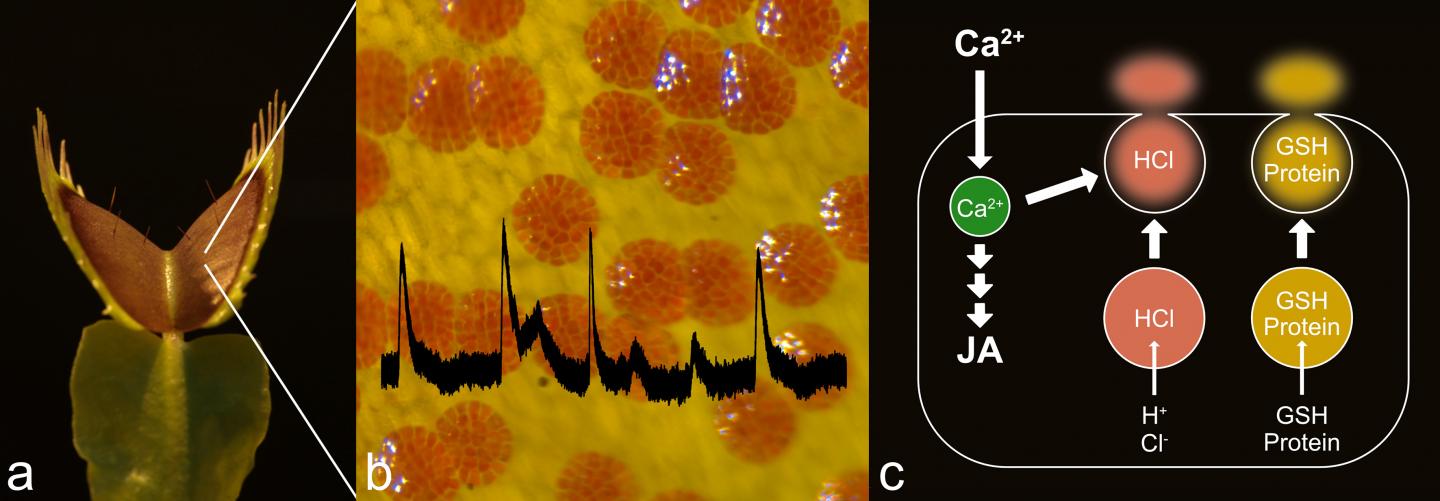
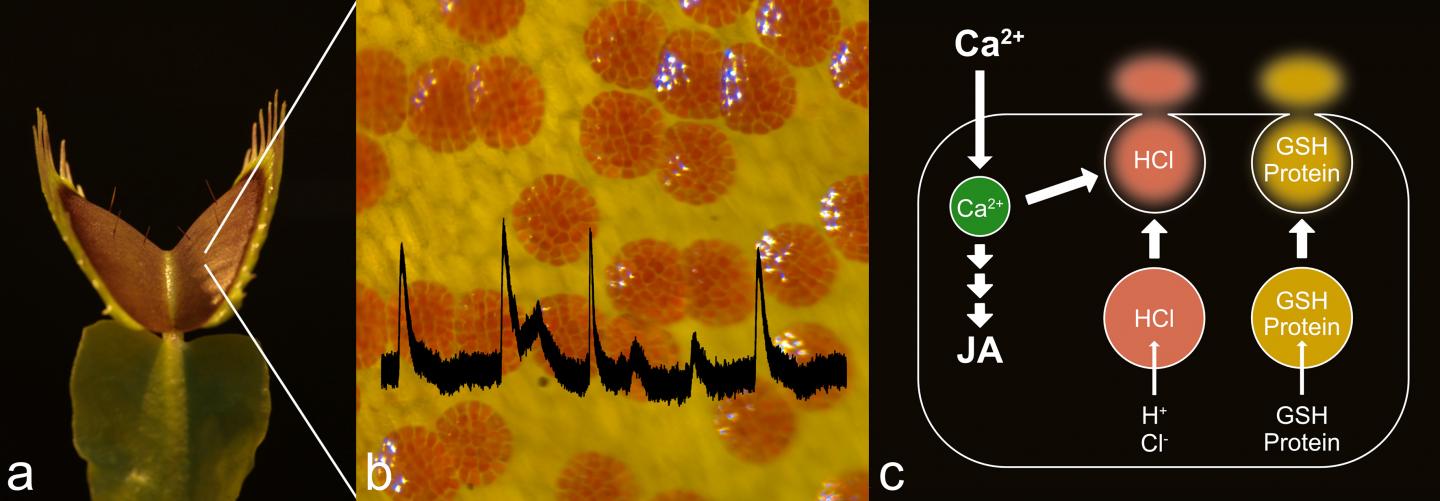
When a prey tries to escape the closed trap, it will inevitably touch the sensory hairs inside. Any mechanical contact with the hairs triggers an electrical signal that spreads across the trap in waves. From the third signal, the plant produces the hormone jasmonate; after the fifth signal, the digestive glands that line the inside of the traps like turf are activated.
Glands secrete acidic vesicles to decompose prey
What happens next in the gland cells? They increasingly produce membranous bubbles filled with liquid (secretory vesicles) and give off their content. This happens after mechanical stimulation of the sensory hairs but also when the glands come into contact with the hormone jasmonate. The entire process depends on calcium and is controlled by a number of specific proteins.
Moreover, genes are activated in the glands: "We assume that they provide for the vesicles being loaded with protons and chloride, that is hydrochloric acid," Hedrich explains and he adds: "We used ion-sensitive electrodes to measure that repeated touching of the sensory hairs triggers the influx of calcium ions into the gland. The rising calcium level in the cytoplasm causes the vesicles to fuse with the plasma membrane, similarly to the neurotransmitter secretion of neurons. The influx of calcium is followed by the efflux of protons and chloride after a time delay."
Conclusive analysis with carbon fibre electrodes
What else do the gland vesicles contain? This was analysed using carbon fibre electrodes in cooperation with Erwin Neher (Göttingen), winner of the Nobel Prize, who has a lot of experience with this technique. Together with Neher, the JMU researcher Sönke Scherzer adjusted the measurement method to the conditions prevailing inside the Venus flytrap.
The team positioned a carbon fibre electrode over the gland surface and waited with excitement what would happen. "At first, we were disappointed because we did not immediately detect signals as known from secretory cells in humans and animals," Scherzer recalls.
Should the vesicles contain hydrochloric acid in the first hours after catching the prey but no digestive enzymes yet? And no molecules yet that assure the enzymes' functioning in the acidic environment? Does the plant have to produce all this first?
That's exactly how it works: Molecular biologist Ines Fuchs found out that the plant only starts to produce the enzymes that decompose the prey after several hours. The first characteristic signals occurred after six hours and the process was in full swing 24 hours later. During this phase, the trap is completely acidic and rich in digestive enzymes.
Stabilising effect of glutathione keeps enzymes fit
Professor Heinz Rennenberg (Freiburg) also found glutathione (GSH) in the secreted enzyme. This molecule keeps the enzymes functional in the acidic environment of the Venus flytrap.
The same processes as described above take place in the same chronological order both when the sensory hairs are stimulated and when exposing the trap to the hormone jasmonate only. "A touch will very quickly trigger the jasmonate signalling pathway, but it takes time until the vesicles are produced and loaded with the proper freight which is facilitated by the hormone," Hedrich explains.
Calcium is a mandatory ingredient
How the Venus flytrap floods its "green stomach" with the right mixture and breaks down the prey into its nutrients can be visualised using magnetic resonance imaging. Eberhard Munz from the MRT centre of the JMU's Department of Physics was responsible for this task.
His experiments also showed that when the influx of calcium into the glands is blocked, the trap remains dry. "The calcium activation of the gland cells is therefore crucial," Hedrich says. "So we will now take a closer look at the biology of the calcium channels of Venus flytrap. We also want to investigate the mechanism which counts the signals transmitted by the sensory hairs in the gland and translates it into jasmonate-dependent biology."
###
Media Contact
Rainer Hedrich
[email protected]
49-931-318-6100
@Uni_WUE
https://www.uni-wuerzburg.de/
############
Story Source: Materials provided by Scienmag