• HOME
  • NEWS
  • EXPLORE
    • CAREER
      • Companies
      • Jobs
    • EVENTS
    • iGEM
      • News
      • Team
    • PHOTOS
    • VIDEO
    • WIKI
  • BLOG
  • COMMUNITY
    • FACEBOOK
    • INSTAGRAM
    • TWITTER
Friday, May 15, 2026
BIOENGINEER.ORG
No Result
View All Result
  • Login
  • HOME
  • NEWS
  • EXPLORE
    • CAREER
      • Companies
      • Jobs
        • Lecturer
        • PhD Studentship
        • Postdoc
        • Research Assistant
    • EVENTS
    • iGEM
      • News
      • Team
    • PHOTOS
    • VIDEO
    • WIKI
  • BLOG
  • COMMUNITY
    • FACEBOOK
    • INSTAGRAM
    • TWITTER
  • HOME
  • NEWS
  • EXPLORE
    • CAREER
      • Companies
      • Jobs
        • Lecturer
        • PhD Studentship
        • Postdoc
        • Research Assistant
    • EVENTS
    • iGEM
      • News
      • Team
    • PHOTOS
    • VIDEO
    • WIKI
  • BLOG
  • COMMUNITY
    • FACEBOOK
    • INSTAGRAM
    • TWITTER
No Result
View All Result
Bioengineer.org
No Result
View All Result
Home NEWS Science News Biology

How transcription factors explore the genome

Bioengineer by Bioengineer
January 30, 2019
in Biology
Reading Time: 2 mins read
0
IMAGE
Share on FacebookShare on TwitterShare on LinkedinShare on RedditShare on Telegram

IMAGE

Credit: David Suter/EPFL


Transcription factors (TFs) are proteins that regulate the transcription of genes, which is the first step in making a protein. The way TFs work is by searching the entire genome and binding to specific regions that regulate genes, turning them “on” or “off”. TFs are known to not only bind to specific sequences of DNA, but also to non-specifically bind to any stretch of DNA.

This non-specific association can drastically increase the ability of TFs to find their specific target sites by allowing them to slide along DNA. However, we do not understand how the more than 1,500 human TFs vary in their efficiency to scan the massive genome, locate and bind specific sites.

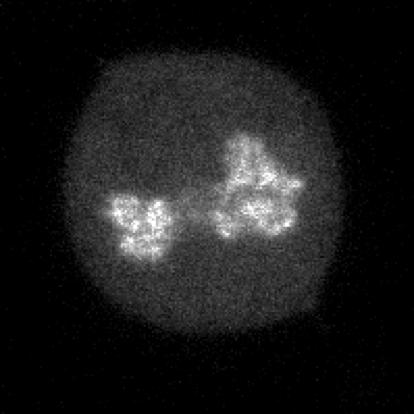
Now, the lab of David Suter at EPFL’s Institute of Bioengineering has found a way to predict the efficiency with which different TFs scan the genome in living cells. The scientists studied 501 TFs in the mouse by looking at how they bind to “mitotic” chromosomes, a property that has been linked to the ability of TFs to associate with DNA in a non-specific manner.

Using photobleaching experiments and single molecule imaging, the scientists found that TFs movements in the nucleus and the efficiency at which they find their binding sites can be predicted by mitotic chromosome binding.

By combining these experiments with the TF mapping in the whole genome, they found that different TFs vary by three orders of magnitude in their ability to find their sites. Thus, TF with strong non-specific DNA binding properties associate with mitotic chromosomes, move slowly in the nucleus and are particularly efficient at finding the specific sequences they need to bind to regulate gene expression.

“Transcription factors differ largely in their ability to scan the genome to find their specific binding sites, and these differences can be predicted by simply looking at how much they bind to mitotic chromosomes,” says David Suter. “Transcription factors that are the most efficient in searching the genome could be able to drive broad changes in gene expression patterns even when expressed at low concentrations, and can therefore be particularly important for cell fate decision processes.”

###

Other contributors

Ulm University

Reference

Mahé Raccaud, Elias T. Friman, Andrea B. Alber, Harsha Agarwal, Cédric Deluz, Timo Kuhn, J. Christof M. Gebhardt, David M. Suter. Mitotic chromosome binding predicts transcription factor properties in interphase. Nature Communications 30 January 2019. DOI: 10.1038/s41467-019-08417-5.

Media Contact
Nik Papageorgiou
[email protected]
41-216-932-105

Original Source

https://actu.epfl.ch/news/how-transcription-factors-explore-the-genome

Related Journal Article

http://dx.doi.org/10.1038/s41467-019-08417-5

Tags: BiologyBiomedical/Environmental/Chemical EngineeringBiotechnologyCell BiologyGenesGeneticsMolecular Biology
Share12Tweet8Share2ShareShareShare2

Related Posts

Single mother must adapt swiftly — the survival of her colony depends on it — Biology

Single mother must adapt swiftly — the survival of her colony depends on it

May 15, 2026
Why Are Nearly Everyone Right-Handed? It Might Be Linked to How We Learned to Walk — Biology

Why Are Nearly Everyone Right-Handed? It Might Be Linked to How We Learned to Walk

May 15, 2026

Excessive Neuronal Activity Initiates Severe Autoimmune Brain Disorder

May 15, 2026

Precision Anti-Aging Strategies Focus on Eliminating Harmful Senescent Cells While Preserving Beneficial Ones

May 15, 2026
Please login to join discussion

POPULAR NEWS

  • Research Indicates Potential Connection Between Prenatal Medication Exposure and Elevated Autism Risk

    843 shares
    Share 337 Tweet 211
  • New Study Reveals Plants Can Detect the Sound of Rain

    730 shares
    Share 291 Tweet 182
  • Salmonella Haem Blocks Macrophages, Boosts Infection

    62 shares
    Share 25 Tweet 16
  • Breastmilk Balances E. coli and Beneficial Bacteria in Infant Gut Microbiomes

    58 shares
    Share 23 Tweet 15

About

We bring you the latest biotechnology news from best research centers and universities around the world. Check our website.

Follow us

Recent News

New Study Connects Age-Related Gut Changes to Higher Disease Risk

Single mother must adapt swiftly — the survival of her colony depends on it

Cancer-Linked Protein Plays Key Role in Tumor DNA Repair

Subscribe to Blog via Email

Enter your email address to subscribe to this blog and receive notifications of new posts by email.

Join 82 other subscribers
  • Contact Us

Bioengineer.org © Copyright 2023 All Rights Reserved.

Welcome Back!

Login to your account below

Forgotten Password?

Retrieve your password

Please enter your username or email address to reset your password.

Log In
No Result
View All Result
  • Homepages
    • Home Page 1
    • Home Page 2
  • News
  • National
  • Business
  • Health
  • Lifestyle
  • Science

Bioengineer.org © Copyright 2023 All Rights Reserved.