Credit: American Chemical Society
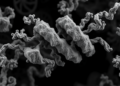
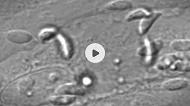
If you’re a cat owner, you might have heard of Toxoplasma gondii, a protozoan that sometimes infects humans through contact with contaminated feces in litterboxes. Although harmless to most people, T. gondii can cause serious illness or death in immunocompromised individuals or fetuses of infected pregnant women. Now, researchers reporting in ACS Nano have studied how the microorganism glides so swiftly through mammalian tissues during an infection. Watch a video of the parasites here.
According to the U.S. Centers for Disease Control and Prevention, about 11% of the U.S. population, and up to 60% of people in some parts of the world, have been infected with T. gondii, which can also be transmitted through contaminated food and water. Although the parasite infects most mammals, it only reproduces sexually in cats, which can expel large numbers of T. gondii oocysts in their feces. Once ingested by people or animals, the oocysts’ envelopes are broken down by digestive enzymes, releasing parasites that can enter cells of the small intestine. There, the parasites transition into what is called the tachyzoite stage, in which they can move very quickly, massively multiply inside host cells and spread throughout the body, forming long-lived cysts in tissues such as muscle, eye and brain. Isabelle Tardieux and colleagues wanted to determine how these tiny tachyzoites glide so swiftly through tissues in a unique helical motion.
To find out, the researchers combined several types of high-resolution and high-speed 2D and 3D live imaging with force microscopy methods. They examined the parasites’ movements through collagen fibers that mimicked the extracellular matrix — a dense network of proteins that surrounds cells in tissues. Tachyzoites squeezed through the collagen meshwork by first pausing and forming a kink in the front part of their bodies. Then, the cell bodies contracted, and the parasites surged forward with a spring-like motion. Delving deeper with the help of photomicropatterning and machine learning approaches, the researchers found that these movements were caused by the formation and breakage of specific attachments between the protozoans and collagen fibers, resulting in the buildup of contractile forces in the parasites’ cytoskeletons. When the front tip of a parasite released its hold on the fibers, it sprung forward with a super-fast, helical glide.
###
The authors acknowledge funding from the Institute for Advanced Biosciences Department of Prevention and Therapy of Chronic Diseases, the Université Grenoble-Alpes and the Fondation pour la Recherche Médicale.
The abstract that accompanies this paper can be viewed here.
The American Chemical Society (ACS) is a nonprofit organization chartered by the U.S. Congress. ACS’ mission is to advance the broader chemistry enterprise and its practitioners for the benefit of Earth and its people. The Society is a global leader in providing access to chemistry-related information and research through its multiple research solutions, peer-reviewed journals, scientific conferences, eBooks and weekly news periodical Chemical & Engineering News. ACS journals are among the most cited, most trusted and most read within the scientific literature; however, ACS itself does not conduct chemical research. As a specialist in scientific information solutions (including SciFinder® and STN®), its CAS division powers global research, discovery and innovation. ACS’ main offices are in Washington, D.C., and Columbus, Ohio.
To automatically receive news releases from the American Chemical Society, contact [email protected].
Follow us: Twitter | Facebook
Media Contact
Katie Cottingham
[email protected]