


Credit: Dr. Reidar Lystad, 2018
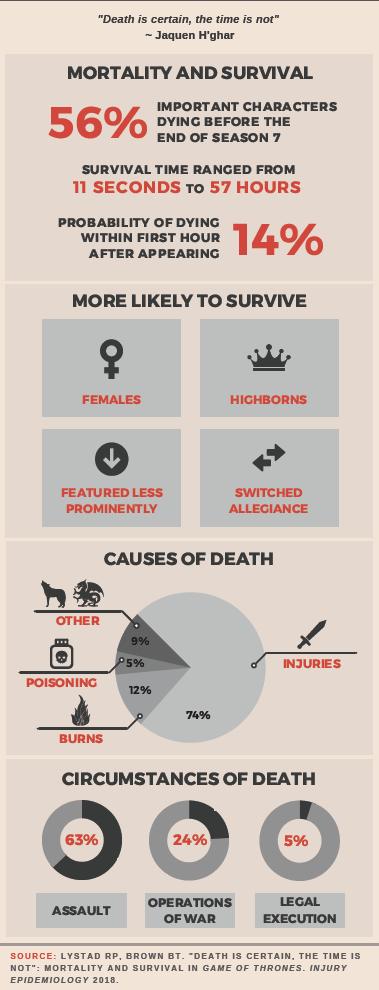
Characters in the Game of Thrones TV series are more likely to die if they do not switch allegiance, and are male, according to an article published in the open access journal Injury Epidemiology.
Researchers at Macquarie University, Australia, evaluated the deaths of all important Game of Thrones characters across seven seasons of the show and found that characters were more likely to survive if they switched allegiances, such as Tyrion Lannister who switches allegiances between the houses Lannister and Targaryen. The risk of death was also greater for characters that were ‘lowborn’ (not a Lord or Lady), compared to those that were ‘highborn’.
Dr Reidar Lystad, injury epidemiologist at the Australian Institute of Health Innovation and corresponding author of the study, said: “The risk of death is high among characters in Game of Thrones. By the end of the seventh season, more than half of the characters had died – 186 out of the 330 characters we included in this study – with violent deaths being the most common by far.”
Dr Lystad added: “While these findings may not be surprising for regular viewers, we have identified several factors that may be associated with better or worse survival, which may help us to speculate about who will prevail in the final season.”
The authors found that the majority of deaths occurred in Westeros (80.1%), and the most common place of death was in the home. The most common causes of death were injuries (73.7%), and particularly wounds of the head and neck, including 13 decapitations. Only two deaths from natural causes occurred across the seven seasons of the show: Maester Aemon and Old Nan, who both died of old age. The remainder of deaths were from burns (11.8%) or poisonings (4.8%). The most common circumstances of deaths were assault (63.0%), operations of war (24.4%), and legal executions (5.4%).
The probability of dying within the first hour after first appearing on screen was around 14%. The survival time of characters ranged from 11 seconds to 57 hours and 15 minutes. The median survival time was estimated to be 28 hours and 48 minutes.
The researchers collected data on mortality and survival of 330 characters from all 67 episodes from seasons one to seven of Game of Thrones. They recorded data on the sociodemographic status of the characters, including their sex, social status, type of occupation, religious affiliation, and allegiance, alongside their survival time, and the circumstances of their death. This information was used to quantify predictors of death. The researchers crosschecked all of their data with Internet Movie Database (IMDb) and Game of Thrones Wiki.
###
A blog on this study will be available here when the embargo lifts: http://blogs.
Infographic available: https:/
Media Contact
Lucy Eccles
Communications Officer
BMC
T +44 20 7418 5730
E [email protected]
Notes to editor:
1. Research article:
“Death is certain, the time is not” mortality and survival in Game of Thrones
Injury Epidemiology 2018
DOI: 10.1186/s40621-018-0174-7
After the embargo lifts, the article will be available here:
https:/
Please name the journal in any story you write. If you are writing for the web, please link to the article. All articles are available free of charge, according to BMC’s open access policy.
2. Injury Epidemiology is dedicated to advancing the scientific foundation for injury prevention and control through timely publication and dissemination of peer-reviewed research. Injury Epidemiology aims to be the premier venue for communicating epidemiologic studies of unintentional and intentional injuries, including, but not limited to, morbidity and mortality from motor vehicle crashes, drug overdose/poisoning, falls, drowning, fires/burns, iatrogenic injury, suicide, homicide, assaults, and abuse.
3. A pioneer of open access publishing, BMC has an evolving portfolio of high quality peer-reviewed journals including broad interest titles such as BMC Biology and BMC Medicine, specialist journals such as Malaria Journal and Microbiome, and the BMC series. At BMC, research is always in progress. We are committed to continual innovation to better support the needs of our communities, ensuring the integrity of the research we publish, and championing the benefits of open research. BMC is part of Springer Nature, giving us greater opportunities to help authors connect and advance discoveries across the world.
Media Contact
Lucy Eccles
[email protected]
Related Journal Article
http://dx.
News source: https://scienmag.com/



