• HOME
  • NEWS
  • EXPLORE
    • CAREER
      • Companies
      • Jobs
    • EVENTS
    • iGEM
      • News
      • Team
    • PHOTOS
    • VIDEO
    • WIKI
  • BLOG
  • COMMUNITY
    • FACEBOOK
    • INSTAGRAM
    • TWITTER
Sunday, July 5, 2026
BIOENGINEER.ORG
No Result
View All Result
  • Login
  • HOME
  • NEWS
  • EXPLORE
    • CAREER
      • Companies
      • Jobs
        • Lecturer
        • PhD Studentship
        • Postdoc
        • Research Assistant
    • EVENTS
    • iGEM
      • News
      • Team
    • PHOTOS
    • VIDEO
    • WIKI
  • BLOG
  • COMMUNITY
    • FACEBOOK
    • INSTAGRAM
    • TWITTER
  • HOME
  • NEWS
  • EXPLORE
    • CAREER
      • Companies
      • Jobs
        • Lecturer
        • PhD Studentship
        • Postdoc
        • Research Assistant
    • EVENTS
    • iGEM
      • News
      • Team
    • PHOTOS
    • VIDEO
    • WIKI
  • BLOG
  • COMMUNITY
    • FACEBOOK
    • INSTAGRAM
    • TWITTER
No Result
View All Result
Bioengineer.org
No Result
View All Result
Home NEWS Science News Biology

How to protect biocatalysts from oxygen

Bioengineer by Bioengineer
October 30, 2023
in Biology
Reading Time: 2 mins read
0
Group of authors
Share on FacebookShare on TwitterShare on LinkedinShare on RedditShare on Telegram

Blocked channels improve oxygen stability
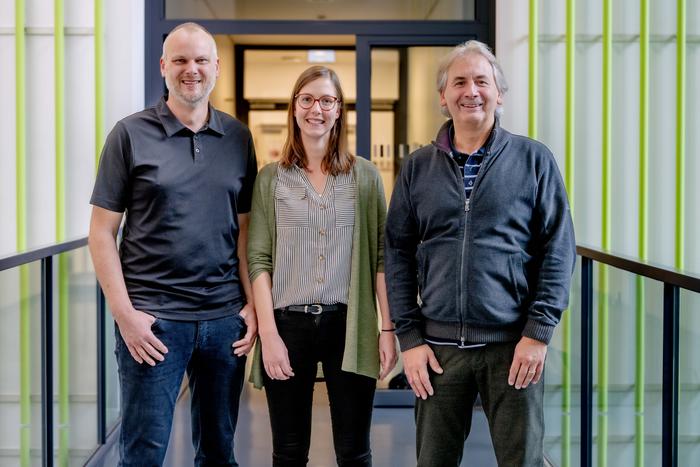
Group of authors

Credit: © RUB, Marquard

Blocked channels improve oxygen stability

A metalloenzyme with particularly high catalytic turnover rates of molecular hydrogen is called [FeFe] hydrogenase. “The turnover of hydrogen takes place at the active site, the H-cluster, inside the enzyme,” explains Thomas Happe. “The hydrogen produced inside then travels through channels to exit the enzyme.”

“Conversely, if the enzyme is exposed to molecular oxygen, the oxygen also uses specific channels to travel from the enzyme surface up to the H-cluster,” adds first author Claudia Brocks. The H-cluster is destroyed at the slightest contact with oxygen and loses the ability to produce any further hydrogen.

The Bochum research team managed to increase the oxygen stability of the [FeFe] hydrogenase enzyme CpI and explain the oxygen protection effect by using an interdisciplinary combination of methods including site-directed mutagenesis, electrochemistry, X-ray crystallography and molecular dynamics simulations. “Selective genetic modifications to an enzyme channel altered the hydrogenase enzyme CpI in such a way that we detected a significant increase in oxygen tolerance and oxygen resistance by electrochemical means,” explains Claudia Brocks. “We used molecular dynamics simulation to study channel modifications. Our analysis revealed blockages in a newly identified dynamic water channel close to the H-cluster.” Thomas Happe adds: “The protective effect against harmful oxygen is based on this channel blockage. Oxygen can only penetrate to the H-cluster with difficulty. Local structural modifications can lead to significant changes in protein dynamics.”


Journal

ChemSusChem

DOI

10.1002/cssc.202301365

Method of Research

Experimental study

Subject of Research

Cells

Article Title

A dynamic water channel affects O2 stability in [FeFe] Hydrogenases

Article Publication Date

13-Oct-2023

Share12Tweet8Share2ShareShareShare2

Related Posts

Evolution-Inspired Biosensors Revolutionize Lipid Tracking in Real Time — Biology

Evolution-Inspired Biosensors Revolutionize Lipid Tracking in Real Time

July 2, 2026
New Study Reveals How to Reduce Risk of Dangerous Wildlife Encounters This Summer — Biology

New Study Reveals How to Reduce Risk of Dangerous Wildlife Encounters This Summer

July 2, 2026

Hepatic IFRD1 Alleviates Metabolic Dysfunction-Linked Steatohepatitis Through the GLUD1/α-KG Pathway

July 2, 2026

Intricate Food Webs Support Ecosystem Health and Stability

July 2, 2026

POPULAR NEWS

  • Detection of EDCs in Breast Milk and Infant Urine Up to Six Months Highlights Early Exposure Risks

    77 shares
    Share 31 Tweet 19
  • Saying Goodbye to PGY-6: Pediatric Fellowship Realities

    103 shares
    Share 41 Tweet 26
  • New Drug Candidate Developed at McMaster Shows Potential for Treating Brain Cancer

    58 shares
    Share 23 Tweet 15
  • KTU Researchers Explore Ultrasound’s Role in Enhancing Blood Flow Beyond Diagnostics

    53 shares
    Share 21 Tweet 13

About

We bring you the latest biotechnology news from best research centers and universities around the world. Check our website.

Follow us

Recent News

Quasi-Bound States Boost Quantum Well Photoresponse

Lysine Pyruvylation Links Glycolysis to Epigenetics

Multiphysics Coupling: Single vs. Multiple DeepONet Branches

Subscribe to Blog via Email

Success! An email was just sent to confirm your subscription. Please find the email now and click 'Confirm' to start subscribing.

Join 83 other subscribers
  • Contact Us

Bioengineer.org © Copyright 2023 All Rights Reserved.

Welcome Back!

Login to your account below

Forgotten Password?

Retrieve your password

Please enter your username or email address to reset your password.

Log In
No Result
View All Result
  • Homepages
    • Home Page 1
    • Home Page 2
  • News
  • National
  • Business
  • Health
  • Lifestyle
  • Science

Bioengineer.org © Copyright 2023 All Rights Reserved.