• HOME
  • NEWS
  • EXPLORE
    • CAREER
      • Companies
      • Jobs
    • EVENTS
    • iGEM
      • News
      • Team
    • PHOTOS
    • VIDEO
    • WIKI
  • BLOG
  • COMMUNITY
    • FACEBOOK
    • INSTAGRAM
    • TWITTER
Tuesday, October 6, 2026
BIOENGINEER.ORG
No Result
View All Result
  • Login
  • HOME
  • NEWS
  • EXPLORE
    • CAREER
      • Companies
      • Jobs
        • Lecturer
        • PhD Studentship
        • Postdoc
        • Research Assistant
    • EVENTS
    • iGEM
      • News
      • Team
    • PHOTOS
    • VIDEO
    • WIKI
  • BLOG
  • COMMUNITY
    • FACEBOOK
    • INSTAGRAM
    • TWITTER
  • HOME
  • NEWS
  • EXPLORE
    • CAREER
      • Companies
      • Jobs
        • Lecturer
        • PhD Studentship
        • Postdoc
        • Research Assistant
    • EVENTS
    • iGEM
      • News
      • Team
    • PHOTOS
    • VIDEO
    • WIKI
  • BLOG
  • COMMUNITY
    • FACEBOOK
    • INSTAGRAM
    • TWITTER
No Result
View All Result
Bioengineer.org
No Result
View All Result
Home NEWS Science News

How to map brain connections using DNA barcodes

Bioengineer by Bioengineer
July 14, 2020
in Science News
Reading Time: 2 mins read
0
IMAGE
Share on FacebookShare on TwitterShare on LinkedinShare on RedditShare on Telegram

IMAGE

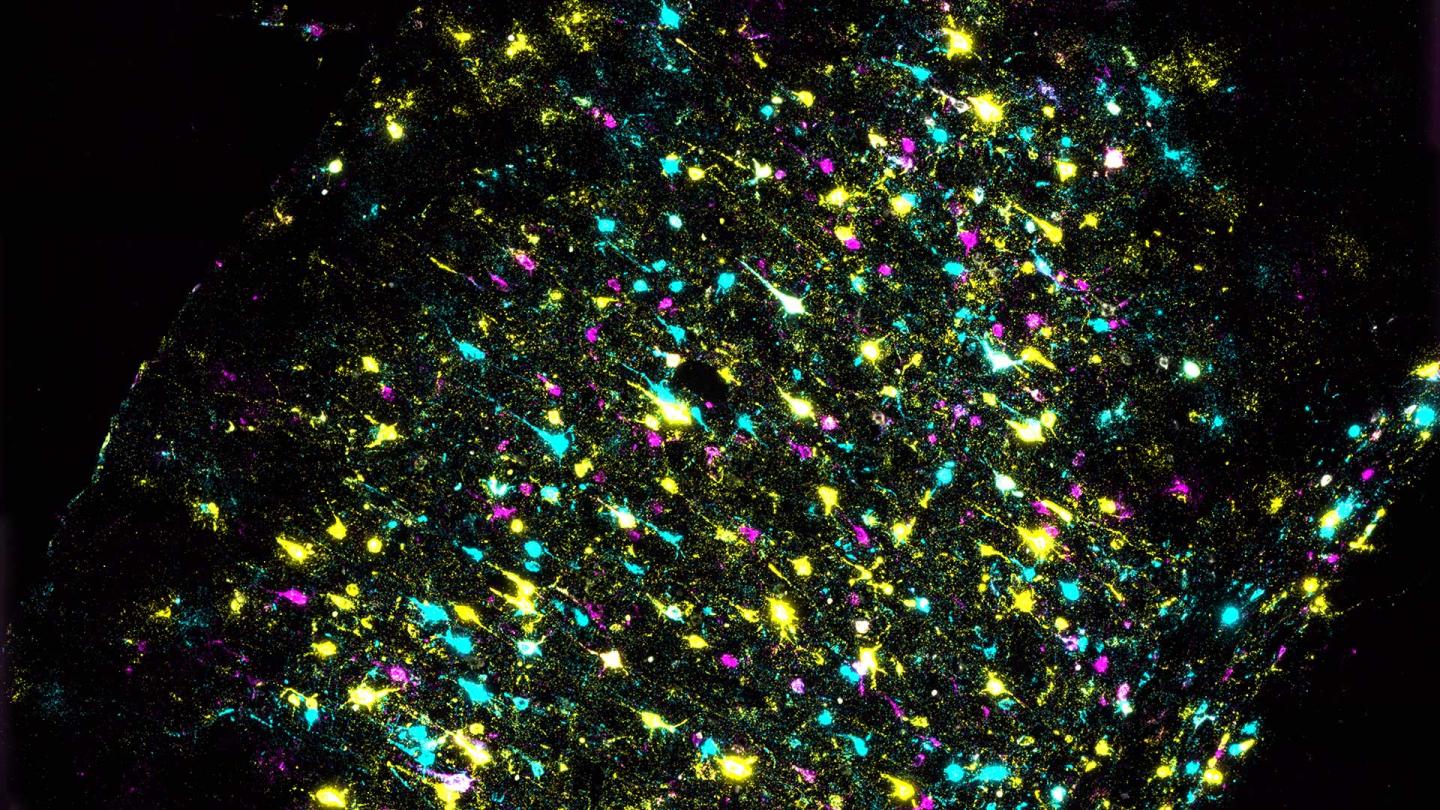
Credit: Xiaoyin Chen, Zador lab/CSHL.

A new method developed at Cold Spring Harbor Laboratory (CSHL) uses DNA sequencing to efficiently map long-range connections between different regions of the brain. The approach dramatically reduces the cost of mapping brain-wide connections compared to traditional microscopy-based methods.

Neuroscientists need anatomical maps to understand how information flows from one region of the brain to another. “Charting the cellular connections between different parts of the brain–the connectome–can help reveal how the nervous system processes information, as well as how faulty wiring contributes to mental illness and other disorders,” says Longwen Huang, a postdoctoral researcher in CSHL Professor Anthony Zador’s lab. Creating these maps has been expensive and time-consuming, demanding massive efforts that are out of reach for most research teams.

Researchers usually follow neurons’ paths using fluorescent labels, which can highlight how individual cells branch through a tangled neural network to find and connect with their targets. But, the palette of fluorescent labels suitable for this work is limited. Researchers can inject different colored dyes into two or three parts of the brain, then trace the connections emanating from those regions. They can repeat this process, targeting new regions, to visualize additional connections. In order to generate a brain-wide map, this must be done hundreds of times, using new research animals each time.

[Watch the mouse brain connectome: https://www.youtube.com/watch?v=m8JmyCm991g]

The method developed in the Zador lab, called brain-wide individual animal connectome sequencing (BRICseq), takes a different approach. “We no longer label brain regions and their projections using colors. We are labeling them using nucleotide sequences,” Huang says. Combining the four letters of the DNA code into short “barcodes” generates a virtually infinite number of labels that can distinguish one cell from one another, he explains. After labeling, researchers use DNA sequencing to analyze tiny segments of brain tissue, interpreting each recurring barcode as a signal of a cellular connection.

“The diversity of barcodes is really high compared to the number of colors we can use in science research. So now we can really label a huge amount of neurons and brain regions per animal, which allows us to map projections from multiple brain regions using these barcodes,” Huang says.

The research team, including former graduate student Justus Kebschull, who worked with Huang to develop the technique, report in the journal Cell that BRICseq accurately maps region-to-region connectivity in the brains of mice. They say the approach will be widely accessible and should be adaptable to other organisms.

###

Media Contact
Sara Roncero-Menendez
[email protected]

Original Source

https://www.cshl.edu/how-to-map-brain-connections-using-dna-barcodes/

Related Journal Article

http://dx.doi.org/10.1016/j.cell.2020.05.029

Tags: BiologyComputer ScienceGeneticsResearch/DevelopmentTechnology/Engineering/Computer Science
Share12Tweet8Share2ShareShareShare2

Related Posts

Lithium Shortages Hit Battery Giants Hardest, Global Supply Network Study Finds

Lithium Shortages Hit Battery Giants Hardest, Global Supply Network Study Finds

October 6, 2026
Scientists Rank Genetic Switches That Power Gene Control in Sperm-Producing Cells

Scientists Rank Genetic Switches That Power Gene Control in Sperm-Producing Cells

October 6, 2026

Hidden Bacterial World Inside a Famous Yunnan Medicinal Plant Revealed

October 6, 2026

Lake Trout Embryos Absorb Vitamin B1 Directly From Lake Water, Study Finds

October 6, 2026
Please login to join discussion

POPULAR NEWS

  • Alloys That Shrink Their Own Grains: New PIX Mechanism Refines Metals With Heat Alone

    Alloys That Shrink Their Own Grains: New PIX Mechanism Refines Metals With Heat Alone

    29 shares
    Share 12 Tweet 7
  • Endurance Exercise Reshapes the Liver in Males and Females Through Distinct Molecular Routes

    29 shares
    Share 12 Tweet 7
  • Single Transcription Factor PU.1 Rapidly Converts Fibroblasts into Macrophage-Lineage Cells

    29 shares
    Share 12 Tweet 7
  • New Scale Measures How Ready Nurse Educators Really Are for the AI Era

    29 shares
    Share 12 Tweet 7

About

We bring you the latest biotechnology news from best research centers and universities around the world. Check our website.

Follow us

Recent News

Alloys That Shrink Their Own Grains: New PIX Mechanism Refines Metals With Heat Alone

Endurance Exercise Reshapes the Liver in Males and Females Through Distinct Molecular Routes

Single Transcription Factor PU.1 Rapidly Converts Fibroblasts into Macrophage-Lineage Cells

Subscribe to Blog via Email

Success! An email was just sent to confirm your subscription. Please find the email now and click 'Confirm' to start subscribing.

Join 85 other subscribers
  • Contact Us

Bioengineer.org © Copyright 2023 All Rights Reserved.

Welcome Back!

Login to your account below

Forgotten Password?

Retrieve your password

Please enter your username or email address to reset your password.

Log In
No Result
View All Result
  • Homepages
    • Home Page 1
    • Home Page 2
  • News
  • National
  • Business
  • Health
  • Lifestyle
  • Science

Bioengineer.org © Copyright 2023 All Rights Reserved.