

• HOME
  • NEWS
  • EXPLORE
    • CAREER
      • Companies
      • Jobs
    • EVENTS
    • iGEM
      • News
      • Team
    • PHOTOS
    • VIDEO
    • WIKI
  • BLOG
  • COMMUNITY
    • FACEBOOK
    • INSTAGRAM
    • TWITTER
Saturday, June 27, 2026
BIOENGINEER.ORG
No Result
View All Result
  • Login
  • HOME
  • NEWS
  • EXPLORE
    • CAREER
      • Companies
      • Jobs
        • Lecturer
        • PhD Studentship
        • Postdoc
        • Research Assistant
    • EVENTS
    • iGEM
      • News
      • Team
    • PHOTOS
    • VIDEO
    • WIKI
  • BLOG
  • COMMUNITY
    • FACEBOOK
    • INSTAGRAM
    • TWITTER
  • HOME
  • NEWS
  • EXPLORE
    • CAREER
      • Companies
      • Jobs
        • Lecturer
        • PhD Studentship
        • Postdoc
        • Research Assistant
    • EVENTS
    • iGEM
      • News
      • Team
    • PHOTOS
    • VIDEO
    • WIKI
  • BLOG
  • COMMUNITY
    • FACEBOOK
    • INSTAGRAM
    • TWITTER
No Result
View All Result
Bioengineer.org
No Result
View All Result
Home NEWS Science News Health

How to convert climate-changing carbon dioxide into plastics and other products

Bioengineer by Bioengineer
November 20, 2018
in Health
Reading Time: 2 mins read
0
Share on FacebookShare on TwitterShare on LinkedinShare on RedditShare on Telegram
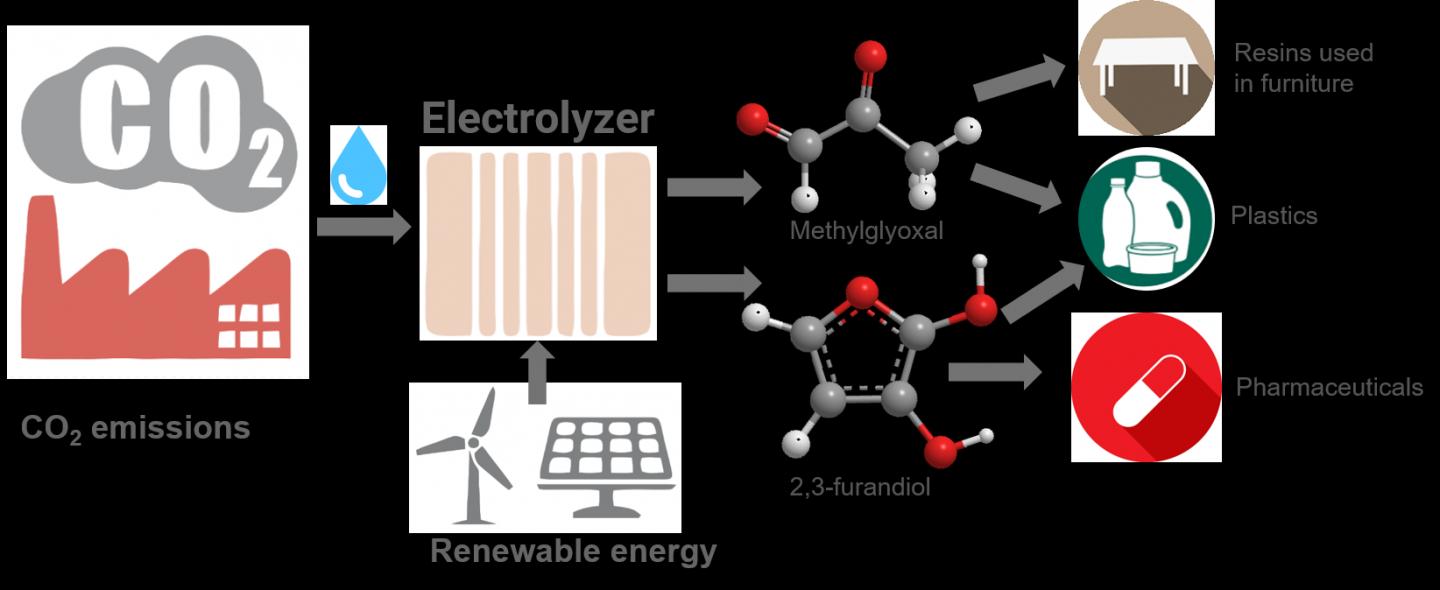
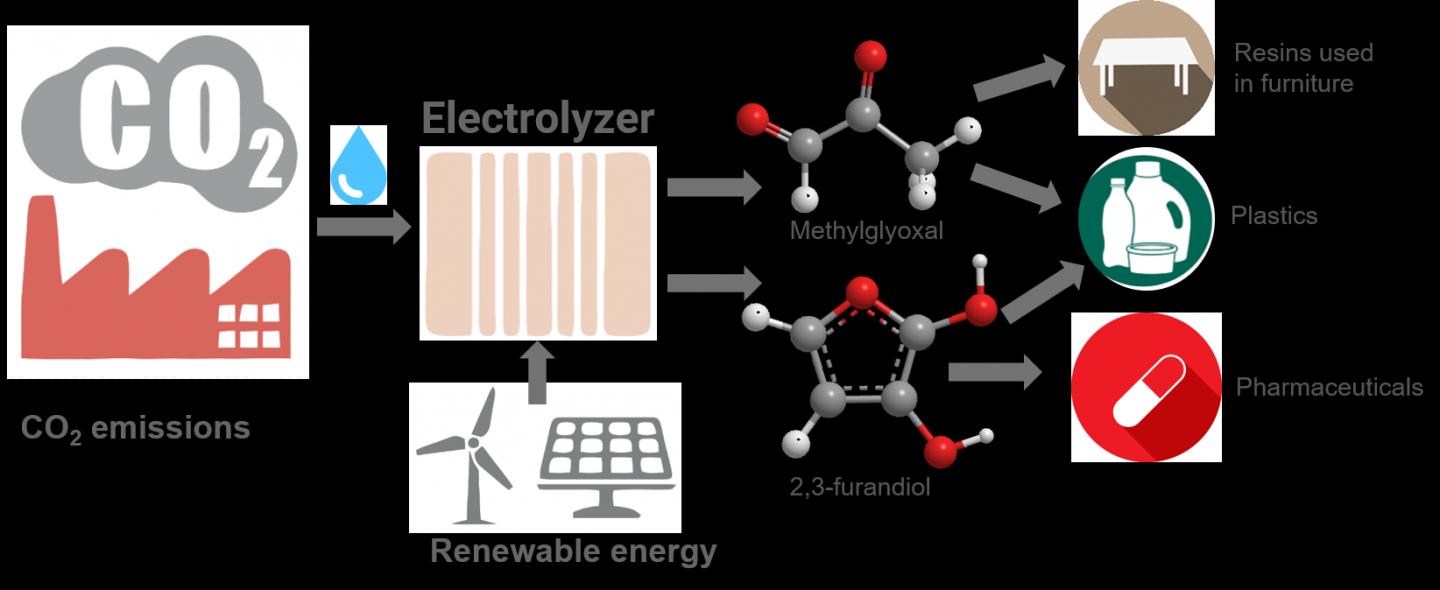
IMAGE

Credit: Karin Calvinho/Rutgers University-New Brunswick

Rutgers scientists have developed catalysts that can convert carbon dioxide – the main cause of global warming – into plastics, fabrics, resins and other products.

The electrocatalysts are the first materials, aside from enzymes, that can turn carbon dioxide and water into carbon building blocks containing one, two, three or four carbon atoms with more than 99 percent efficiency. Two of the products created by the researchers – methylglyoxal (C3) and 2,3-furandiol (C4) – can be used as precursors for plastics, adhesives and pharmaceuticals. Toxic formaldehyde could be replaced by methylglyoxal, which is safer.

The discovery, based on the chemistry of artificial photosynthesis, is detailed in the journal Energy & Environmental Science.

"Our breakthrough could lead to the conversion of carbon dioxide into valuable products and raw materials in the chemical and pharmaceutical industries," said study senior author Charles Dismukes, Distinguished Professor in the Department of Chemistry and Chemical Biology and Department of Biochemistry and Microbiology at Rutgers University-New Brunswick. He is also a principal investigator at Rutgers' Waksman Institute of Microbiology.

Previously, scientists showed that carbon dioxide can be electrochemically converted into methanol, ethanol, methane and ethylene with relatively high yields. But such production is inefficient and too costly to be commercially feasible, according to study lead author Karin Calvinho, a chemistry doctoral student in Rutgers' School of Graduate Studies.

However, carbon dioxide and water can be electrochemically converted into a wide array of carbon-based products, using five catalysts made of nickel and phosphorus, which are cheap and abundant, she said. The choice of catalyst and other conditions determine how many carbon atoms can be stitched together to make molecules or even generate longer polymers. In general, the longer the carbon chain, the more valuable the product.

Based on their research, the Rutgers scientists earned patents for the electrocatalysts and formed RenewCO2, a start-up company. The next step is to learn more about the underlying chemical reaction, so it can be used to produce other valuable products such as diols, which are widely used in the polymer industry, or hydrocarbons that can be used as renewable fuels. The Rutgers experts are designing, building and testing electrolyzers for commercial use.

###

Media Contact

Todd Bates
[email protected]
848-932-0550
@RutgersU

http://www.rutgers.edu

Original Source

https://news.rutgers.edu/how-convert-climate-changing-carbon-dioxide-plastics-and-other-products/20181116#.W-7kkuhKi70 http://dx.doi.org/10.1039/C8EE00936H

Share12Tweet8Share2ShareShareShare2

Related Posts

Tracking Lanthanide-Labeled Microplastics in Plants

June 25, 2026

Neural Design Enables Zero-Shot Drug-Binding Proteins

June 25, 2026

Genomic Insights into Human Skin Fungi Diversity

June 25, 2026

Chiral Laser Gyroscopes Surpass Lock-In Limit

June 25, 2026
Please login to join discussion

POPULAR NEWS

  • Saying Goodbye to PGY-6: Pediatric Fellowship Realities

    103 shares
    Share 41 Tweet 26
  • Multi-Hospital Study Reveals Long Covid Burden Is Twice as High as Current Estimates

    92 shares
    Share 36 Tweet 23
  • Detection of EDCs in Breast Milk and Infant Urine Up to Six Months Highlights Early Exposure Risks

    77 shares
    Share 31 Tweet 19
  • New Drug Candidate Developed at McMaster Shows Potential for Treating Brain Cancer

    58 shares
    Share 23 Tweet 15

About

We bring you the latest biotechnology news from best research centers and universities around the world. Check our website.

Follow us

Recent News

Tracking Lanthanide-Labeled Microplastics in Plants

POSTECH Researchers Slash Cost of Reconstituted Cell-Free Systems by 95%

AI and Physics Collaborate to Design Advanced Hydrogen Storage Materials

Subscribe to Blog via Email

Success! An email was just sent to confirm your subscription. Please find the email now and click 'Confirm' to start subscribing.

Join 82 other subscribers
  • Contact Us

Bioengineer.org © Copyright 2023 All Rights Reserved.

Welcome Back!

Login to your account below

Forgotten Password?

Retrieve your password

Please enter your username or email address to reset your password.

Log In
No Result
View All Result
  • Homepages
    • Home Page 1
    • Home Page 2
  • News
  • National
  • Business
  • Health
  • Lifestyle
  • Science

Bioengineer.org © Copyright 2023 All Rights Reserved.