• HOME
  • NEWS
  • EXPLORE
    • CAREER
      • Companies
      • Jobs
    • EVENTS
    • iGEM
      • News
      • Team
    • PHOTOS
    • VIDEO
    • WIKI
  • BLOG
  • COMMUNITY
    • FACEBOOK
    • INSTAGRAM
    • TWITTER
Saturday, May 9, 2026
BIOENGINEER.ORG
No Result
View All Result
  • Login
  • HOME
  • NEWS
  • EXPLORE
    • CAREER
      • Companies
      • Jobs
        • Lecturer
        • PhD Studentship
        • Postdoc
        • Research Assistant
    • EVENTS
    • iGEM
      • News
      • Team
    • PHOTOS
    • VIDEO
    • WIKI
  • BLOG
  • COMMUNITY
    • FACEBOOK
    • INSTAGRAM
    • TWITTER
  • HOME
  • NEWS
  • EXPLORE
    • CAREER
      • Companies
      • Jobs
        • Lecturer
        • PhD Studentship
        • Postdoc
        • Research Assistant
    • EVENTS
    • iGEM
      • News
      • Team
    • PHOTOS
    • VIDEO
    • WIKI
  • BLOG
  • COMMUNITY
    • FACEBOOK
    • INSTAGRAM
    • TWITTER
No Result
View All Result
Bioengineer.org
No Result
View All Result
Home NEWS Science News Chemistry

How to control friction in topological insulators

Bioengineer by Bioengineer
October 14, 2019
in Chemistry
Reading Time: 2 mins read
0
IMAGE
Share on FacebookShare on TwitterShare on LinkedinShare on RedditShare on Telegram

IMAGE

Credit: Image: University of Basel, Departement of Physics


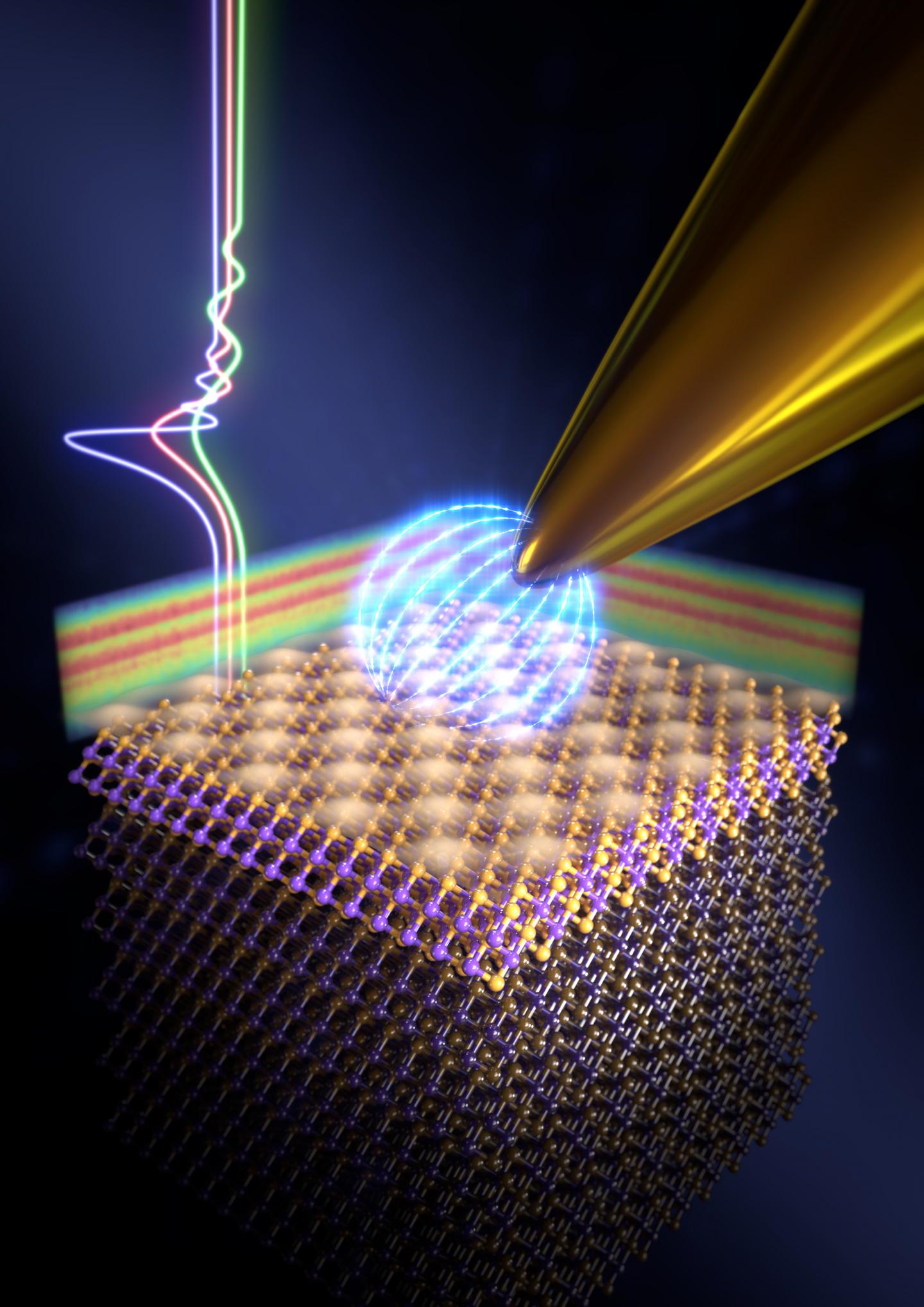
Topological insulators are innovative materials that conduct electricity on the surface, but act as insulators on the inside. Physicists at the University of Basel and the Istanbul Technical University have begun investigating how they react to friction. Their experiment shows that the heat generated through friction is significantly lower than in conventional materials. This is due to a new quantum mechanism, the researchers report in the scientific journal Nature Materials.

Thanks to their unique electrical properties, topological insulators promise many innovations in the electronics and computer industries, as well as in the development of quantum computers. The thin surface layer can conduct electricity almost without resistance, resulting in less heat than traditional materials. This makes them of particular interest for electronic components.

Furthermore, in topological insulators, the electronic friction – i.e. the electron-mediated conversion of electrical energy into heat – can be reduced and controlled. Researchers of the University of Basel, the Swiss Nanoscience Institute (SNI) and the Istanbul Technical University have now been able to experimentally verify and demonstrate exactly how the transition from energy to heat through friction behaves – a process known as dissipation.

Measuring friction with a pendulum

The team headed by Professor Ernst Meyer at the Department of Physics of the University of Basel investigated the effects of friction on the surface of a bismuth telluride topological insulator. The scientists used an atomic force microscope in pendulum mode. Here, the conductive microscope tip made of gold oscillates back and forth just above the two-dimensional surface of the topological insulator. When a voltage is applied to the microscope tip, the movement of the pendulum induces a small electrical current on the surface.

In conventional materials, some of this electrical energy is converted into heat through friction. The result on the conductive surface of the topological insulator looks very different: the loss of energy through the conversion to heat is significantly reduced.

“Our measurements clearly show that at certain voltages there is virtually no heat generation caused by electronic friction,” explains Dr. Dilek Yildiz, who carried out this work within the SNI PhD School.

A novel mechanism

The researchers were also able to observe for the first time a new quantum-mechanical dissipation mechanism that occurs only at certain voltages. Under these conditions, the electrons migrate from the tip through an intermediate state into the material – similar to the tunneling effect in scanning tunneling microscopes. By regulating the voltage, the scientists were able to influence the dissipation. “These measurements confirm the great potential of topological insulators, since electronic friction can be controlled in a targeted manner,” adds Meyer.

###

Media Contact
Reto Caluori
[email protected]
41-612-072-495

Related Journal Article

http://dx.doi.org/10.1038/s41563-019-0492-3

Tags: Atomic/Molecular/Particle PhysicsChemistry/Physics/Materials SciencesElectrical Engineering/ElectronicsNanotechnology/Micromachines
Share13Tweet8Share2ShareShareShare2

Related Posts

Miniature Sensor Uses Light to Detect Touch — Chemistry

Miniature Sensor Uses Light to Detect Touch

May 8, 2026
Iron Minerals Determine Whether Dissolved Organic Matter Fuels Microbes or Becomes Long-Term Carbon Storage — Chemistry

Iron Minerals Determine Whether Dissolved Organic Matter Fuels Microbes or Becomes Long-Term Carbon Storage

May 8, 2026

Kate Evans Appointed Associate Lab Director for Biological and Environmental Systems Science at ORNL

May 8, 2026

Advancing Multiscale Modeling and Overcoming Operational Challenges in Autothermal COâ‚‚-to-Methanol Reactors

May 8, 2026
Please login to join discussion

POPULAR NEWS

  • Research Indicates Potential Connection Between Prenatal Medication Exposure and Elevated Autism Risk

    839 shares
    Share 336 Tweet 210
  • New Study Reveals Plants Can Detect the Sound of Rain

    726 shares
    Share 290 Tweet 181
  • Scientists Investigate Possible Connection Between COVID-19 and Increased Lung Cancer Risk

    68 shares
    Share 27 Tweet 17
  • Salmonella Haem Blocks Macrophages, Boosts Infection

    61 shares
    Share 24 Tweet 15

About

We bring you the latest biotechnology news from best research centers and universities around the world. Check our website.

Follow us

Recent News

Esomeprazole vs. Fexuprazan: Anti-Inflammatory Effects Compared

Medical Care Patterns in Complex-Needs Chinese Elders

Epidermal MHC-II Drives NK Cell Attack in Psoriasis

Subscribe to Blog via Email

Enter your email address to subscribe to this blog and receive notifications of new posts by email.

Join 82 other subscribers
  • Contact Us

Bioengineer.org © Copyright 2023 All Rights Reserved.

Welcome Back!

Login to your account below

Forgotten Password?

Retrieve your password

Please enter your username or email address to reset your password.

Log In
No Result
View All Result
  • Homepages
    • Home Page 1
    • Home Page 2
  • News
  • National
  • Business
  • Health
  • Lifestyle
  • Science

Bioengineer.org © Copyright 2023 All Rights Reserved.