


Apply immune expertise and some genital wart cream!
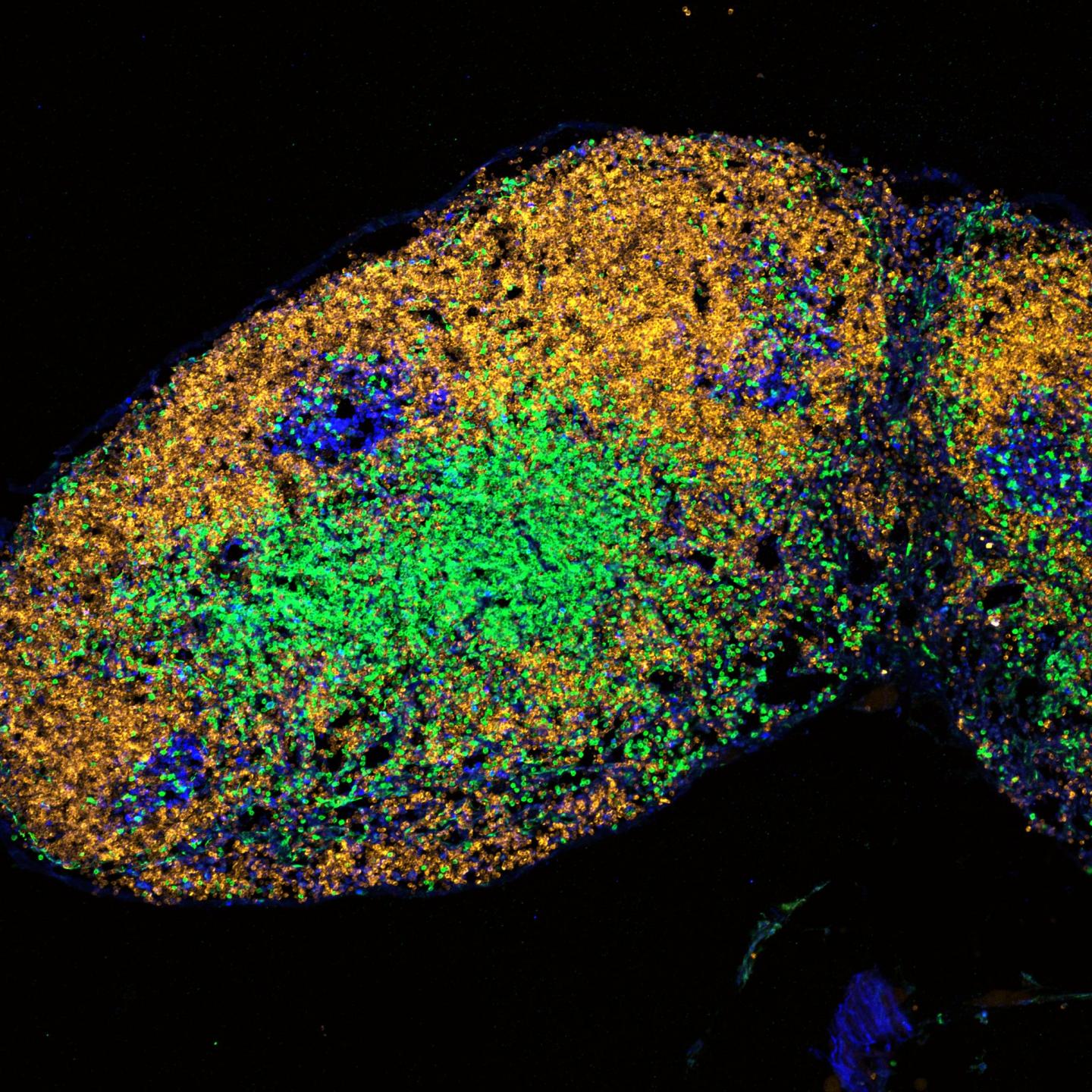
Credit: Babraham Institute
Research just published by the Linterman lab shows that the immune system of older mice can be given a helping hand by applying immunology expertise and some genital wart treatment (don’t try this at home just yet)!
Mice and humans show similar age-dependent changes in their immune system so this finding offers hope for easily increasing the robustness of vaccination response in the older population.
As we age, the function of our immune system declines, rendering us more susceptible to infections, and making us less able to generate protective immunity after vaccination. By understanding the cellular and molecular mechanisms that underpin this poor response in older individuals, researchers in the Linterman lab were able to repurpose an existing treatment for genital warts, and demonstrate that this was effective in overcoming the age-related effects on two of the many cell types making up our immune system. The research is published online in the journal eLife.
Dr Michelle Linterman, a group leader in the Institute’s Immunology research programme, said: “The current coronavirus pandemic highlights that older members of our families and communities are more susceptible to the morbidity and mortality associated with infectious diseases. Therefore, it is imperative that we understand how the immune system in older people works, and to explore how we might be able to boost their immune responses to vaccines to ensure they work well in this vulnerable part of our society.”
Vaccines work by generating antibodies that are able to block the ability of pathogens to infect us. Antibody secreting cells are produced in the germinal centre, immune reaction hubs that forms after infection or vaccination. With age, the magnitude and quality of the germinal centre reaction declines.
Immune cells called T follicular helper cells are essential to the germinal centre response. In this study the team used mice and humans to investigate why T follicular helper cell numbers decline with age, and if there is a way to boost them upon vaccination.
“The germinal centre response is a highly collaborative process that requires multiple cell types to interact at the right place and the right time. Therefore, it made sense to us that defects in one or more of these cell types could explain the poor germinal centre response observed in older individuals after vaccination,” explains Dr Linterman.
The researchers found that older mice and humans form fewer T follicular helper cells after vaccination, which is linked with a poor germinal centre response and antibody response. By developing our understanding of the cellular and molecular events occurring in the germinal centre after vaccination, the researchers identified that T follicular helper cells in older mice and people received less stimulatory interactions from their immune system co-workers. By using a cream (imiquimod, currently used to treat genital warts in humans) on the site of immunisation to boost the number of stimulatory cells, they were able to restore the formation of T follicular helper cells in older mice and also rescue the age-dependent defects in another immune cell type (dendritic cells). Encouragingly, this demonstrates that the age-related defects in T follicular helper cell formation in ageing are not irreversible, and can be overcome therapeutically.
The full picture and evaluation of whether this approach will work as an intervention in humans requires more research into why the germinal centre response changes with age, and what can be done to overcome this. Once achieved, it could be that clinical trials are established to incorporate this knowledge into new vaccine formulations for older people.
###
Media Contact
Louisa Wood
[email protected]
44-078-334-81170
Original Source
https:/
Related Journal Article
http://dx.



