• HOME
  • NEWS
  • EXPLORE
    • CAREER
      • Companies
      • Jobs
    • EVENTS
    • iGEM
      • News
      • Team
    • PHOTOS
    • VIDEO
    • WIKI
  • BLOG
  • COMMUNITY
    • FACEBOOK
    • INSTAGRAM
    • TWITTER
Tuesday, May 12, 2026
BIOENGINEER.ORG
No Result
View All Result
  • Login
  • HOME
  • NEWS
  • EXPLORE
    • CAREER
      • Companies
      • Jobs
        • Lecturer
        • PhD Studentship
        • Postdoc
        • Research Assistant
    • EVENTS
    • iGEM
      • News
      • Team
    • PHOTOS
    • VIDEO
    • WIKI
  • BLOG
  • COMMUNITY
    • FACEBOOK
    • INSTAGRAM
    • TWITTER
  • HOME
  • NEWS
  • EXPLORE
    • CAREER
      • Companies
      • Jobs
        • Lecturer
        • PhD Studentship
        • Postdoc
        • Research Assistant
    • EVENTS
    • iGEM
      • News
      • Team
    • PHOTOS
    • VIDEO
    • WIKI
  • BLOG
  • COMMUNITY
    • FACEBOOK
    • INSTAGRAM
    • TWITTER
No Result
View All Result
Bioengineer.org
No Result
View All Result
Home NEWS Science News Biology

How the snail’s shell got its coil

Bioengineer by Bioengineer
May 14, 2019
in Biology
Reading Time: 3 mins read
0
IMAGE
Share on FacebookShare on TwitterShare on LinkedinShare on RedditShare on Telegram

IMAGE

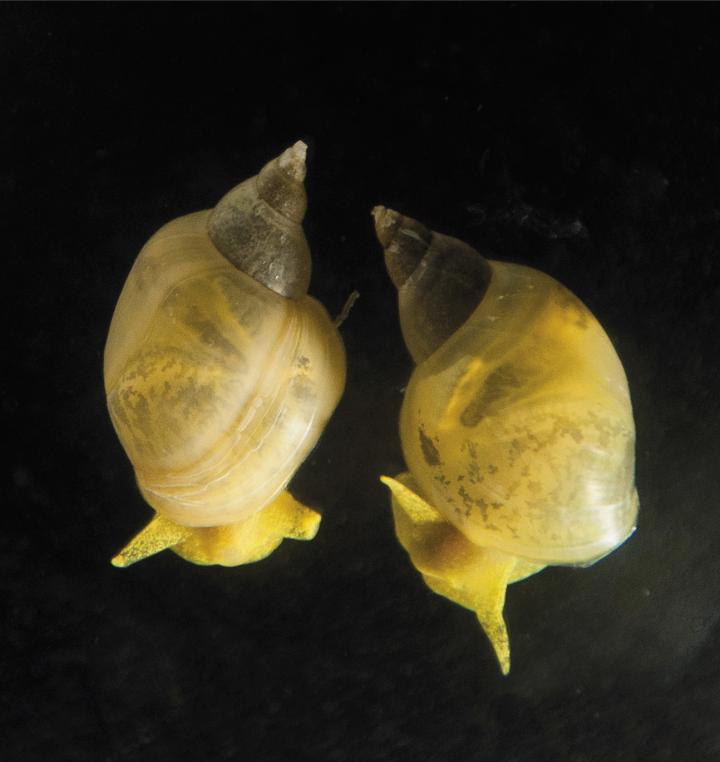
Credit: Dr Hiromi Takahashi of the Kuroda laboratory.

If you look at a snail’s shell, the chances are it will coil to the right. But, occasionally, you might find an unlucky one that twists in the opposite direction – as fans of Jeremy the
lefty snail will remember, these snails struggle to mate with the more common rightward-coiling individuals.

This chirality (direction of coiling) of snail shells is an outward manifestation of left-right asymmetry: a phenomenon seen across animal evolution and extending to humans – your heart is (probably) on your left side, while your liver is to the right. But how does this
asymmetry come about? Researchers from Japan, writing in the journal Development, think they now have a definitive answer – for one species of freshwater snail (Lymnaea stagnalis) at least.

Successfully applying CRISPR gene editing technology to molluscs for the first time, Masanori Abe and Reiko Kuroda (working at Tokyo University of Science, but recently
relocated to Chubu University, Japan), have now made snails with mutations in a gene called Lsdia1, which had previously been suggested – but not conclusively proven – to be involved in snail shell coiling; snails without a functional copy of Lsdia1 produce offspring with shells that coil to the left, showing that this single gene is responsible for rightwardcoiling. Surprisingly, the researchers could see signs of asymmetry at the earliest possible
stage of development – when the snail embryo was just a single cell. Moreover, the mutant snails could be reared to adults, when they produced exclusively leftward-coiling
offspring. According to Kuroda: “It is remarkable that these snails with reversed coiling are healthy and fertile, and that this coiling can be inherited generation after generation
(we now have 5th-generation leftward-coiling snails). Further, these results may have an implication for snail evolution and speciation – given that left- and rightward-coiling snails probably wouldn’t interbreed.”

It’s still not clear how Lsdia1 might control left-right asymmetry: the gene encodes a formin, a protein that is involved in regulating the cell’s internal skeleton, but more work is needed to understand how this influences the cellular behaviours that control handedness – which is something Kuroda and her colleagues are actively working on. But given that genes like Lsdia1 are found throughout the animal kingdom, similar mechanisms for controlling left-right asymmetry could be at play in other species – including our own.

As Kuroda says: “Although diverse mechanisms have been proposed for different animals, we think a unified mechanism, involving formins and cellular chirality, is probable”. So while it may seem a big leap from snail shell coiling to human left-right asymmetries, it’s possible that future studies on how Lsdia1 works in snails might eventually help us understand why some babies are born with their heart on the right (which is of course the
wrong) side of their chest.

###

If reporting this story, please mention the journal Development as the source and, if reporting online, please carry a link to:
http://dev.biologists.org/content/146/9/dev175976

REFERENCE: Abe, M. and Kuroda, R. (2019) The development of CRISPR for a mollusc establishes the formin Lsdia1 as the long-sought gene for snail dextral/sinistral coiling (Development, in press)
doi: 10.1242/dev.175976

Media Contact
Reiko Kuroda
[email protected]

Related Journal Article

http://dx.doi.org/10.1242/dev.175976

Tags: BiologyBiomechanics/BiophysicsDevelopmental/Reproductive BiologyEvolutionGenetics
Share12Tweet8Share2ShareShareShare2

Related Posts

From Complexity to Clarity: Unraveling the “Topological Laws” Governing Cell Death — Biology

From Complexity to Clarity: Unraveling the “Topological Laws” Governing Cell Death

May 11, 2026
New Classification Framework Identifies Tumor-Associated Bacterial Effectors as Crucial Drivers of Tumor Biology and Immune Response — Biology

New Classification Framework Identifies Tumor-Associated Bacterial Effectors as Crucial Drivers of Tumor Biology and Immune Response

May 11, 2026

HIV-1 Strains Reveal Varied Paths to Antibody Escape

May 11, 2026

CRISPRi Screening Identifies Fungal-Specific Drug Targets

May 11, 2026
Please login to join discussion

POPULAR NEWS

  • Research Indicates Potential Connection Between Prenatal Medication Exposure and Elevated Autism Risk

    841 shares
    Share 336 Tweet 210
  • New Study Reveals Plants Can Detect the Sound of Rain

    728 shares
    Share 290 Tweet 182
  • Salmonella Haem Blocks Macrophages, Boosts Infection

    62 shares
    Share 25 Tweet 16
  • Breastmilk Balances E. coli and Beneficial Bacteria in Infant Gut Microbiomes

    57 shares
    Share 23 Tweet 14

About

We bring you the latest biotechnology news from best research centers and universities around the world. Check our website.

Follow us

Recent News

Humans and Zebra Finches Share Similar Speech Learning Techniques #ASA190

New Study Uncovers How Fungal Parasites Attack Strawberries and Raspberries

City of Hope Researchers to Present Groundbreaking Immunotherapy and Precision Medicine Advances Across Multiple Cancer Types at ASCO 2026

Subscribe to Blog via Email

Enter your email address to subscribe to this blog and receive notifications of new posts by email.

Join 82 other subscribers
  • Contact Us

Bioengineer.org © Copyright 2023 All Rights Reserved.

Welcome Back!

Login to your account below

Forgotten Password?

Retrieve your password

Please enter your username or email address to reset your password.

Log In
No Result
View All Result
  • Homepages
    • Home Page 1
    • Home Page 2
  • News
  • National
  • Business
  • Health
  • Lifestyle
  • Science

Bioengineer.org © Copyright 2023 All Rights Reserved.