• HOME
  • NEWS
  • EXPLORE
    • CAREER
      • Companies
      • Jobs
    • EVENTS
    • iGEM
      • News
      • Team
    • PHOTOS
    • VIDEO
    • WIKI
  • BLOG
  • COMMUNITY
    • FACEBOOK
    • INSTAGRAM
    • TWITTER
Thursday, February 5, 2026
BIOENGINEER.ORG
No Result
View All Result
  • Login
  • HOME
  • NEWS
  • EXPLORE
    • CAREER
      • Companies
      • Jobs
        • Lecturer
        • PhD Studentship
        • Postdoc
        • Research Assistant
    • EVENTS
    • iGEM
      • News
      • Team
    • PHOTOS
    • VIDEO
    • WIKI
  • BLOG
  • COMMUNITY
    • FACEBOOK
    • INSTAGRAM
    • TWITTER
  • HOME
  • NEWS
  • EXPLORE
    • CAREER
      • Companies
      • Jobs
        • Lecturer
        • PhD Studentship
        • Postdoc
        • Research Assistant
    • EVENTS
    • iGEM
      • News
      • Team
    • PHOTOS
    • VIDEO
    • WIKI
  • BLOG
  • COMMUNITY
    • FACEBOOK
    • INSTAGRAM
    • TWITTER
No Result
View All Result
Bioengineer.org
No Result
View All Result
Home NEWS Science News Neuroscience

How the brain recognizes familiar music

Bioengineer by Bioengineer
March 7, 2015
in Neuroscience
Reading Time: 2 mins read
1
Share on FacebookShare on TwitterShare on LinkedinShare on RedditShare on Telegram

Research from McGill University reveals that the brain’s motor network helps people remember and recognize music that they have performed in the past better than music they have only heard. A recent study by Prof. Caroline Palmer of the Department of Psychology sheds new light on how humans perceive and produce sounds, and may pave the way for investigations into whether motor learning could improve or protect memory or cognitive impairment in aging populations. The research is published in the journal Cerebral Cortex.

“The memory benefit that comes from performing a melody rather than just listening to it, or saying a word out loud rather than just hearing or reading it, is known as the ’production effect’ on memory”, says Prof. Palmer, a Canada Research Chair in Cognitive Neuroscience of Performance. “Scientists have debated whether the production effect is due to motor memories, such as knowing the feel of a particular sequence of finger movements on piano keys, or simply due to strengthened auditory memories, such as knowing how the melody tones should sound. Our paper provides new evidence that motor memories play a role in improving listeners’ recognition of tones they have previously performed.”

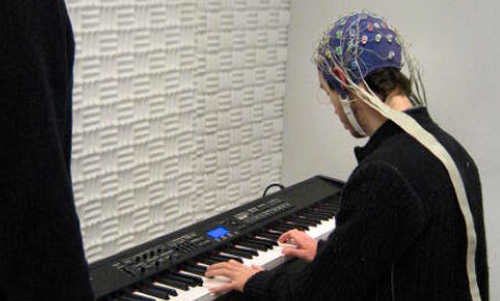
For the study, researchers recruited twenty skilled pianists from Lyon, France. The group was asked to learn simple melodies by either hearing them several times or performing them several times on a piano. Pianists then heard all of the melodies they had learned, some of which contained wrong notes, while their brain electric signals were measured using electroencephalography (EEG).

“We found that pianists were better at recognizing pitch changes in melodies they had performed earlier,” said the study’s first author, Brian Mathias, a McGill PhD student who conducted the work at the Lyon Neuroscience Research Centre in France with additional collaborators Drs. Barbara Tillmann and Fabien Perrin.

The team found that EEG measurements revealed larger changes in brain waves and increased motor activity for previously performed melodies than for heard melodies about 200 milliseconds after the wrong notes. This reveals that the brain quickly compares incoming auditory information with motor information stored in memory, allowing us to recognize whether a sound is familiar.

“This paper helps us understand ‘experiential learning’, or ‘learning by doing’, and offers pedagogical and clinical implications,” said Mathias, “The role of the motor system in recognizing music, and perhaps also speech, could inform education theory by providing strategies for memory enhancement for students and teachers.”

This study was conducted within the framework of the European Erasmus Mundus Auditory Cognitive Neuroscience exchange program, in which North American researchers complete a research project in collaboration with a European laboratory for 6-12 months.

Story Source:

The above story is based on materials provided by McGill University.
Share12Tweet8Share2ShareShareShare2

Related Posts

Redox biomarker could predict progression of epilepsy

October 5, 2016

Neural membrane’s structural instability may trigger multiple sclerosis

October 5, 2016

Scientists find new path in brain to ease depression

October 5, 2016

Key players responsible for learning and memory formation uncovered

October 3, 2016
Please login to join discussion

POPULAR NEWS

  • Robotic Ureteral Reconstruction: A Novel Approach

    Robotic Ureteral Reconstruction: A Novel Approach

    81 shares
    Share 32 Tweet 20
  • Digital Privacy: Health Data Control in Incarceration

    63 shares
    Share 25 Tweet 16
  • Study Reveals Lipid Accumulation in ME/CFS Cells

    57 shares
    Share 23 Tweet 14
  • Breakthrough in RNA Research Accelerates Medical Innovations Timeline

    53 shares
    Share 21 Tweet 13

About

We bring you the latest biotechnology news from best research centers and universities around the world. Check our website.

Follow us

Recent News

How Cells Break Down Damaged Huntingtin Proteins

Unlocking the Mysteries: How Dream Engineering Can Address Puzzling Questions

Astrocytes: Brain Disorder Guardians or Troublemakers?

Subscribe to Blog via Email

Enter your email address to subscribe to this blog and receive notifications of new posts by email.

Join 73 other subscribers
  • Contact Us

Bioengineer.org © Copyright 2023 All Rights Reserved.

Welcome Back!

Login to your account below

Forgotten Password?

Retrieve your password

Please enter your username or email address to reset your password.

Log In
No Result
View All Result
  • Homepages
    • Home Page 1
    • Home Page 2
  • News
  • National
  • Business
  • Health
  • Lifestyle
  • Science

Bioengineer.org © Copyright 2023 All Rights Reserved.