Plants protect themselves from environmental hazards like insects, drought and heat by producing salicylic acid, also known as aspirin. A new understanding of this process may help plants survive increasing stress caused by climate change.
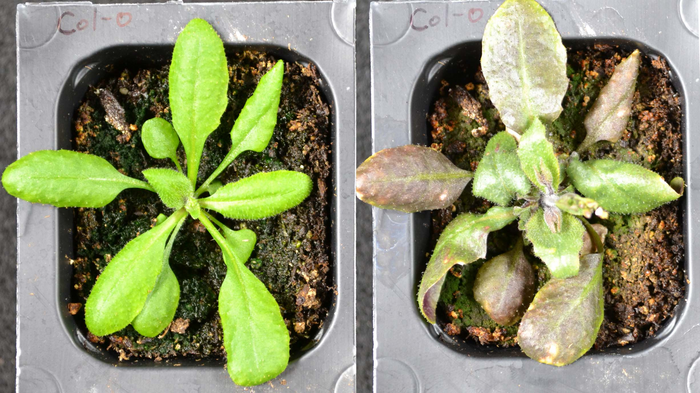
Credit: Jin-Zheng Wang/UCR
Plants protect themselves from environmental hazards like insects, drought and heat by producing salicylic acid, also known as aspirin. A new understanding of this process may help plants survive increasing stress caused by climate change.
UC Riverside scientists recently published a seminal paper in the journal Science Advances reporting how plants regulate the production of salicylic acid.
The researchers studied a model plant called Arabidopsis, but they hope to apply their understanding of stress responses in the cells of this plant to many other kinds of plants, including those grown for food.
“We’d like to be able to use the gained knowledge to improve crop resistance,” said Jin-Zheng Wang, UCR plant geneticist and co-first author on the new study. “That will be crucial for the food supply in our increasingly hot, bright world.”
Environmental stresses result in the formation of reactive oxygen species or ROS in all living organisms. Without sunscreen on a sunny day, human skin produces ROS, which causes freckles and burns. High levels of ROS in plants are lethal.
As with many substances, the poison is in the amount. At low levels, ROS have an important function in plant cells.
“At non-lethal levels, ROS are like an emergency call to action, enabling the production of protective hormones such as salicylic acid,” Wang said. “ROS are a double-edged sword.”
The research team discovered that heat, unabated sunshine, or drought cause the sugar-making apparatus in plant cells to generate an initial alarm molecule known as MEcPP.
Going forward, the researchers want to learn more about MEcPP, which is also produced in organisms such as bacteria and malaria parasites. Accumulation of MEcPP in plants triggers the production of salicylic acid, which in turn begins a chain of protective actions in the cells.
“It’s like plants use a painkiller for aches and pains, just like we do,” said Wilhelmina van de Ven, UCR plant biologist and co-first study author.
The acid protects plants’ chloroplasts, which are the site of photosynthesis, a process of using light to convert water and carbon dioxide into sugars for energy.
“Because salicylic acid helps plants withstand stresses becoming more prevalent with climate change, being able to increase plants’ ability to produce it represents a step forward in challenging the impacts of climate change on everyday life,” said Katayoon Dehesh, senior paper author and UCR distinguished professor of molecular biochemistry.
“Those impacts go beyond our food. Plants clean our air by sequestering carbon dioxide, offer us shade, and provide habitat for numerous animals. The benefits of boosting their survival are exponential,” she said.
Journal
Science Advances
DOI
10.1126/sciadv.abo0724
Method of Research
Experimental study
Article Title
Reciprocity between a retrograde signal and a putative metalloprotease reconfigures plastidial metabolic and structural states
Article Publication Date
3-Jun-2022