• HOME
  • NEWS
  • EXPLORE
    • CAREER
      • Companies
      • Jobs
    • EVENTS
    • iGEM
      • News
      • Team
    • PHOTOS
    • VIDEO
    • WIKI
  • BLOG
  • COMMUNITY
    • FACEBOOK
    • INSTAGRAM
    • TWITTER
Tuesday, May 19, 2026
BIOENGINEER.ORG
No Result
View All Result
  • Login
  • HOME
  • NEWS
  • EXPLORE
    • CAREER
      • Companies
      • Jobs
        • Lecturer
        • PhD Studentship
        • Postdoc
        • Research Assistant
    • EVENTS
    • iGEM
      • News
      • Team
    • PHOTOS
    • VIDEO
    • WIKI
  • BLOG
  • COMMUNITY
    • FACEBOOK
    • INSTAGRAM
    • TWITTER
  • HOME
  • NEWS
  • EXPLORE
    • CAREER
      • Companies
      • Jobs
        • Lecturer
        • PhD Studentship
        • Postdoc
        • Research Assistant
    • EVENTS
    • iGEM
      • News
      • Team
    • PHOTOS
    • VIDEO
    • WIKI
  • BLOG
  • COMMUNITY
    • FACEBOOK
    • INSTAGRAM
    • TWITTER
No Result
View All Result
Bioengineer.org
No Result
View All Result
Home NEWS Science News Chemistry

How spin dances with dipole

Bioengineer by Bioengineer
March 21, 2019
in Chemistry
Reading Time: 2 mins read
0
IMAGE
Share on FacebookShare on TwitterShare on LinkedinShare on RedditShare on Telegram

IMAGE

Credit: ©Science China Press

Both electric dipoles and spin moments can be ordered in solids, leading to ferro-type phases, e.g. ferromagnetism or ferroelectricity. Generally these two degrees of freedom are not simultaneously active in solids. Multiferroics, are those materials with orders of both spin moments and electric dipoles, which provide an ideal platform for these two vectors to twist together.

Even though, the coupling between magnetism and ferroelectricity is nontrivial since they obey different physical rules. From the symmetric aspect, an electric dipole breaks the spatial inversion symmetry while a spin moment breaks the time reversal symmetry. Microscopically, the existing of net magnetization requires unpaired spin, while the formation of dipole usually needs empty orbitals. Then how can they dance together?

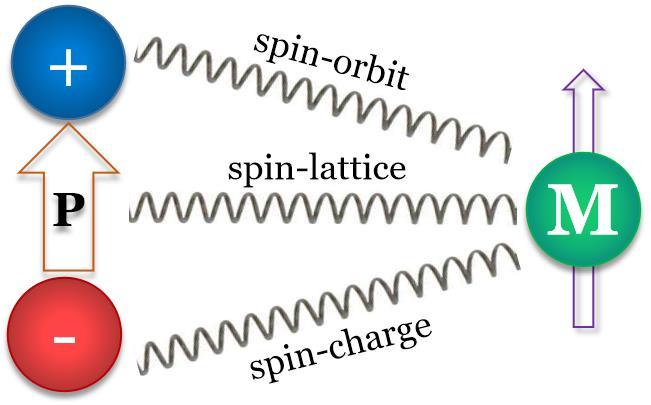
Thanks to the extensive studies in the past decades, now scientists know how to active both degrees of freedom in solids and link them together. In a recent Topical Review by Dong, Xiang, and Dagotto, published in Natl. Sci. Rev., the authors summarize various mechanisms to coupling magnetism and ferroelectricity, which can be categorized to three paths: spin-orbit coupling, spin-lattice coupling, spin-charge coupling. These physical mechanisms have been explained with examples of typical materials.

###

This research received funding from the National Natural Science Foundation of China, Special Funds for Major State Basic Research, the Qing Nian Ba Jian Program, the U.S. Department of Energy, Office of Science, Basic Energy Sciences, Materials Science and Engineering Division.

See the article:

Shuai Dong, Hongjun Xiang and Elbio Dagotto.

Magnetoelectricity in multiferroics: a theoretical perspective

Natl Sci Rev 2018; doi: 10.1093/nsr/nwz023

https://doi.org/10.1093/nsr/nwz023

The National Science Review is the first comprehensive scholarly journal released in English in China that is aimed at linking the country’s rapidly advancing community of scientists with the global frontiers of science and technology. The journal also aims to shine a worldwide spotlight on scientific research advances across China.

Media Contact
Bei Yan
[email protected]

Related Journal Article

http://dx.doi.org/10.1093/nsr/nwz023

Tags: Chemistry/Physics/Materials Sciences
Share12Tweet8Share2ShareShareShare2

Related Posts

TransEuroOGS Project to Connect Optical Ground Stations Across Europe — Chemistry

TransEuroOGS Project to Connect Optical Ground Stations Across Europe

May 19, 2026
Decarbonizing the Grid: The Essential First Step to Capturing Carbon from the Environment — Chemistry

Decarbonizing the Grid: The Essential First Step to Capturing Carbon from the Environment

May 19, 2026

Overcoming Mid-Infrared Interconnection Challenges: Durable Bonding Technique for High-Power Optics Using Liquid-Like Chalcogenide Glass

May 19, 2026

Solar Energy Breakthrough Enables Production of ‘Clean’ Chemicals, Plastics, and Food

May 19, 2026
Please login to join discussion

POPULAR NEWS

  • Research Indicates Potential Connection Between Prenatal Medication Exposure and Elevated Autism Risk

    845 shares
    Share 338 Tweet 211
  • New Study Reveals Plants Can Detect the Sound of Rain

    731 shares
    Share 292 Tweet 182
  • Salmonella Haem Blocks Macrophages, Boosts Infection

    62 shares
    Share 25 Tweet 16
  • Breastmilk Balances E. coli and Beneficial Bacteria in Infant Gut Microbiomes

    58 shares
    Share 23 Tweet 15

About

We bring you the latest biotechnology news from best research centers and universities around the world. Check our website.

Follow us

Recent News

New Houston Methodist Study Reveals Rising Breast Cancer Risk Among Younger Women and Enhanced Outcomes for Older Patients

Mount Sinai Experts to Unveil New AI Model Predicting Lung Nodule Risk and Study Effects of Air Pollution During Pregnancy at ATS 2026 International Conference

TransEuroOGS Project to Connect Optical Ground Stations Across Europe

Subscribe to Blog via Email

Enter your email address to subscribe to this blog and receive notifications of new posts by email.

Join 82 other subscribers
  • Contact Us

Bioengineer.org © Copyright 2023 All Rights Reserved.

Welcome Back!

Login to your account below

Forgotten Password?

Retrieve your password

Please enter your username or email address to reset your password.

Log In
No Result
View All Result
  • Homepages
    • Home Page 1
    • Home Page 2
  • News
  • National
  • Business
  • Health
  • Lifestyle
  • Science

Bioengineer.org © Copyright 2023 All Rights Reserved.