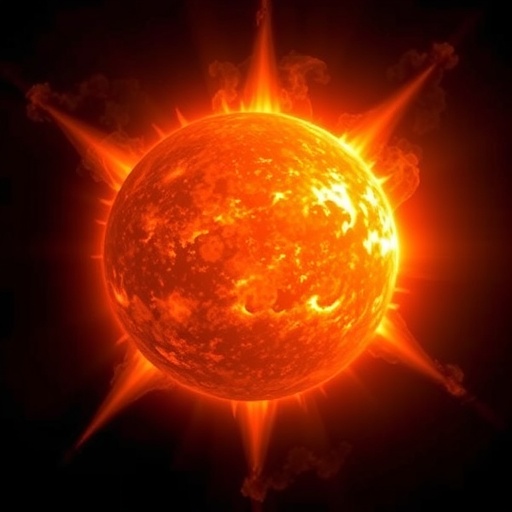
The Sun’s corona—its outer atmosphere—burns at over a million degrees Celsius, an extraordinary temperature that far exceeds that of its visible surface. Yet, amid this inferno, vast structures of remarkably cooler solar plasma, approximately 10,000 degrees Celsius, persist. These formations, known as solar prominences, are striking both in their size and nature, stretching thousands of kilometers and often appearing as delicate, flickering flames suspended against the blazing backdrop of the corona. Despite their fragile appearance, prominences are dense and massive, with plasma densities over a hundred times greater than that of the surrounding corona. In essence, they are colossal clouds of solar material seemingly floating against gravitational forces, akin to a mountainous mass suspended in mid-air. These formations can endure for weeks or even months. However, their dramatic potential is undeniable; when destabilized, prominences erupt violently, propelling charged particles into space. Should this stellar expulsion direct toward Earth, it can spark intense geomagnetic storms that threaten our technological infrastructure.
Understanding the lifecycle of solar prominences has long challenged astrophysicists. The recent landmark study from the Max Planck Institute for Solar System Research (MPS) in Germany brings new clarity to these enigmatic solar phenomena. Published in the prestigious journal Nature Astronomy, the research leverages advanced computational simulations to dissect the physics behind prominence formation and longevity. Unlike previous studies limited primarily to the solar atmosphere, this research integrates a detailed model encompassing both the Sun’s outer layers and the complex, convective zone beneath its visible surface. This holistic approach unravels the intricate interplay between magnetic fields and plasma flows, essential for sustaining these captivating solar structures.
At the heart of prominence dynamics lies the Sun’s magnetic field, an intricate and ever-shifting web forged by turbulent plasma convection deep below the surface. These magnetic fields extend outward, permeating the corona where prominences manifest, and dictate the behavior of plasma trapped within them. The research zeroes in on the lower solar atmosphere, or chromosphere, where temperatures peak around 20,000 degrees Celsius—significantly cooler than the million-degree corona. Here, turbulent motions twist magnetic field lines into complex configurations conducive to prominence formation. Specifically, the team modeled a magnetic field topology characterized by a double arch shape—akin to twin mountain peaks with a central dip nestled between them. This magnetic dip acts as a cradle, catching and holding cooler plasma to form the visible prominence.
The simulations reveal a fascinating injection process driven by small-scale magnetic disturbances that cause the chromosphere to eject blobs of cool plasma upward. These plasma parcels, akin to quivering flame-like tongues, become trapped in the magnetic dip within the corona. This trapping mechanism is vital, as it prevents the prominence material from dispersing rapidly into the outer corona’s scorching environment. However, prominences continually lose material, as parts of the plasma “rain” back down toward lower atmospheric layers. This natural attrition raises the question: How do prominences persist for extended periods despite these losses?
The answer, as uncovered by the researchers, lies in a delicate equilibrium maintained by continuous replenishment processes. The simulations demonstrate that two primary plasma supply routes compensate for the material loss. First, the chromosphere regularly injects fresh cool plasma into the prominence region, driven by magnetically energized ejections. Second, a smaller but significant contribution arises from the coronal plasma itself. Hot plasma traveling along the magnetic field lines condenses in the magnetic dip once it cools, adding mass to the prominence. This condensation process is reminiscent of water vapor cooling and coalescing into droplets, but here it involves solar plasma within the harsh conditions of the corona.
By incorporating the complex conditions of both atmospheric and sub-atmospheric layers in their numerical model, the MPS team has, for the first time, convincingly demonstrated how these dynamic supply mechanisms operate in tandem. The balance between plasma injection from below and condensation from above creates a self-sustaining system that explains the long-lived nature of prominences. Previous modeling efforts, often restricted to the corona, could only account for mass maintenance via condensation and thus offered an incomplete picture. This new work bridges a critical knowledge gap, underscoring the fundamental role that deep solar interior dynamics play in shaping corona phenomena.
Lisa-Marie Zeßner-Ondratschek, the study’s lead author, highlights the magnetic field’s decisive role, stating, “In the Sun’s atmosphere, the magnetic field is the driving force.” Through sophisticated magnetohydrodynamic simulations, the team traced how magnetic field lines not only mold plasma structures but also regulate flows of material across the chromosphere and corona interface. The double arch magnetic topology emerges as a natural and stable configuration favoring plasma confinement. The carefully resolved temperature gradients—ranging from the cool solar surface (~6,000°C) through the hotter chromosphere and into the scorching corona—also prove critical in governing plasma behavior and energy transport in the prominence system.
Implications of this research extend beyond solar physics. Since eruptive prominences are progenitors of coronal mass ejections (CMEs), which can unleash potent space weather events affecting satellite operations, power grids, and communication systems on Earth, a deeper mechanistic understanding furthers the goal of reliable space weather prediction. Accurate modeling of prominence growth and destabilization enhances scientists’ ability to forecast solar eruptions, providing vital lead time to mitigate their impact. The integrated simulation approach pioneered by MPS researchers represents a significant leap forward in predictive heliophysics.
Moreover, the study’s findings emphasize the inseparable coupling between the Sun’s interior turbulent plasma processes and the dramatic atmospheric manifestations observable in the corona. This interplay suggests that phenomena rooted in the Sun’s convective zone influence cycles of magnetic field evolution and coronal activity in intricate ways. Numerical models incorporating comprehensive solar layer physics, as demonstrated in this work, promise refined insight into solar magnetism’s complexities with broader applications to other magnetically active stars.
In conclusion, these self-consistent numerical simulations elucidate the formation, dynamic equilibrium, and survival of solar prominences with unprecedented fidelity. By capturing the continuous injection and condensation-driven supply of plasma within a magnetic dip, the study breaks new ground in explaining the longevity of these delicate yet massive solar structures. As solar observation techniques advance and computational power grows, such integrative models will become indispensable in decoding solar dynamics and safeguarding human technologies against the Sun’s volatile behavior.
Subject of Research: Not applicable
Article Title: Self-consistent numerical simulations for the formation and dynamics of solar prominences
News Publication Date: 22-Apr-2026
Web References: 10.1038/s41550-026-02840-7
Image Credits: MPS
Keywords
Solar prominences, solar corona, plasma simulation, magnetic fields, chromosphere, Sun’s convection zone, space weather prediction, coronal mass ejections, heliophysics, magnetohydrodynamics, solar plasma dynamics, solar magnetic topology
Tags: geomagnetic storms impactMax Planck Institute solar researchNature Astronomy solar studysolar atmosphere dynamicssolar eruptions and space weathersolar material supply mechanismssolar plasma structuressolar prominence densitysolar prominence lifecyclesolar prominence stabilitysolar prominencessun corona temperature