Major depressive disorder is often discussed as a disorder of mood, but its effects are rarely confined to the mind. People living with depression can also experience cardiovascular disease, metabolic disorders, chronic pain, inflammatory conditions and other physical illnesses at higher rates than the general population. Untangling why those conditions cluster together is one of the most difficult questions in psychiatric medicine. A research article in Nature Genetics, titled “Dissecting pleiotropy between major depressive disorder and physical disease comorbidities,” focuses on that problem by examining the biological overlap between depression and physical disease. The study’s title identifies its central subject—pleiotropy, in which a single biological factor influences multiple traits—but the supplied publication record does not include the article’s abstract, methods, results or conclusions. Any precise claim about the study’s findings therefore remains unavailable from the source material.
The question is important because comorbidity changes both the experience of illness and the way healthcare systems respond to it. Depression may alter sleep, appetite, physical activity, stress physiology and adherence to treatment, while chronic physical disease can produce pain, disability, social isolation and uncertainty—factors that can increase the risk of depressive symptoms. These relationships can run in both directions, making simple cause-and-effect explanations unreliable. A person who has depression and diabetes, for example, may share inherited biological risk for both conditions, develop one illness partly as a consequence of the other, receive medications that affect the second condition, or be exposed to social and environmental pressures that influence both. A genetic study of pleiotropy attempts to separate these overlapping explanations rather than treating every association as evidence that one disease directly causes another.
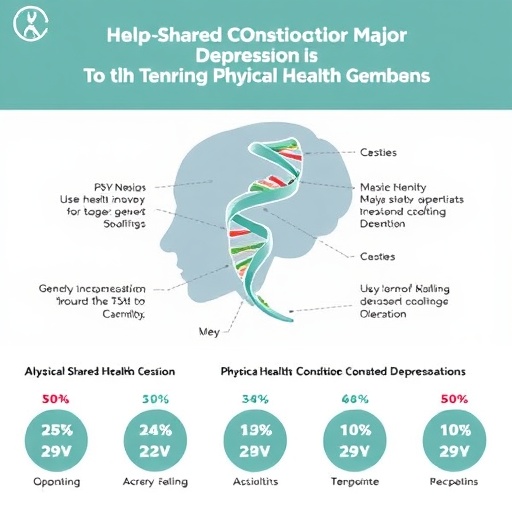
In genetics, pleiotropy describes the influence of one genetic variant, gene or biological pathway on more than one observable characteristic. The concept is not inherently harmful: many genes participate in several physiological systems, and the same molecular machinery may contribute to brain function, immune regulation, energy metabolism or cardiovascular biology. When researchers compare genetic associations for major depressive disorder with those for physical diseases, they can search for shared signals. Such overlap might point to common mechanisms, including inflammation, hormonal regulation, neuronal signalling, mitochondrial activity or the processing of stress. It might also reveal that apparently separate clinical diagnoses are partly different expressions of a shared underlying vulnerability. However, genetic overlap is not the same as a direct causal pathway. A shared variant can affect two diseases independently, or it can influence an intermediate trait that connects them.
Major depressive disorder is particularly challenging to study because it is clinically heterogeneous. Diagnostic criteria group together people with different combinations of symptoms, including persistent sadness, loss of interest or pleasure, changes in sleep and appetite, impaired concentration, fatigue and feelings of worthlessness or guilt. The disorder also varies in age of onset, duration, recurrence, severity and response to treatment. This diversity means that a genetic association detected across thousands of participants may represent only one component of a much broader biological landscape. Physical comorbidities are similarly diverse. Cardiovascular disease, obesity, type 2 diabetes, autoimmune illness and chronic pain have distinct causes, yet each may intersect with depression through overlapping biological and social routes. A study examining pleiotropy across multiple conditions therefore confronts the problem of identifying reproducible shared biology amid substantial variation.
Modern psychiatric genetics generally addresses these questions through large-scale association data. Genome-wide association studies scan millions of DNA positions across the genomes of many participants and compare variant frequencies between people with and without a trait or diagnosis. The resulting associations are usually small in effect, but collectively they can be used to estimate polygenic liability: the combined contribution of many variants to an individual’s statistical risk. Researchers can then compare polygenic patterns for major depressive disorder with those associated with physical diseases. Statistical measures such as genetic correlation quantify whether the same genetic variants tend to influence two traits in the same direction or in opposite directions. More detailed analyses can test whether overlap is concentrated in particular genomic regions, genes, tissues or biological pathways.
Those approaches can generate powerful clues, but they require careful interpretation. Genetic correlation may arise from genuine shared biology, from correlations between study samples, or from differences in ancestry, diagnosis, age, sex, socioeconomic conditions and other sources of bias. Depression-related genetic studies have historically relied heavily on participants of European ancestry, limiting how confidently their results can be generalized to other populations. Diagnostic definitions can also differ between clinical records, self-reported questionnaires and structured research assessments. Physical disease studies may use similarly varied criteria. These issues matter because a statistical signal can appear stronger or weaker depending on how traits are measured and who is included. Genetic findings also describe population-level probabilities; they do not determine whether a particular person will develop depression or any associated physical illness.
The word “dissecting” in the article title suggests an effort to move beyond a single measure of genetic correlation and examine the components of shared risk in greater detail. In principle, such work can distinguish broad pleiotropy—where many variants each contribute modestly to several traits—from more localized overlap involving particular genomic regions. It can also investigate whether the genetic architecture connecting depression with a physical disease is concentrated in biological pathways or tissues relevant to the brain, immune system, endocrine organs or metabolism. Other analyses may ask whether the apparent relationship is driven by a subset of symptoms, by disease severity, or by factors such as smoking, body mass index and sleep. The supplied source does not state which of these analyses the authors performed, so these possibilities should not be presented as reported results of the study.
The clinical significance of this research lies in the possibility of improving how depression and physical illness are recognized and treated together. If robust shared mechanisms can be identified, they might help researchers find therapeutic targets that benefit both mental and physical health. Genetic evidence could also support better risk stratification, although it is not currently a substitute for clinical assessment. A biological pathway associated with both depression and cardiovascular disease, for instance, might motivate studies of anti-inflammatory or metabolic interventions, but only controlled clinical trials can establish whether changing that pathway improves outcomes. Likewise, evidence of shared inherited risk could encourage integrated care, in which mental-health screening is routine for patients with chronic disease and physical-health monitoring is routine for people receiving psychiatric treatment. The goal would be more coordinated care, not the reduction of complex illnesses to a DNA score.
The publication of “Dissecting pleiotropy between major depressive disorder and physical disease comorbidities” places the study within a rapidly expanding effort to understand mental illness as part of whole-body biology. Its subject reflects a shift away from the old division between psychiatric and physical disease, while also highlighting the danger of replacing one oversimplification with another. Depression is not merely a chemical imbalance, and genetic overlap does not erase the roles of life experience, healthcare access, infection, trauma, medication, behaviour or chance. Because the available source contains only the bibliographic record, the article’s specific discoveries, datasets and implications cannot be independently summarized here. What can be said is that the research addresses a central problem in contemporary genetics: determining how shared biological influences contribute to the striking and clinically consequential coexistence of major depressive disorder with physical disease.
Subject of Research: Genetic pleiotropy between major depressive disorder and physical disease comorbidities
Subject of Research: Biology
Article Title: Dissecting pleiotropy between major depressive disorder and physical disease comorbidities
Article References: Woodward, D. J., Reay, W. R., Wormington, B., Diaz-Torres, S., Ong, J.-S., Gerring, Z. F., Thorp, J. G., & Derks, E. M. (2026). Dissecting pleiotropy between major depressive disorder and physical disease comorbidities. Nature Genetics. https://doi.org/10.1038/s41588-026-02735-3
Image Credits: AI Generated
DOI: 10.1038/s41588-026-02735-3
Keywords: major depressive disorder, pleiotropy, psychiatric genetics, physical disease, comorbidity, genetic correlation, genome-wide association studies, shared biological risk
Cite Scienmag News
APA MLA Chicago
Audrey B. (August 29, 2026). How Shared Genetics Link Major Depression to Physical Health Conditions. Scienmag. https://scienmag.com/how-shared-genetics-link-major-depression-to-physical-health-conditions/
Audrey B. “How Shared Genetics Link Major Depression to Physical Health Conditions.” Scienmag, 29 August 2026, https://scienmag.com/how-shared-genetics-link-major-depression-to-physical-health-conditions/. Accessed 29 August 2026.
Audrey B. “How Shared Genetics Link Major Depression to Physical Health Conditions.” Scienmag. August 29, 2026. https://scienmag.com/how-shared-genetics-link-major-depression-to-physical-health-conditions/
Copy citation Download RIS
Tags: biological factors linking depression and physical conditionsbiological overlap between depression and chronic paincomorbidity of major depressive disorder and cardiovascular diseasedepression and cardiovascular diseasedepression and chronic paindepression and metabolic disordersgenetic basis of depression and physical comorbiditiesgenetic factors influencing metabolic disorders and depressionGenetic links between depression and physical health conditionsgenetic overlap between depression and physical illnessesgenetic pleiotropyimpact of depression on physical healthimpact of genetics on depression-related health outcomesinflammation and mental healthmajor depressive disorderphysical and mental health comorbidityphysical health comorbiditiespleiotropy in psychiatric geneticspsychiatric and physical health gene interactionspsychiatric geneticsresearch on pleiotropy in mental and physical illnessesrole of genetics in depression-related stress and treatmentshared genetics in inflammatory conditions and mental health