• HOME
  • NEWS
  • EXPLORE
    • CAREER
      • Companies
      • Jobs
    • EVENTS
    • iGEM
      • News
      • Team
    • PHOTOS
    • VIDEO
    • WIKI
  • BLOG
  • COMMUNITY
    • FACEBOOK
    • INSTAGRAM
    • TWITTER
Tuesday, September 1, 2026
BIOENGINEER.ORG
No Result
View All Result
  • Login
  • HOME
  • NEWS
  • EXPLORE
    • CAREER
      • Companies
      • Jobs
        • Lecturer
        • PhD Studentship
        • Postdoc
        • Research Assistant
    • EVENTS
    • iGEM
      • News
      • Team
    • PHOTOS
    • VIDEO
    • WIKI
  • BLOG
  • COMMUNITY
    • FACEBOOK
    • INSTAGRAM
    • TWITTER
  • HOME
  • NEWS
  • EXPLORE
    • CAREER
      • Companies
      • Jobs
        • Lecturer
        • PhD Studentship
        • Postdoc
        • Research Assistant
    • EVENTS
    • iGEM
      • News
      • Team
    • PHOTOS
    • VIDEO
    • WIKI
  • BLOG
  • COMMUNITY
    • FACEBOOK
    • INSTAGRAM
    • TWITTER
No Result
View All Result
Bioengineer.org
No Result
View All Result
Home NEWS Science News Biology

How seeing corpses reduces the lifespan of flies

Bioengineer by Bioengineer
June 13, 2023
in Biology
Reading Time: 3 mins read
0
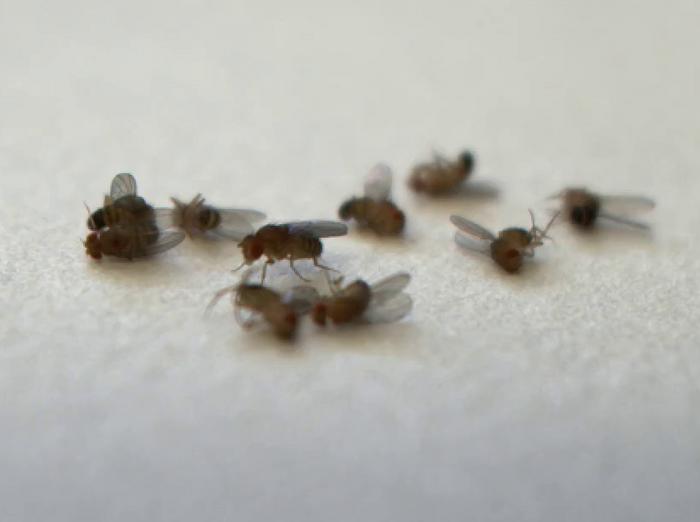
How seeing corpses reduces the lifespan of flies
Share on FacebookShare on TwitterShare on LinkedinShare on RedditShare on Telegram

Researchers led by Christi Gendron at the University of Michigan, US, have found the link between death perception and reduced aging in flies. Their new study, published June 13th in the open access journal PLOS Biology shows that a specific group of brain cells in the fly, called R2 and R4 neurons, are activated when flies encounter other dead flies, and that this increased activity leads to more rapid aging.
How seeing corpses reduces the lifespan of flies

Credit: Christi Gendron (CC-BY 4.0, https://creativecommons.org/licenses/by/4.0/)

Researchers led by Christi Gendron at the University of Michigan, US, have found the link between death perception and reduced aging in flies. Their new study, published June 13th in the open access journal PLOS Biology shows that a specific group of brain cells in the fly, called R2 and R4 neurons, are activated when flies encounter other dead flies, and that this increased activity leads to more rapid aging.

Aging is a complex process that can be affected by both genetics and the environment. While we know that perceptual experiences can affect aging, how this happens is still mostly a mystery. One example is the effect of “death perception” in fruit flies. Previously, the group at the University of Michigan reported that when fruit flies see other dead fruit flies, they experience advanced aging, and that this depends on a type of serotonin receptor. In their new follow-up study, the researchers report the details of this process.

A series of experiments in fruit flies showed that a specific group of neurons is responsible. Fluorescent tagging showed that exposure to dead flies led to increased activity in a region of the fly brain called the ellipsoid body. Silencing different ring neurons in this region revealed that two types of ring neurons, R2 and R4, are necessary for the effect, and other tests showed that the key is the serotonin receptor 5-HT2A located on these neurons. Finally, the researchers showed that when these neurons were artificially activated, fruit fly lifespans decreased, even when flies did not actually experience any death perception. Understanding how neural circuits like this regulate aging could eventually lead to targeted drug therapies in humans that slow the aging process.

Coauthor Scott Pletcher adds, “We identified specific neurons and evolutionarily conserved molecules in the fly brain that help tune rates of aging in response to environmental conditions and experiences.”

#####

In your coverage, please use this URL to provide access to the freely available paper in PLOS Biology: http://journals.plos.org/plosbiology/article?id=10.1371/journal.pbio.3002149  

Citation: Gendron CM, Chakraborty TS, Duran C, Dono T, Pletcher SD (2023) Ring neurons in the Drosophila central complex act as a rheostat for sensory modulation of aging. PLoS Biol 21(6): e3002149. https://doi.org/10.1371/journal.pbio.3002149

Author Countries: United States

Funding: This work is supported by National Institutes of Health, National Institute on Aging RO1AG051649 (to SDP), National Institutes of Health, National Institute on Aging RO1AG030593 (to SDP), National Institutes of Health, National Institute on Aging RO1AG063371 (to SDP), and the Glenn Medical Foundation (to SDP). The funders had no role in study design, data collection and analysis, decision to publish, or preparation of the manuscript.


Journal

PLoS Biology

DOI

10.1371/journal.pbio.3002149

Method of Research

Experimental study

Subject of Research

Animals

COI Statement

Competing interests: The authors have declared that no competing interests exist.

Share12Tweet8Share2ShareShareShare2

Related Posts

Methylation puts parasites in motion

Methylation puts parasites in motion

August 31, 2026
Desiccation promotes DNA damage and rifampin resistance in Mycobacterium tuberculosis

Desiccation promotes DNA damage and rifampin resistance in Mycobacterium tuberculosis

August 31, 2026

Gastrointestinal Parasitism in Cattle and Water Buffaloes in Pakistan: Prevalence and Associated Risk Factors

August 31, 2026

Development of HPLC–PDA method for steviol glycosides analysis in food matrices

August 31, 2026

POPULAR NEWS

  • β-Sitosterol from Ipomoea carnea Jacq. As a promising anti-inflammatory agent: Evidence from in silico modeling and in vitro validation

    29 shares
    Share 12 Tweet 7
  • Design, fabrication and characterization of a wearable Fiber Bragg grating sensor for cardiorespiratory monitoring using finger plethysmography

    29 shares
    Share 12 Tweet 7
  • KAIST opens the era of industrial-scale microbial foods, proposing growth strategies for the next-generation protein market

    29 shares
    Share 12 Tweet 7
  • Virologist awarded $2 million NIH grant to investigate how virus-infected cells live and die

    29 shares
    Share 12 Tweet 7

About

We bring you the latest biotechnology news from best research centers and universities around the world. Check our website.

Follow us

Recent News

β-Sitosterol from Ipomoea carnea Jacq. As a promising anti-inflammatory agent: Evidence from in silico modeling and in vitro validation

Design, fabrication and characterization of a wearable Fiber Bragg grating sensor for cardiorespiratory monitoring using finger plethysmography

KAIST opens the era of industrial-scale microbial foods, proposing growth strategies for the next-generation protein market

Subscribe to Blog via Email

Success! An email was just sent to confirm your subscription. Please find the email now and click 'Confirm' to start subscribing.

Join 85 other subscribers
  • Contact Us

Bioengineer.org © Copyright 2023 All Rights Reserved.

Welcome Back!

Login to your account below

Forgotten Password?

Retrieve your password

Please enter your username or email address to reset your password.

Log In
No Result
View All Result
  • Homepages
    • Home Page 1
    • Home Page 2
  • News
  • National
  • Business
  • Health
  • Lifestyle
  • Science

Bioengineer.org © Copyright 2023 All Rights Reserved.