• HOME
  • NEWS
  • EXPLORE
    • CAREER
      • Companies
      • Jobs
    • EVENTS
    • iGEM
      • News
      • Team
    • PHOTOS
    • VIDEO
    • WIKI
  • BLOG
  • COMMUNITY
    • FACEBOOK
    • INSTAGRAM
    • TWITTER
Thursday, June 25, 2026
BIOENGINEER.ORG
No Result
View All Result
  • Login
  • HOME
  • NEWS
  • EXPLORE
    • CAREER
      • Companies
      • Jobs
        • Lecturer
        • PhD Studentship
        • Postdoc
        • Research Assistant
    • EVENTS
    • iGEM
      • News
      • Team
    • PHOTOS
    • VIDEO
    • WIKI
  • BLOG
  • COMMUNITY
    • FACEBOOK
    • INSTAGRAM
    • TWITTER
  • HOME
  • NEWS
  • EXPLORE
    • CAREER
      • Companies
      • Jobs
        • Lecturer
        • PhD Studentship
        • Postdoc
        • Research Assistant
    • EVENTS
    • iGEM
      • News
      • Team
    • PHOTOS
    • VIDEO
    • WIKI
  • BLOG
  • COMMUNITY
    • FACEBOOK
    • INSTAGRAM
    • TWITTER
No Result
View All Result
Bioengineer.org
No Result
View All Result
Home NEWS Science News

How proteins reshape cell membranes

Bioengineer by Bioengineer
February 24, 2017
in Science News
Reading Time: 2 mins read
0
Share on FacebookShare on TwitterShare on LinkedinShare on RedditShare on Telegram
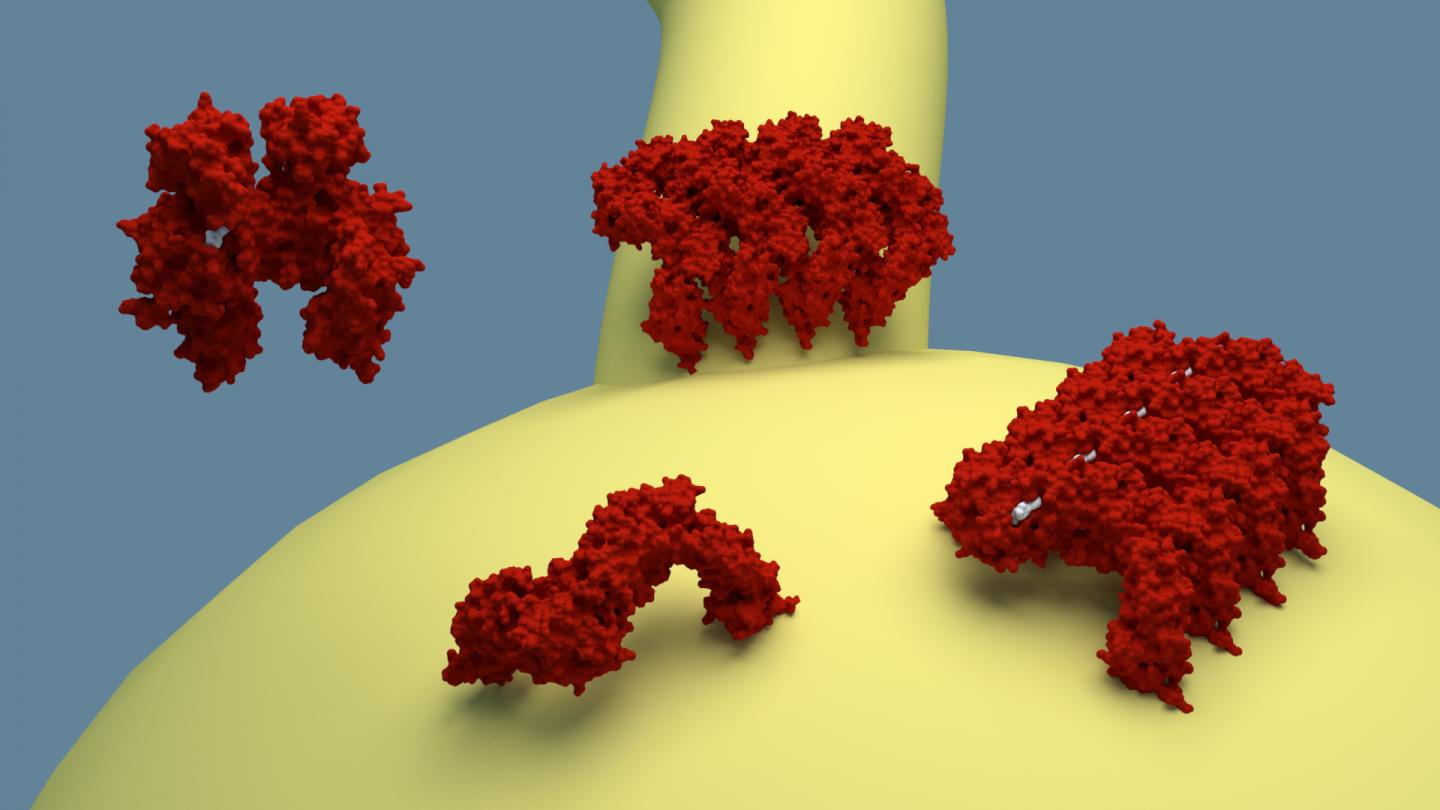
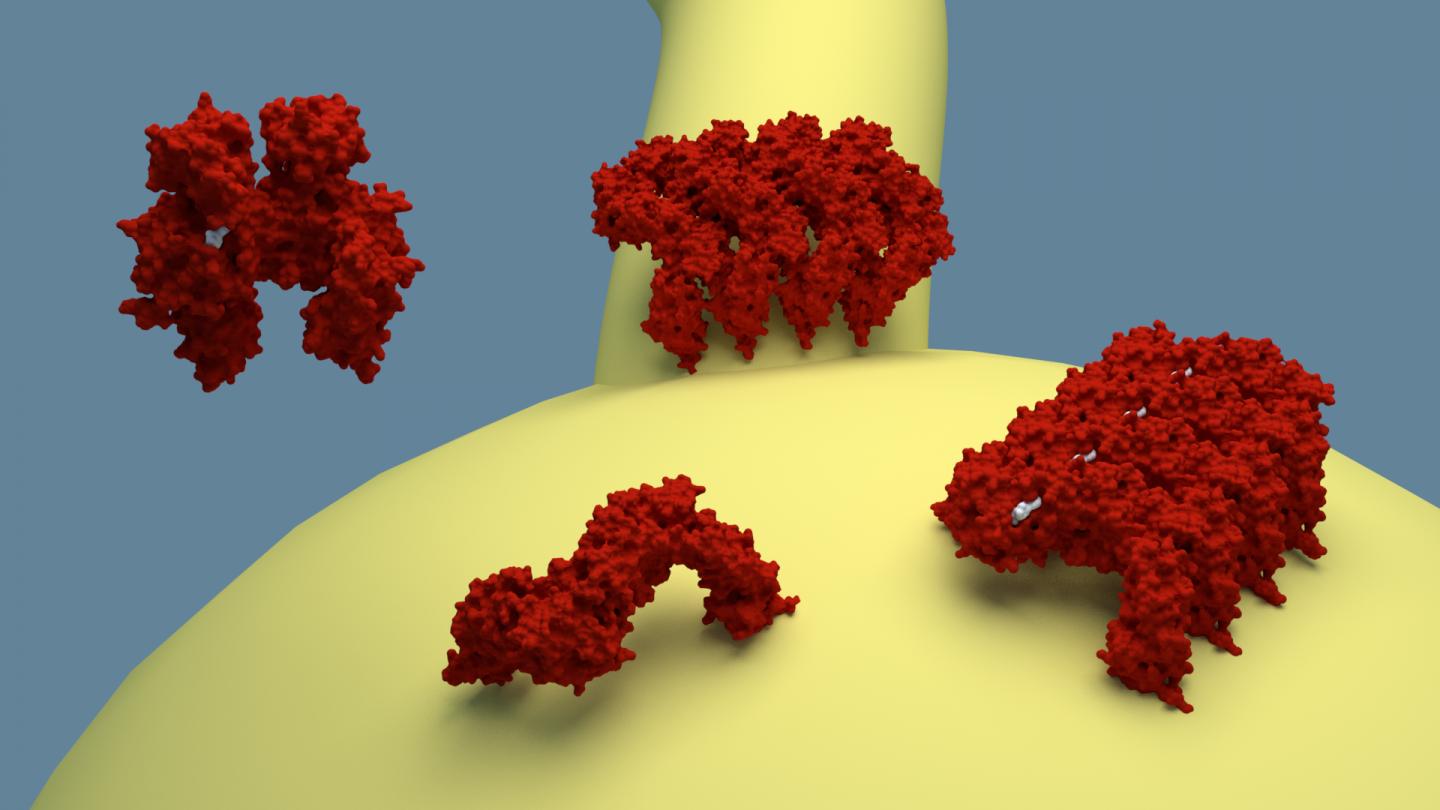
IMAGE

Credit: Image: Arthur Alves de Melo, MDC

Small "bubbles" frequently form on membranes of cells and are taken up into their interior. The process involves EHD proteins – a focus of research by Prof. Oliver Daumke of the MDC. He and his team have now shed light on how these proteins assemble on the surface of a cell and reshape its membrane.

Fairground entertainers can transform simple balloons into elaborate figures with just a few twists. They do this by "pinching off" sections of the balloon's surface – a method similar to that used by cells to create small bubbles known as vesicles for the transport of molecules. Vesicles are used to take up nutrients and play an important role in the transmission of neural signals.

EHD proteins are one type of molecular machine responsible for the creation of vesicles. These proteins bind themselves to the inside of a cell membrane, where they form long chains and ring-like structures. The rings then invaginate the membrane, contract like a drawstring, and, finally, detach the vesicle from the surface of the cell.

Oliver Daumke of the Max Delbrück Center for Molecular Medicine in the Helmholtz Association (MDC) is investigating the function and spatial structure of these EHD proteins. In an earlier study, he and his team analyzed the three-dimensional structure of EHDs in an inactive form – i.e. not bound to the membrane. Until now, scientists did not know how EHD proteins become activated, attach to the membrane and shape it into tubular structures.

Together with international colleagues, Daumke and his PhD student Arthur Alves de Melo have now published an article in the current issue of the scientific journal PNAS that describes the active form of this molecular EHD machine – that which occurs when it comes into contact with the membrane. Comparing the active and inactive protein structures, they discovered that EHD molecules flip open when they bind to the membrane, exposing specialized regions. One of these regions allows them to organize in extended chains and ring-like structures. Another region reorients toward the membrane and anchors the molecular machines on the cell surface.

With this work, Daumke's team has now described two steps in the operation of EHDs. "To understand the complete operating cycle and thus the full function of these molecular EHD machines, we must now analyze various other states," he says. "That is a task for the coming years."

###

Arthur Alves Melo et al. (2017): "Structural insights into the activation mechanism of dynamin-like Eps15-homology domain proteins." PNAS.

Media Contact

Vera Glaßer
[email protected]
49-309-406-2120

http://www.mdc-berlin.de

############

Story Source: Materials provided by Scienmag

Share12Tweet8Share2ShareShareShare2

Related Posts

Tracking Lanthanide-Labeled Microplastics in Plants

June 25, 2026

POSTECH Researchers Slash Cost of Reconstituted Cell-Free Systems by 95%

June 25, 2026

AI and Physics Collaborate to Design Advanced Hydrogen Storage Materials

June 25, 2026

Natural Hallucinogens: Evolution’s Ecological Tools, Not Mere Chemical Byproducts

June 25, 2026
Please login to join discussion

POPULAR NEWS

  • Saying Goodbye to PGY-6: Pediatric Fellowship Realities

    103 shares
    Share 41 Tweet 26
  • Multi-Hospital Study Reveals Long Covid Burden Is Twice as High as Current Estimates

    92 shares
    Share 36 Tweet 23
  • Detection of EDCs in Breast Milk and Infant Urine Up to Six Months Highlights Early Exposure Risks

    77 shares
    Share 31 Tweet 19
  • New Drug Candidate Developed at McMaster Shows Potential for Treating Brain Cancer

    58 shares
    Share 23 Tweet 15

About

We bring you the latest biotechnology news from best research centers and universities around the world. Check our website.

Follow us

Recent News

Tracking Lanthanide-Labeled Microplastics in Plants

POSTECH Researchers Slash Cost of Reconstituted Cell-Free Systems by 95%

AI and Physics Collaborate to Design Advanced Hydrogen Storage Materials

Subscribe to Blog via Email

Enter your email address to subscribe to this blog and receive notifications of new posts by email.

Join 82 other subscribers
  • Contact Us

Bioengineer.org © Copyright 2023 All Rights Reserved.

Welcome Back!

Login to your account below

Forgotten Password?

Retrieve your password

Please enter your username or email address to reset your password.

Log In
No Result
View All Result
  • Homepages
    • Home Page 1
    • Home Page 2
  • News
  • National
  • Business
  • Health
  • Lifestyle
  • Science

Bioengineer.org © Copyright 2023 All Rights Reserved.