• HOME
  • NEWS
  • EXPLORE
    • CAREER
      • Companies
      • Jobs
    • EVENTS
    • iGEM
      • News
      • Team
    • PHOTOS
    • VIDEO
    • WIKI
  • BLOG
  • COMMUNITY
    • FACEBOOK
    • INSTAGRAM
    • TWITTER
Friday, August 21, 2026
BIOENGINEER.ORG
No Result
View All Result
  • Login
  • HOME
  • NEWS
  • EXPLORE
    • CAREER
      • Companies
      • Jobs
        • Lecturer
        • PhD Studentship
        • Postdoc
        • Research Assistant
    • EVENTS
    • iGEM
      • News
      • Team
    • PHOTOS
    • VIDEO
    • WIKI
  • BLOG
  • COMMUNITY
    • FACEBOOK
    • INSTAGRAM
    • TWITTER
  • HOME
  • NEWS
  • EXPLORE
    • CAREER
      • Companies
      • Jobs
        • Lecturer
        • PhD Studentship
        • Postdoc
        • Research Assistant
    • EVENTS
    • iGEM
      • News
      • Team
    • PHOTOS
    • VIDEO
    • WIKI
  • BLOG
  • COMMUNITY
    • FACEBOOK
    • INSTAGRAM
    • TWITTER
No Result
View All Result
Bioengineer.org
No Result
View All Result
Home NEWS Science News Biology

How one marine chemistry lab slashed their carbon footprint

Bioengineer by Bioengineer
March 1, 2022
in Biology
Reading Time: 2 mins read
0
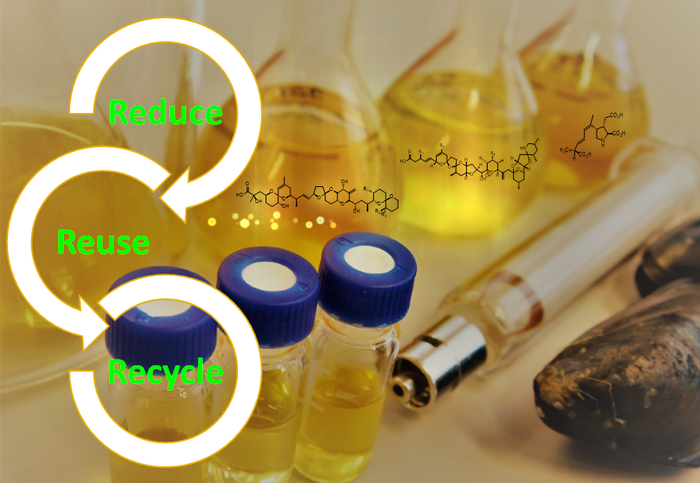
“Reduce, reuse, recycle”
Share on FacebookShare on TwitterShare on LinkedinShare on RedditShare on Telegram

Laboratories may consume large quantities of plastics, generate waste, and emit greenhouse gases. A report published in PLOS Sustainability and Transformation by Jane Kilcoyne and her colleagues at the Marine Institute, Galway, Ireland exemplifies how laboratories can significantly reduce their plastics and carbon footprint, and reduce financial costs, by transitioning to more efficient, sustainable laboratory materials and methods.
“Reduce, reuse, recycle”

Credit: Jane Kilcoyne, CC-BY 4.0 (https://creativecommons.org/licenses/by/4.0/)

Laboratories may consume large quantities of plastics, generate waste, and emit greenhouse gases. A report published in PLOS Sustainability and Transformation by Jane Kilcoyne and her colleagues at the Marine Institute, Galway, Ireland exemplifies how laboratories can significantly reduce their plastics and carbon footprint, and reduce financial costs, by transitioning to more efficient, sustainable laboratory materials and methods.

There are an estimated 20,500 laboratories involved in medical, biological, or agricultural research globally. The Marine Institute’s national monitoring program for the detection of biotoxins in shellfish introduced more sustainable practices into the laboratory, with the goal of reducing their plastics, waste to incineration/landfill, and greenhouse gas footprint, without compromising scientific standards.

The laboratory, comprising of a team of seven staff members, was able to significantly reduce its environmental footprint in multiple categories. By applying the reduce, reuse, recycle principle, more than 96 percent of non-chemical waste, including polystyrene and shellfish, was diverted from incineration/landfill, while single-use plastics were reduced by 69 percent. Hazardous chemical waste decreased by about 23 percent, and fume hood and cold storage equipment energy consumption decreased by 30 percent. A transition to digital document management led to an 81 percent reduction in printing. The strategies implemented led to annual cost savings of approximately €15,800. Sustainability efforts are still required, which the team will continue in order to meet the ultimate goal of achieving green lab certification.

The authors add: “Going green in the workplace is a win-win. Introducing more sustainable work practices into our monitoring program led to reduced environmental and financial costs, enhanced efficiencies, and boosted staff engagement.”


DOI

10.1371/journal.pstr.0000001

Method of Research

Experimental study

Subject of Research

Not applicable

Article Title

Reducing environmental impacts of marine biotoxin monitoring: A laboratory report

Article Publication Date

1-Mar-2022

COI Statement

The authors have declared that no competing interests exist.

Share12Tweet8Share2ShareShareShare2

Related Posts

Mainz cell biologist Uwe Wolfrum honored for major contributions to vision research

Mainz cell biologist Uwe Wolfrum honored for major contributions to vision research

August 21, 2026
Scientists trace the origins and domestication of modern cultivated chrysanthemums

Scientists trace the origins and domestication of modern cultivated chrysanthemums

August 21, 2026

New Tool Reveals Hidden Patterns in Complex Biological Data

August 21, 2026

Tropical Mountain Forest Canopies and Understories Reveal Contrasting Biodiversity Patterns Along Elevation

August 21, 2026

POPULAR NEWS

  • IDAMS Study Improves Early Prediction of Severe Dengue Outcomes

    29 shares
    Share 12 Tweet 7
  • Ultra-stretchable piezoelectric sensor monitors aircraft impacts across wide temperature ranges

    29 shares
    Share 12 Tweet 7
  • Apophis Flyby in 2029 Offers Rare Opportunity for Planetary Science and Defense

    29 shares
    Share 12 Tweet 7
  • Telemedicine-Supported Home Injections Offer New Care Model for Breast Cancer Patients

    29 shares
    Share 12 Tweet 7

About

We bring you the latest biotechnology news from best research centers and universities around the world. Check our website.

Follow us

Recent News

IDAMS Study Improves Early Prediction of Severe Dengue Outcomes

Ultra-stretchable piezoelectric sensor monitors aircraft impacts across wide temperature ranges

Apophis Flyby in 2029 Offers Rare Opportunity for Planetary Science and Defense

Subscribe to Blog via Email

Enter your email address to subscribe to this blog and receive notifications of new posts by email.

Join 85 other subscribers
  • Contact Us

Bioengineer.org © Copyright 2023 All Rights Reserved.

Welcome Back!

Login to your account below

Forgotten Password?

Retrieve your password

Please enter your username or email address to reset your password.

Log In
No Result
View All Result
  • Homepages
    • Home Page 1
    • Home Page 2
  • News
  • National
  • Business
  • Health
  • Lifestyle
  • Science

Bioengineer.org © Copyright 2023 All Rights Reserved.