• HOME
  • NEWS
  • EXPLORE
    • CAREER
      • Companies
      • Jobs
    • EVENTS
    • iGEM
      • News
      • Team
    • PHOTOS
    • VIDEO
    • WIKI
  • BLOG
  • COMMUNITY
    • FACEBOOK
    • INSTAGRAM
    • TWITTER
Saturday, May 30, 2026
BIOENGINEER.ORG
No Result
View All Result
  • Login
  • HOME
  • NEWS
  • EXPLORE
    • CAREER
      • Companies
      • Jobs
        • Lecturer
        • PhD Studentship
        • Postdoc
        • Research Assistant
    • EVENTS
    • iGEM
      • News
      • Team
    • PHOTOS
    • VIDEO
    • WIKI
  • BLOG
  • COMMUNITY
    • FACEBOOK
    • INSTAGRAM
    • TWITTER
  • HOME
  • NEWS
  • EXPLORE
    • CAREER
      • Companies
      • Jobs
        • Lecturer
        • PhD Studentship
        • Postdoc
        • Research Assistant
    • EVENTS
    • iGEM
      • News
      • Team
    • PHOTOS
    • VIDEO
    • WIKI
  • BLOG
  • COMMUNITY
    • FACEBOOK
    • INSTAGRAM
    • TWITTER
No Result
View All Result
Bioengineer.org
No Result
View All Result
Home NEWS Science News Biology

How nature, nurture shape the sleeping brain

Bioengineer by Bioengineer
September 24, 2018
in Biology
Reading Time: 2 mins read
0
Share on FacebookShare on TwitterShare on LinkedinShare on RedditShare on Telegram
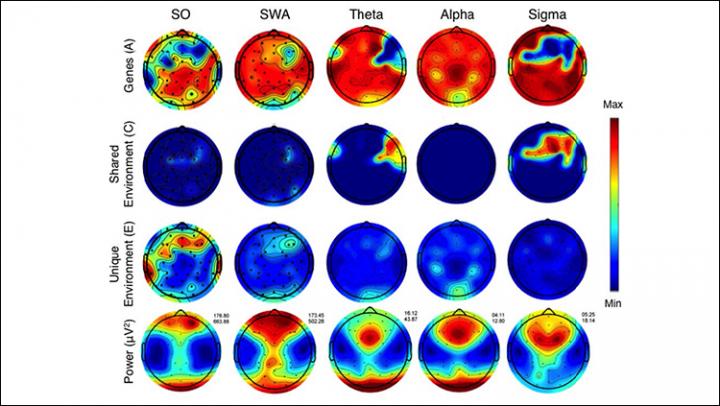
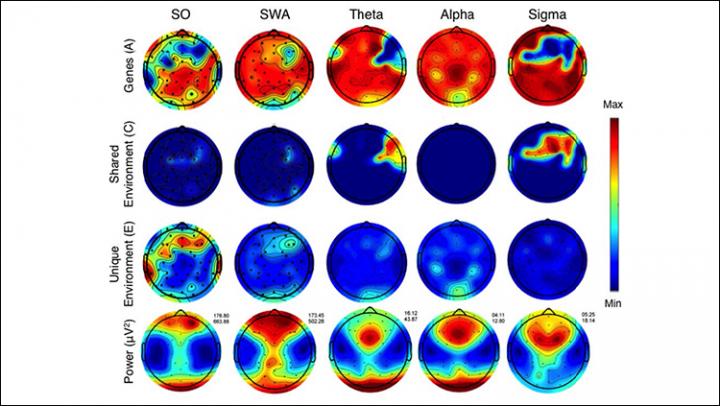
IMAGE

Credit: Rusterholz et al., JNeurosci (2018)

Some patterns of electrical activity generated by the brain during sleep are inherited, according to a study of teenage twins published in JNeurosci. Pinpointing the relative contributions of biology and experience to sleep neurophysiology could inform therapies for numerous psychiatric disorders in which alterations in brain activity during sleep can be detected.

Leila Tarokh and colleagues used electroencephalography to measure the brain activity of 11- to 14-year-old pairs of identical and fraternal twins during two consecutive nights of sleep at home. This study design allowed the researchers to tease apart the influence of genetic and environmental factors on brain activity during sleep. They found both types of factors shape two patterns of activity — slow waves and spindles — that are crucial for core functions of sleep, including memory consolidation. The influence of genes and environment on this activity depended on the brain region in question, with frontal regions being under strong environmental control and regions toward the back of the brain under stronger genetic control.

###

Article: Nature and Nurture: Brain region specific inheritance of sleep neurophysiology in adolescence

DOI: https://doi.org/10.1523/JNEUROSCI.0945-18.2018

Corresponding author: Leila Tarokh (University of Ber, Switzerland), [email protected]

About JNeurosci

JNeurosci, the Society for Neuroscience's first journal, was launched in 1981 as a means to communicate the findings of the highest quality neuroscience research to the growing field. Today, the journal remains committed to publishing cutting-edge neuroscience that will have an immediate and lasting scientific impact, while responding to authors' changing publishing needs, representing breadth of the field and diversity in authorship.

About The Society for Neuroscience

The Society for Neuroscience is the world's largest organization of scientists and physicians devoted to understanding the brain and nervous system. The nonprofit organization, founded in 1969, now has nearly 37,000 members in more than 90 countries and over 130 chapters worldwide.

Media Contact

David Barnstone
[email protected]
202-962-4000
@SfNJournals

http://www.sfn.org

Related Journal Article

http://dx.doi.org/10.1523/JNEUROSCI.0945-18.2018

Share13Tweet8Share2ShareShareShare2

Related Posts

Ohio Wall Lizards Overcame Genetic Bottleneck Through Reproduction, Study Finds — Biology

Ohio Wall Lizards Overcame Genetic Bottleneck Through Reproduction, Study Finds

May 29, 2026
Double Agent Unveils Unexpected Revelations — Biology

Double Agent Unveils Unexpected Revelations

May 29, 2026

University of Toronto Scientists Work to Enhance Access to Advanced Research and Biomanufacturing Tools in Resource-Limited Areas

May 29, 2026

CLPTM1L Alters Lipid Rafts to Drive Glioblastoma Progression

May 29, 2026
Please login to join discussion

POPULAR NEWS

  • ESMO 2025: mRNA COVID Vaccines Enhance Efficacy of Cancer Immunotherapy

    319 shares
    Share 128 Tweet 80
  • Multi-Hospital Study Reveals Long Covid Burden Is Twice as High as Current Estimates

    80 shares
    Share 32 Tweet 20
  • Common Food Preservatives Associated with Elevated Blood Pressure and Increased Heart Disease Risk

    56 shares
    Share 22 Tweet 14
  • New Study Reveals Plants Can Detect the Sound of Rain

    736 shares
    Share 294 Tweet 184

About

We bring you the latest biotechnology news from best research centers and universities around the world. Check our website.

Follow us

Recent News

Reducing Chronic Health Risks in Childhood Cancer Survivors

Nanoparticles Silence CLYBL, Reprogram Macrophages, Protect Lungs

T-Cell Engager Shows Promise in Autoimmune Neuropathy

Subscribe to Blog via Email

Enter your email address to subscribe to this blog and receive notifications of new posts by email.

Join 82 other subscribers
  • Contact Us

Bioengineer.org © Copyright 2023 All Rights Reserved.

Welcome Back!

Login to your account below

Forgotten Password?

Retrieve your password

Please enter your username or email address to reset your password.

Log In
No Result
View All Result
  • Homepages
    • Home Page 1
    • Home Page 2
  • News
  • National
  • Business
  • Health
  • Lifestyle
  • Science

Bioengineer.org © Copyright 2023 All Rights Reserved.