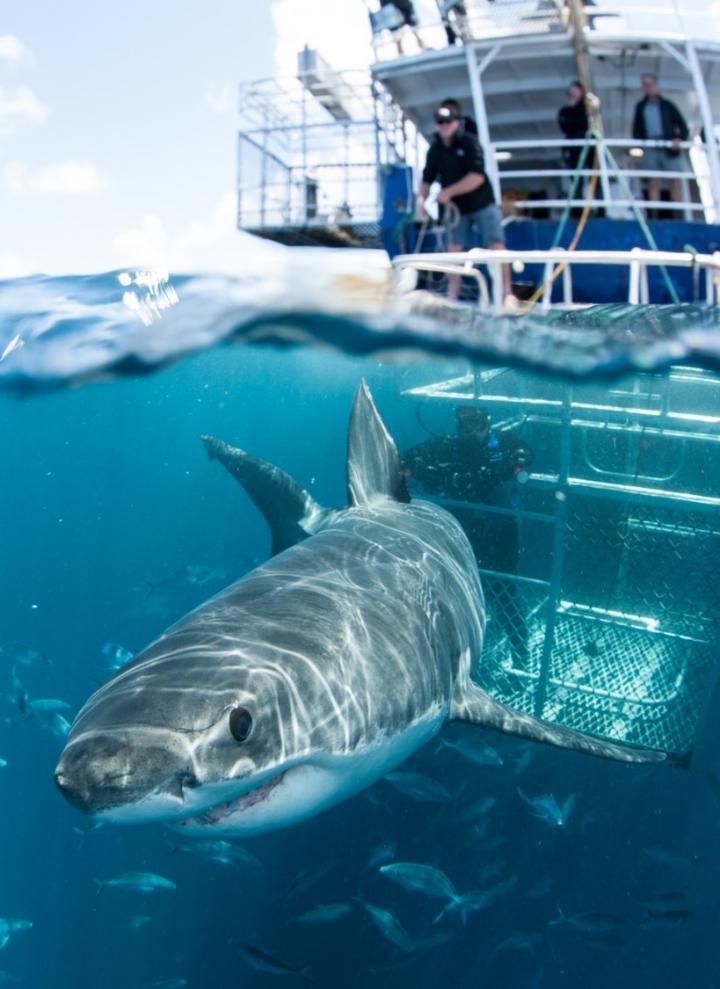
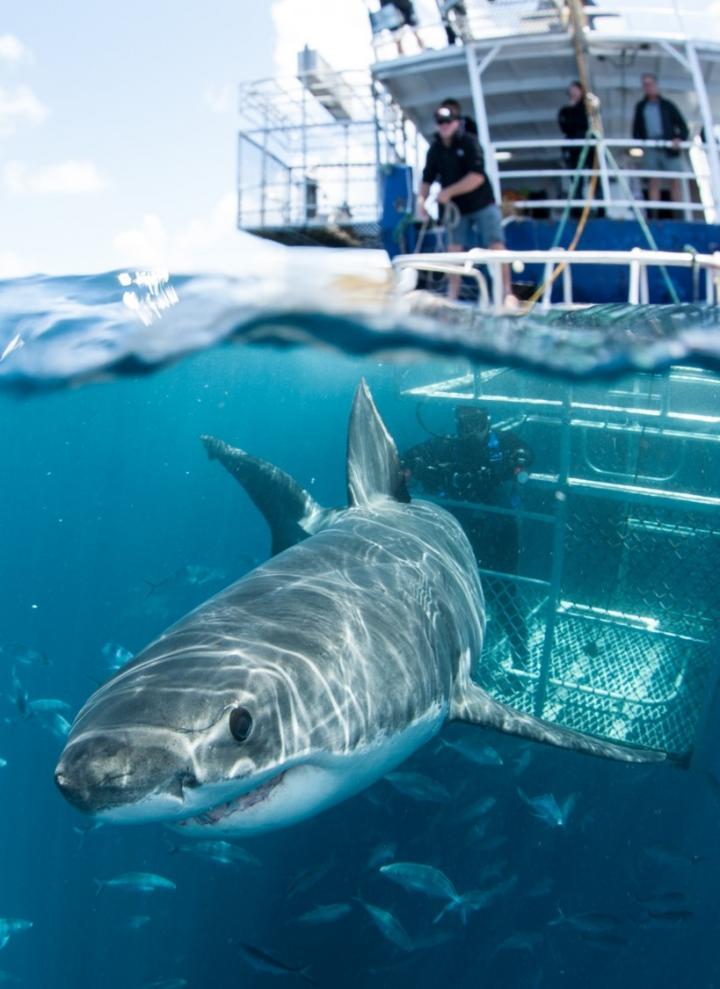
Credit: Photos copyright Andrew Fox (Fox Shark Research Foundation)
A new study in Conservation Physiology, published by Oxford University Press, reveals that white shark activity increases dramatically when the animals are interacting with cage-diving operators.
In recent decades, wildlife tourism has rapidly expanded and is one of the fastest growing sectors of the tourism industry. Ecotourism opportunities to cage-dive with white sharks, large marine predators, are available in Australia, South Africa, the United States of America, Mexico, and New Zealand, with up to seven companies operating simultaneously in one site.
Previous studies have shown that wildlife tourism can change behavior of animal species by altering their habitats or eating patterns. How these changes affect the health of individual animals or animal populations is unclear.
The study shows that white sharks are more active and likely use more energy when interacting with tourism operators compared to other situations (e.g. when operators are absent), raising questions about the behavioral changes such tourism may be causing.
The researchers tracked ten white sharks at South Australia's Neptune Islands with devices for nine days, finding that the increased movement when sharks are interacting with cage-diving operators results in overall dynamic body acceleration, a proxy for activity, 61% higher compared to other times when sharks are present in the area.
Since body acceleration is considered a proxy of metabolic rate, interacting with cage-divers is likely to use a lot more energy than standard white shark behaviors.
"This suggests that the cage-diving industry has the potential to affect the energy budget of white sharks," said Charlie Huveneers, associate professor at Flinders University and the study's lead researcher. "However, the mere presence of the cage-diving operators in the general vicinity of the sharks was not sufficient to elicit such behavioral changes. These only occurred when white sharks were close to the cage-diving vessels."
"Spending time interacting with cage-diving operators might distract sharks from normal behaviors such as foraging on natural, energy-rich prey like pinnipeds," Huveneers added.
Commercial white shark cage-diving uses approved and regulated attractants to entice sharks within close proximity of the cages and provide good viewing opportunities for divers. However, in contrast to many other shark-related tourism activities, operators are not allowed to feed white sharks. The interaction with cage-diving tourists is, therefore, not rewarded by more food. This suggests that the increased energy expenditure from interacting with cage-diving operators might not be compensated by either bait or natural prey consumption.
This study indicates that wildlife tourism may change the activity levels of white sharks and calls for an understanding of the frequency of shark-tourism interactions to appreciate the impact of ecotourism on this species fitness.
###
The paper, "Interacting with wildlife tourism increases activity levels of white sharks," will be available at: http://doi.org/10.1093/conphys/coy019
Direct correspondence to:
Charlie Huveneers
College of Science and Engineering, Flinders University
Adelaide, South Australia, 5042, AUSTRALIA
[email protected]
To request a copy of the study, please contact:
Daniel Luzer
[email protected]
Sharing on social media? Find Oxford Journals online at @OxfordJournals
Please acknowledge Conservation Physiology as a source in any articles.
Media Contact
Daniel Luzer
[email protected]
http://global.oup.com/academic/;jsessionid=13378C4
Related Journal Article
http://dx.doi.org/10.1093/conphys/coy019