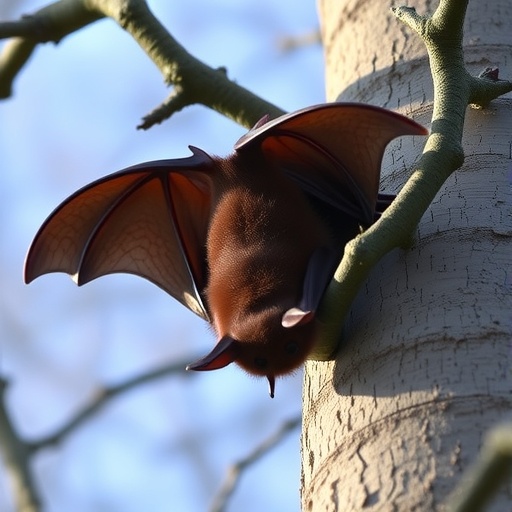
In the world of forest ecology and wildlife conservation, one of the most pressing concerns is the preservation of endangered species that play critical roles in ecosystem health. The Indiana bat (Myotis sodalis), a small yet powerful insectivore, has been federally protected since 1967, primarily due to the rapid loss of its natural habitat. Recent groundbreaking research conducted by scientists at Minot State University in collaboration with the University of Illinois Urbana-Champaign sheds new light on the types of trees that best serve as roosting sites for these elusive bats. The findings of this study promise to reshape forest management practices and accelerate efforts to conserve this endangered mammal.
Indiana bats are vital natural pest controllers, helping to curb populations of mosquitoes and other insects that can damage young trees and spread diseases. Yet, the loss of suitable roosting habitat threatens their survival, making it imperative to understand what constitutes an ideal bat roost. The study, spanning multiple regions including central Indiana, New Jersey’s Great Swamp National Wildlife Refuge, and the Southern Appalachian Mountains, combined meticulous fieldwork, bat radiotracking, and dendrochronological analysis to capture the nuanced relationship between bat roost suitability and tree characteristics.
The central revelation of this research revolves around the importance of tree diameter as the primary factor for bat occupancy. While it might seem intuitive that older trees, having lived long enough to achieve substantial size, would be better roosts, the study found that age itself is surprisingly less relevant. This insight liberates forest managers from the constraint of waiting for decades or even centuries to facilitate bat habitats. Specifically, trees reaching a sufficient diameter, regardless of their chronological age, can serve as effective roosts, a discovery that carries profound implications for fast-tracking conservation initiatives.
Understanding the nuances of forest succession is crucial to interpreting these findings. Early-successional trees, characterized by rapid growth and preference for open, sunlit environments, contrast sharply with late-successional trees, which grow more slowly in shaded, closed-canopy forests and enjoy longer lifespans. The research demonstrated that early-successional trees can reach the minimum diameter suitable for Indiana bat roosts in roughly 70 years, compared to the 130 years generally required for late-successional species. This acceleration opens practical pathways for forest managers aiming to foster bat populations within relatively short timeframes.
Despite their shorter lifespan, early-successional trees provide one of the fastest routes to viable bat roosts. However, this is not an either-or scenario. The study underscores the necessity of maintaining a diverse forest structure that includes both early- and late-successional species. Late-successional trees, while slower to mature, tend to remain standing for longer after death, offering prolonged roost availability. These dead standing trees, or snags, form vital roosting niches due to bark splitting that creates cavities where bats can shelter and rear their young.
The longevity of snags is particularly important given the frequent turnover bats impose on their shelters. The study found that late-successional snags remained standing about 12 years post-mortem, compared to 8 years for early-successional snags. Since bats often switch roosts every few years, sustaining a continual supply of active roost sites demands forest management strategies that encourage both rapid regeneration and long-term habitat stability. Managers must ensure an ongoing supply of suitable trees to prevent habitat bottlenecks and population declines.
Methodologically, the research employed radiotelemetry to track Indiana bats to their roosting sites, allowing precise identification of individual tree usage across varied forest types. Dendrochronology, or tree-ring analysis, then determined tree ages to correlate size and age with bat occupancy. The cross-site approach, covering geographically and ecologically distinct forests, assures the robustness and generalizability of the findings across the eastern United States.
This work highlights the significant temporal challenge inherent in habitat restoration. Even the fastest-growing trees capable of supporting bat roosts require approximately 70 years to become viable shelters. Recognizing this, researchers emphasized the need for foresighted forest planning that transcends typical managerial timeframes. Conservation efforts must be sustained and visionary, planned with the understanding that habitat suitability evolves over decades and even centuries, well beyond the tenure of most forest managers or policymakers.
Furthermore, the study opens broader avenues for conservation biology. While it focused on the Indiana bat, an umbrella species for forest health, its framework can be adapted to other endangered bat species in the eastern United States. Each species occupies unique ecological niches and may have different roosting preferences, but the principle that habitat suitability depends on measurable tree characteristics rather than merely age provides a valuable baseline for future investigations.
In conclusion, this collaborative research offers a path forward to reconcile the urgent need for bat conservation with the practical realities of forest dynamics. By identifying tree diameter as the critical predictor of roost suitability and differentiating between successional stages, the study equips forest managers with actionable insights. It champions a mixed management approach that encourages both early- and late-successional tree species, ensuring a sustainable, enduring supply of roosts for the Indiana bat. The researchers advocate for immediate action, underscoring the necessity of proactive strategies starting now to secure the future of these irreplaceable insectivores.
Subject of Research: Habitat suitability and roost tree characteristics for endangered Indiana bats (Myotis sodalis)
Article Title: Tree roosts used by an endangered bat require almost a century to develop
News Publication Date: Not specified in the source
Web References:
https://dx.doi.org/10.1016/j.foreco.2026.123942
https://aces.illinois.edu/news/bats-protect-young-trees-insect-damage-three-times-fewer-bugs
References:
Pettit, J., O’Keefe, J., et al. Tree roosts used by an endangered bat require almost a century to develop. Forest Ecology and Management. DOI: 10.1016/j.foreco.2026.123942
Image Credits: Joy O’Keefe, University of Illinois Urbana-Champaign
Keywords: Indiana bat, endangered species, forest management, roost tree diameter, early-successional trees, late-successional trees, bat conservation, dendrochronology, habitat restoration, forest ecology
Tags: bat habitat loss impactbat radiotracking in habitat studiesconservation of Myotis sodalisdendrochronological analysis of treesendangered Indiana bats habitatforest ecology and wildlife conservationforest management for bat conservationhabitat preservation for endangered batsIndiana bat roosting tree speciesnatural pest control by batsregional bat habitat researchtree maturity for bat roosts