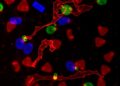
In the realm of biological phenomena, bacteria offer a fascinating glimpse into the emergence of complex systems from relatively simple beginnings. These single-celled organisms, though self-regulated at an individual level, have the remarkable ability to form intricate colonies that function collectively, assuming roles that no single bacterium could undertake alone. Within these colonies, microbial members differentiate their functions: some excrete a gelatinous matrix that binds the community, others produce and distribute vital nutrients, while a select group exhibits enhanced motility, aiding in colonization and expansion. This division of labor exemplifies the concept of emergence, where new properties and capabilities arise unexpectedly from the interactions of simpler constituents.
Emergence is not confined to lifeforms alone; it pervades chemical systems as well. Professor Harald Schwalbe, from Goethe University Frankfurt’s Institute of Organic Chemistry and Chemical Biology, emphasizes that molecular interactions give rise to novel properties unattainable by individual atoms in isolation. Water molecules provide a quintessential example: composed of two hydrogen atoms covalently bonded to one oxygen atom, water manifests unique physicochemical characteristics that are not inherent in its elemental components. This phenomenon underscores the profound significance of emergent behavior, bridging the inanimate and living worlds.
Central to life’s existence is the extraordinary polarity of water molecules. The asymmetric distribution of electron density renders the oxygen atom with a partial negative charge and the hydrogens with a partial positive charge. These dipolar interactions foster hydrogen bonding among water molecules, instilling cohesion and resulting in water’s liquid state across a broad temperature range on Earth. Between 0°C and 100°C, water remains liquid, providing a stable milieu conducive to biochemical reactions fundamental to life. This temperature window is finely tuned to Earth’s position relative to the Sun, reinforcing the inextricable link between physical planetary conditions and biochemical existence.
The unique solvent properties of water orchestrate molecular behavior in living organisms. DNA, for instance, is composed of nucleotides with diverse chemical groups exhibiting varied polarity. In aqueous environments, polar sections tend to face outward, interacting favorably with water, while nonpolar regions retract inward, shielded from the solvent. This arrangement drives the iconic double-helical structure of DNA, akin to a spiral staircase wherein the hydrophilic “railings” align externally, and the hydrophobic “steps” reside internally. Such structural organization is a direct consequence of water’s emergent properties imposing order at the molecular level.
Beyond structural influence, water’s interactions facilitate the precise folding of proteins and the stability of nucleic acids, enabling biological macromolecules to perform their functions with remarkable specificity. Emergence thus acts as a mediator, imposing constraints and guiding the self-assembly processes that yield the defined three-dimensional conformations critical to life. Without this molecular-level governance, biological polymers would fail to organize into functional entities, thwarting the complexity that underpins living systems.
The emergence of new properties is intimately connected to changes in system states. Complex systems can reach critical thresholds—points at which qualitative transformations occur, giving rise to unforeseen functionalities. Such phase transitions typify emergent phenomena. In the context of prebiotic chemistry and early life, these critical states likely paved the way for transformative leaps, enabling molecular assemblies to acquire novel capabilities. Importantly, the precise timing and nature of these transitions evade prediction, reflecting the intrinsic unpredictability of emergent complexity.
To sustain these emergent processes, a continual influx of energy is essential. On Earth, sunlight serves as the primary energy source powering chemical reactions and maintaining non-equilibrium conditions necessary for life’s progression. This energy input drives metabolic pathways, molecular self-organization, and evolutionary innovations. The dynamic interplay between energy flow and emergent structure underscores the delicate balance fundamental to sustaining complex biological systems.
Evolutionary mechanisms, acting over vast temporal scales, collaborated with emergence to sculpt the diversity and complexity characteristic of Earth’s biosphere. Selective pressures and genetic variation facilitated the optimization of molecular functions and organismal traits. Yet, the pathway traversed by life is not predetermined or reproducible. Schwalbe points out the contingency inherent in evolution: a hypothetical rewind of the planet’s four-billion-year history would yield divergent life forms, shaped by alternative emergent events and evolutionary possibilities.
This understanding redefines our conception of life’s origins and complexity. Life’s emergence is not a linear, programmed event but a tapestry woven from stochastic processes, energy inputs, and chemical constraints. The concert of emergence and evolution yields a landscape rich with potentialities, in which complexity arises spontaneously under favorable conditions. Such insights deepen our appreciation of life as a dynamic emergent phenomenon rooted in chemical and physical realities.
Contemporary research at the intersection of chemistry and biology continues to elucidate the principles governing emergence. By investigating molecular interactions, solvent roles, and energy transduction, scientists aim to reconstruct the steps leading from inert matter to living systems. This multidisciplinary approach leverages advances in chemical modeling, molecular biology, and evolutionary theory to unravel the intricacies of complexity in natural systems.
These revelations also have profound implications beyond Earth biology. Understanding the interplay between chemistry, emergence, and evolution informs the search for extraterrestrial life and the engineering of synthetic biological systems. It challenges researchers to identify signatures of life that transcend terrestrial paradigms, broadening the scope of astrobiology and bioengineering alike.
In conclusion, the phenomenon of emergence provides a pivotal framework for interpreting the transition from chemistry to life. Water’s molecular peculiarities catalyze the formation and stabilization of complex biological molecules, fostering the order and function essential to living organisms. Coupled with evolutionary processes and continuous energy flow, emergence underwrites the rich tapestry of biological complexity observable today. This synthesis of chemistry and biology not only illuminates life’s origins but also equips science with conceptual tools to explore and harness the vast potentials within complex systems.
Subject of Research: Not applicable
Article Title: The Role of Chemistry Across Disciplines From Humanities to Life Sciences in Understanding Complexity and Emergence.
News Publication Date: 6-Mar-2026
Web References: 10.1002/anie.202523427
Keywords: Origins of life, Life sciences, Biochemistry, Biochemical processes, Biocatalysis, Biosynthesis, Evolutionary biology, Evolution, History of life, Chemistry, Chemical biology, Chemical compounds, Biomolecules, Carbon compounds, Inorganic compounds, Organic compounds, Water, Solvents, Chemical modeling, Molecular chemistry, Water chemistry, Water molecules
Tags: bacterial colony differentiationchemical basis of lifecomplex systems from single cellsemergence bridging chemistry and biologyemergence in biological systemsinterdisciplinary life origin researchmicrobial division of labormolecular interactions and emergencenovel properties of water moleculesorigin of life from simple moleculesphysicochemical properties of waterself-organization in bacteria